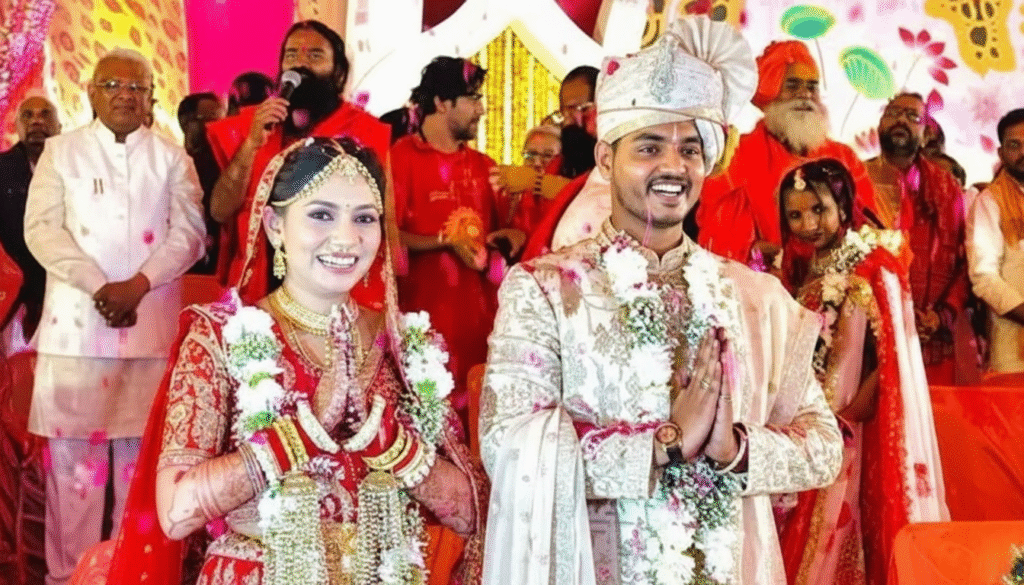
Madhya Pradesh Chief Minister Dr Mohan Yadav’s younger son, Dr Abhimanyu Yadav, married Dr Ishita Patel in a community mass wedding held on the banks of the Kshipra river in Ujjain, where 21 other couples also tied the knot alongside them. The event was consciously designed as a modest, socially inclusive ceremony that showcased traditional rituals while discouraging extravagance and ostentatious spending on weddings.
Main news report
The Ujjain mass wedding brought together 22 couples, including Dr Abhimanyu and Dr Ishita, who took their vows in a collective ceremony rooted in Sanatan traditions on the Kshipra riverfront. Instead of a private luxury celebration, the Chief Minister’s family chose this format to underline the values of simplicity, social harmony and responsible spending in an era where high-profile political weddings often make headlines for excess.
According to the invitation and organisers, the ceremony was conceived as a socially conscious initiative where guests were requested not to bring costly gifts, with emphasis placed on blessings and community participation. The programme highlighted that the chief minister wanted his son’s marriage to reflect the message frequently delivered from government platforms that weddings should be simple, inclusive and sensitive to the financial realities of ordinary families.
Ceremony, rituals and arrangements
The wedding followed vibrant traditional customs: grooms arrived on horses and brides rode in decorated carriages before joining a festive procession towards the riverside venue. Organisers created multiple domes, a large central stage and extensive hospitality arrangements to host thousands of guests and devotees arriving in Ujjain over the weekend, while keeping the decor and rituals culturally rooted rather than opulent.
Police and civic agencies implemented traffic diversions and layered security around the mass wedding site to manage both the wedding crowds and regular temple visitors in the holy city. Social workers, local administration and volunteers coordinated food, seating and guidance for the participating couples, reinforcing the image of the event as a community-led celebration rather than an exclusive political show.
Dignitaries and spiritual presence
The ceremony drew a wide spectrum of dignitaries, from governors and union ministers to state leaders and MLAs, who attended to bless the newlyweds and acknowledge the symbolic value of the decision to host a mass wedding. Among the prominent figures present were Karnataka Governor Thawar Chand Gehlot, Union Minister Jyotiraditya Scindia, Union Minister of State Durga Das Uikey and Madhya Pradesh Assembly Speaker Narendra Singh Tomar. Report in more detail by Organiser.
Spiritual leaders and seers also lent religious gravitas to the function, with Yoga Guru Baba Ramdev and other prominent saints participating in the rituals and offering blessings to all 22 couples. Religious leaders praised the event as an example of how public figures can combine customary Hindu marriage rites with a strong message of social cohesion and economic restraint.
Message of social equality and simplicity
Family sources and officials described the choice of a mass wedding as a deliberate step by Dr Mohan Yadav to set a practical example for citizens by curbing showy expenditure in high-profile marriages. The inclusion of couples from varied social and economic backgrounds, including Scheduled Caste and Scheduled Tribe communities, underlined the aim of promoting equality and shared celebration rather than class-based segregation in wedding spaces.
Governor Mangubhai Patel and other leaders publicly commended the Chief Minister for using a personal family occasion to send a wider message about social harmony, responsible celebration and support for community-oriented marriage programmes. Organisers and participants alike framed the ceremony as a model that can inspire more families—especially those in public life—to adopt simpler, more inclusive weddings that reduce financial pressure while preserving cultural richness.
EEAT elements and context
From an experience and expertise standpoint, the event brings together multiple verified details: names and professional backgrounds of the bride and groom as doctors, the exact location on the Kshipra river in Ujjain, the presence of 21 other couples and the dates and logistical arrangements reported by mainstream news outlets. Authoritative coverage from national and regional media, as well as statements from constitutional authorities and religious leaders, lends credibility to the narrative that this wedding was intentionally positioned as a benchmark for modest yet dignified public celebrations.
For readers, the trust factor is reinforced through consistent accounts across several established publications that independently highlight the same core elements—mass ceremony, emphasis on simplicity, inclusion of diverse communities and large-scale but disciplined public participation. Together, these aspects make the Ujjain mass wedding not only a personal milestone for Dr Abhimanyu Yadav and Dr Ishita Patel, but also a notable case study in how political families can align private events with broader messages of social responsibility and communal harmony.
For more bold and shocking national updates, check our India News Today top 10 list.