
#Bondi Beach Terror Attack#Bondi Beach Terror Attack#Bondi Beach Terror Attack#Bondi Beach Terror Attack
Bondi Beach Terror Attack/sbkinews.in
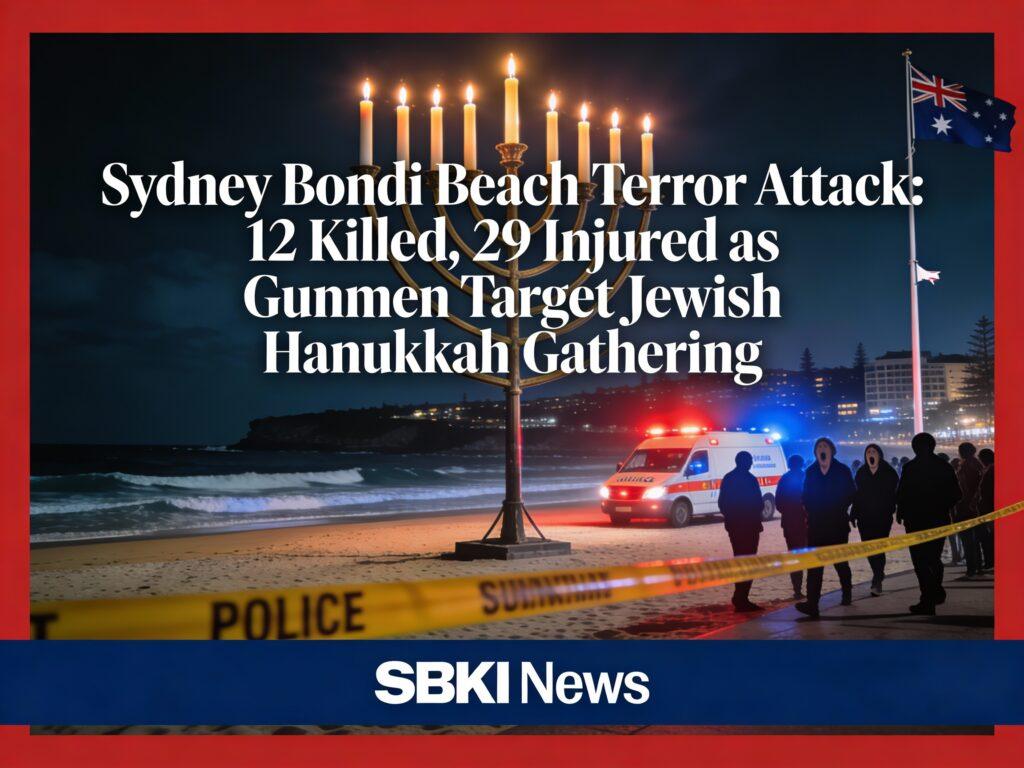
A deadly terror attack on the Jewish community has shaken Australia after gunmen opened fire during a religious gathering at Sydney’s Bondi Beach. According to police briefings and early media reports, at least 12 people were killed and 29 others injured when two armed assailants targeted a Hanukkah celebration on Sunday evening, turning a festival of lights into a night of horror. Among the dead is said to be one Israeli national, while the injured reportedly include a child and two police officers who rushed in to confront the attackers. Authorities have described the incident as a terrorist attack and launched a large‑scale investigation into the planning, motives and possible international links behind the assault.
How the attack unfolded
Witness accounts indicate that hundreds of people from the local Jewish community had gathered at Bondi Beach to mark the beginning of Hanukkah, an important festival that commemorates the rededication of the Second Temple in Jerusalem. As families lit candles and took part in prayers and songs, the two gunmen allegedly approached the area and began indiscriminate firing into the crowd. Panic spread instantly as worshippers, including children and elderly people, tried to find cover behind vehicles, beach structures and nearby shops. Emergency services received multiple distress calls around 6.30 pm local time, prompting rapid deployment of armed response units, ambulances and rescue teams.
Police officials say one attacker was killed at the scene in an exchange of fire, while the second was shot, disarmed and taken into custody in a critical condition. Bomb squads and forensic teams then moved in to secure the perimeter and search for secondary devices, after suspicious objects were found in nearby areas and in a vehicle believed to belong to one of the suspects. Authorities temporarily sealed off a large radius around Bondi Beach, evacuated nearby buildings and advised residents to stay indoors while specialists examined an improvised explosive device reportedly recovered from the attackers’ car. Hospitals across Sydney activated emergency protocols as ambulances rushed the wounded for surgery and trauma care.BBC
Suspects and early investigation
Preliminary information from security sources suggests that one of the attackers has been identified as a 24‑year‑old man of Pakistani origin named Naveed Akram. Investigators are examining his travel history, residence status, possible radicalisation online and any links to extremist networks based in South Asia or the Middle East. The identity of the second attacker has not yet been formally released, but police say both men appear to have planned the assault specifically to target the Jewish community gathering at Bondi. Counter‑terrorism units are now analysing digital devices, social‑media accounts and financial records to determine whether they had local accomplices, handlers abroad or were acting as self‑radicalised lone‑wolf attackers inspired by global propaganda.
Australian intelligence agencies are also coordinating with international partners, including Israeli and other Western security services, to trace any cross‑border connections. Investigators are looking closely at encrypted messaging platforms, possible reconnaissance visits to the site, and weapons procurement channels inside the country. Authorities have emphasised that the probe is at an early stage and that details around ideological motivation, organisational backing and logistics will be shared once verified. Meanwhile, community leaders have been briefed on heightened security arrangements around synagogues, Jewish schools and other potential soft targets in Sydney and other major cities.
Bondi Beach Terror Attack
Reactions from leaders and community
The attack has drawn swift condemnation from leaders across the world. Australian federal and state authorities have called it an assault not only on the Jewish community but on the country’s core values of safety, pluralism and religious freedom. Community organisations have described the shooting as the worst attack on Jews on Australian soil in recent memory, and vigils are being planned in major cities to mourn the victims and express solidarity with their families. Mental‑health and counselling services have been offered to survivors, first responders and local residents traumatised by the violence.
Indian Prime Minister Narendra Modi issued a strong statement denouncing the attack and expressing heartfelt condolences to the families who lost loved ones. He reiterated that India follows a policy of “zero tolerance” toward terrorism and supports global efforts to fight it in all forms and manifestations, whether directed at religious communities, critical infrastructure or public gatherings. Israel’s leadership has likewise condemned the assault and thanked Australian authorities for their swift action, while calling for robust international cooperation against antisemitic and extremist violence. Several other world leaders, including those from Europe and North America, have echoed similar messages and stressed the need to counter hate‑fuelled radicalisation online and offline.
Bondi Beach Terror Attack
Significance for the Jewish community
Bondi Beach is home to a vibrant Jewish population, and the annual Hanukkah event there is known for drawing families, tourists and students from across Sydney. For many, it symbolises the ability to celebrate Jewish identity openly and joyfully in a multicultural society far from historic centres of Judaism. The fact that the attackers chose this setting underscores growing concerns about antisemitic threats worldwide, from vandalism and online abuse to physical assaults and organised terror plots. Security experts have warned that public religious gatherings, especially those advertised in advance, can be attractive targets for extremists seeking maximum visibility and impact.
In the wake of the shooting, Australian Jewish organisations are working closely with law‑enforcement agencies to reassess security protocols, including perimeter checks, surveillance coverage, volunteer training and contingency plans for large events. At the same time, many leaders are urging the community not to withdraw from public life or communal celebrations, but to insist on both safety and visibility as core principles of democratic society. Interfaith groups have also stepped forward, with Christian, Muslim, Hindu and other faith leaders condemning the violence and visiting the site to offer prayers, flowers and messages of support.
Broader implications for counter‑terror strategy
From a policy perspective, the Sydney attack raises urgent questions about how countries can better detect and disrupt plots that blend local grievances, international ideological influences and easily available weapons. Experts argue that effective counter‑terrorism today requires a combination of robust intelligence‑sharing, targeted online monitoring, community‑based early‑warning mechanisms and careful protection of civil liberties. There is also a growing emphasis on counter‑radicalisation initiatives—such as education, mental‑health outreach and engagement with religious scholars—to challenge extremist narratives before they lead to violence.
For India, which has long dealt with cross‑border terrorism and has a significant diaspora in Australia, the incident is another reminder of why international cooperation against terror financing, training and propaganda is crucial. The shared stance of “zero tolerance” expressed by New Delhi aligns with broader multilateral frameworks that push for stronger action at the UN and other forums against groups and individuals who incite or organise such attacks. In the coming weeks, investigators’ findings about the attackers’ backgrounds and networks will likely shape additional security measures around mass gatherings, diaspora communities and symbolic locations worldwide.
SBKI News– Sabki Khabar India Se, this coverage stands firmly with the victims and their families, reaffirming a commitment to responsible, fact‑checked reporting that exposes terror, counters hate, and keeps readers informed with “Real News, Every Angle.”