
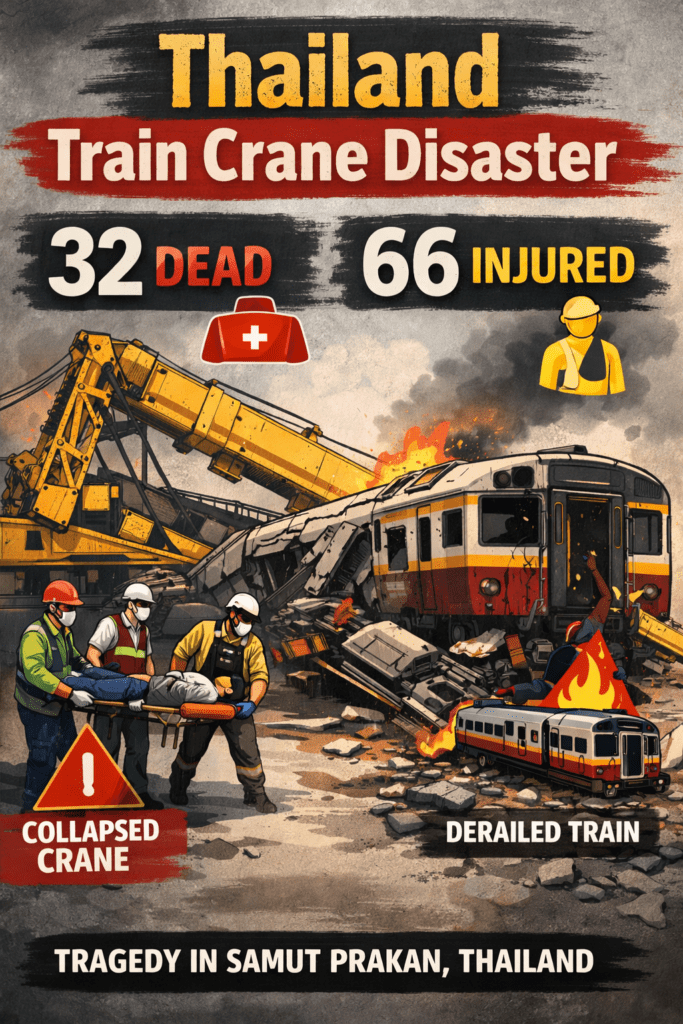
#Thailand train crane accident#Thailand train crane accident#Thailand train crane accident#Thailand train crane accident
Thailand Train Crane Disaster
A devastating accident in Thailand claimed 32 lives when a crane collapsed onto a moving passenger train, derailing multiple coaches in Nakhon Ratchasima province. The incident, occurring on Wednesday morning, injured 66 others, highlighting critical safety lapses in rail infrastructure. Authoritative reports from Reuters confirm the toll as rescue efforts continue amid national mourning.
Incident Details
The crash unfolded at 9:05 AM local time in Sikhio district, 230 km northeast of Bangkok. A construction crane being transported or operating near the tracks toppled directly onto State Railway of Thailand (SRT) train No. 133, en route from Bangkok to Nong Khai. Several carriages derailed, mangling metal and trapping passengers in wreckage.
Eyewitnesses described a “thunderous impact” as the crane’s arm buckled, slicing through the train’s roof. Initial investigations point to possible overloading, mechanical failure, or inadequate clearance during transport. Rescue teams used hydraulic cutters to free survivors, with hospitals in Nakhon Ratchasima overwhelmed.
Casualty Breakdown
Deaths: 32 confirmed, including women and children; many succumbed to crush injuries or bleeding.
Injured: 66 treated, 20 critically with fractures, head trauma.
Rescued: All passengers accounted for by evening; DNA identification underway for remains.
SRT suspended services on the northeastern line, stranding thousands. Prime Minister Paetongtarn Shinawatra expressed condolences, ordering a full probe.
Emergency Response
Over 200 responders from Thailand’s Disaster Prevention Department deployed cranes, ambulances, and sniffer dogs. Military helicopters airlifted the severely wounded to Bangkok’s top trauma centers. Blood donation drives surged locally, reflecting community solidarity.
The site resembled a war zone: twisted rails, scattered debris, and bloodied carriages. Forensic teams combed for black box data from the crane, while psychologists counseled bereaved families.
Historical Context
Thailand’s rail network, a British colonial legacy, faces chronic underfunding. This marks the deadliest since 2000’s train collision (60 deaths). Recent mishaps include 2024’s Bangkok derailment (12 injured) due to signal failure. Critics blame privatization delays and aging tracks spanning 4,000 km.
Nakhon Ratchasima, a rail hub near Laos border, sees heavy freight-passenger traffic. Monsoon-season soil erosion may have destabilized crane supports.
Government Actions
Transport Minister Suriya Juangroongruangkit announced:
72-hour investigation by Accident Investigation Committee.
10 million baht compensation per family.
Nationwide crane safety audits.
Opposition demands accountability, alleging corruption in SRT contracts. Shinawatra cabinet faces pressure amid 2026 budget talks.
Rail Safety Comparison
| Factor | Thailand Rail | Global Standards |
|---|---|---|
| Fatal Accidents/Year | 15+ | <5 (EU avg) |
| Track Age | 50+ years | <30 years |
| Maintenance Budget | $200M annually | $1B+ (Japan) |
| Crane Regulations | Lax enforcement | Strict ISO |
Passenger Stories
Survivor Somchai, 45, recounted: “The sky fell. I held my daughter’s hand amid screams.” Migrant workers heading home for Lunar New Year comprised many victims. Social media flooded with prayers, #PrayForSikhio trending regionally.
Expert Analysis
Rail engineer Dr. Anan Techakasem notes: “Low-hanging cranes near live tracks violate basic protocols. Human error likely tops list.” Climate change exacerbates risks, with heavier rains weakening foundations. International aid from Japan Railways offered.
Regional Impact
Nong Khai services halted, crippling northeast trade. Insurance claims projected at 500M baht. Tourism dips as safety fears spread. India, with similar rail density, monitors for lessons amid its own upgrade drives.
Preventive Measures Needed
AI track monitoring.
Mandatory crane escorts.
Double tracks in high-risk zones.
Worker training upgrades.
This tragedy underscores Asia’s infrastructure urgency as populations boom.
Investigation Updates
Preliminary probe reveals the crane—likely transporting materials for nearby rail upgrades—exceeded height limits for the active track. Operator error and missing safety signals emerge as prime suspects. Thailand’s Transport Ministry vows criminal charges if negligence confirmed, with forensic analysis of crane hydraulics underway.
Survivor Testimonies
Trauma surgeon Dr. Priya Patel treated 15 victims: “Many suffered severed limbs from the crane’s boom piercing coaches.” A child survivor clung to seats amid chaos, now recovering. Families camp at crash site, demanding transparency.BBC
Economic Fallout
Line closure disrupts 50,000 daily commuters and $10M cargo. Stockpiled rice exports to Laos delay, hitting farmers. Insurance firms brace for 1B baht payouts.
Stay informed, stay vigilant – SBKI News, your trusted voice for global breaking coverage.