The retirement of Cheteshwar Pujara
In the often-brutally transactional world of modern sport, where farewells are frequently managed by press releases and perfunctory social media graphics, the retirement of Cheteshwar Pujara felt different. Neither a final, tearful lap of a crowded stadium nor a lavish press conference at BCCI headquarters were used to announce it.Instead, it arrived, much like the man himself, with a quiet dignity—a simple social media post, reflecting on a journey of passion and perseverance.
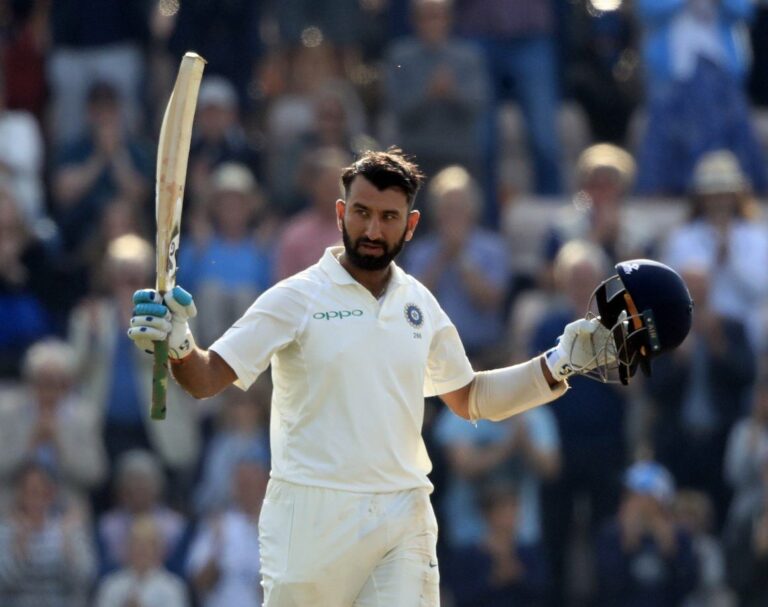
But it was a response to this post that truly framed the moment, giving voice to a national sentiment of respect, gratitude, and a tinge of melancholy. Congress MP and celebrated author Shashi Tharoor, a known cricket aficionado, penned an emotional message that cut to the heart of the matter, transforming Pujara’s personal announcement into a broader conversation about legacy, respect, and the nature of a dignified exit.
Tharoor’s words were not just a tribute; they were a poignant critique, a eulogy for a bygone era of cricket, and a mirror held up to the face of the modern game. He wrote, “He deserved a dignified farewell from international cricket, not just a domestic league signing. One of the finest test batsmen of his generation, a bulwark of the Indian batting lineup for well over a decade, and a role model for his quiet, old-school dedication to the craft. Thank you, @cheteshwar1, & happy retirement!”
In that single sentence—”He deserved a dignified farewell from international cricket, not just a domestic league signing”—Tharoor encapsulated a complex feeling shared by many purists. It was a recognition that Pujara was not just any cricketer; he was an institution, a testament to a specific, increasingly rare set of values.
The Unassuming Colossus: Revisiting Pujara’s Legacy
To understand the weight of Tharoor’s words, one must first understand the weight of Pujara’s contribution. In an age dominated by the pyrotechnics of T20 cricket, where value is measured in strike rates and social media virality, Pujara was an anachronism. He was the last classical Test specialist, a player who built his game, and his legacy, not on the number of sixes he hit, but on the number of balls he faced.
His value was intangible yet immense. He served as the cornerstone and anchor that enabled the flashy skills of Rahane, Pant, and Kohli to thrive.His greatest performances were not measured in centuries alone, but in hours spent at the crease, wearing down the world’s best bowling attacks through sheer resolve. He was the human barrier, the “Wall” that had been passed down from Dravid, a title he never actively sought but embodied through his technique and temperament.
Series-winning tours of Australia in 2018-19 and 2020-21 are unthinkable without Pujara. In the 2018-19 series, he faced 1258 balls, the most by any Indian in a Test series in Australia, absorbing unimaginable physical punishment from Pat Cummins, Josh Hazlewood, and Mitchell Starc. He didn’t just score runs; he exhausted the opposition, a strategy that was pivotal in India’s historic triumph. He was the immovable object to Australia’s irresistible force, a triumph of mind over matter.
Tharoor’s Lament: The Dignity of a Farewell
Tharoor’s tweet touches on a sensitive nerve in Indian cricket: the treatment of its stalwarts. The concept of a “dignified farewell” is a rare luxury. For every Sachin Tendulkar, who got a meticulously planned retirement tour, there are dozens of greats like VVS Laxman, Rahul Dravid, and Anil Kumble whose exits felt somewhat abrupt, determined less by the players themselves and more by selection committees.
Pujara’s case feels particularly poignant because his decline was not one of ability, but of relevance in a rapidly shifting ecosystem.He was left from the team following a dismal 2023 World Test Championship final.At 35, the door was not entirely shut, but the path back was steep. The selectors, looking to build for the future, moved on. The silent message was clear: the services of the old warhorse were no longer required.
This is the core of Tharoor’s emotional message. It is a lament for the loss of ceremony, for the acknowledgment of a career in its entirety, not just its most recent chapters. A “dignified farewell” isn’t necessarily a fan-driven stadium tour; it is the recognition from the establishment—the BCCI, the selection panel—of a player’s immense contribution before the curtain falls. It is the opportunity for a final nod to the fans, a thank you, and a sense of closure for all parties.
By contrasting it with “a domestic league signing,” Tharoor highlights the new reality. The glitz of franchise cricket, for all its entertainment value, cannot replace the honour of representing the nation. For a player like Pujara, whose entire identity was built around the India Test cap, his signing by Sussex in the County Championship or by a franchise in a overseas T20 league, while a professional necessity, is a pale successor to the pride of national duty.
A Changing Game and an Enduring Spirit
Tharoor’s message also serves as an elegy for the format Pujara loved most. Test cricket is under siege, and Pujara was one of its last true guardians. His retirement marks the end of an era where a player could build a legendary career solely on the foundations of the five-day game. The new generation is defined by all-format athletes, with Test technique often being an afterthought.
In mourning the lack of a grand send-off for Pujara, Tharoor is also, in a way, mourning the diminishing status of the traditional Test cricketer. The game’s economics and audience preferences have shifted, and the Pujaras of the world are becoming extinct. His retirement is a stark reminder of this evolution.
Yet, to focus solely on the sadness would be to miss the essence of both Pujara’s career and Tharoor’s tribute. The overwhelming emotion is one of profound gratitude.Because it was a collective “thank you” from all the Australian fans who stayed up late to watch Tharoor bat and from all the purists who found happiness, his letter struck a chord.
Pujara’s dignity was never in the theatrics of his exit, but in the quiet consistency of his presence. He may not have gotten the farewell he “deserved” in the eyes of many, but he crafted his own dignified exit on his own terms—with a gracious note, reflecting on his journey with pride and without a hint of bitterness.
In the end, Shashi Tharoor’s emotional message did what perhaps the system could not: it gave the nation a moment to pause and collectively honour one of its quietest heroes. It provided the public, dignified farewell that the institution did not. The “Wall” may have finally been breached, but the legacy of Cheteshwar Pujara, as Tharoor so eloquently affirmed, remains an impregnable fortress in the annals of Indian cricket. His was a career built not on noise, but on silence—the silent respect of opponents, the silent appreciation of purists, and the silent, unwavering strength that defined an era.