
Afghanistan earthquake/sbkinews.in
After over 1,400 deaths in Afghanistan from Sunday’s earthquake, a fresh tremor struck the same region just 48 hours later, worsening an already dire humanitarian crisis. On Sunday night, a powerful 6.0 magnitude earthquake devastated remote villages in eastern Afghanistan’s provinces of Kunar and Nangarhar, killing at least 1,411 people and injuring more than 3,100, according to Taliban officials. Rescue efforts, already challenged by mountainous terrain and damaged roads, have been severely hampered by ongoing aftershocks and a new 5.5 magnitude quake that struck on Tuesday.
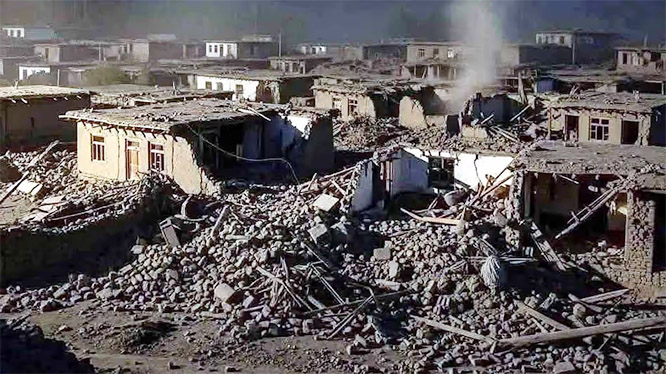
At a shallow depth of roughly 8 to 10 kilometres, the epicentre of Sunday’s earthquake was situated close to the Pakistani border, about 27 kilometres northeast of Jalalabad. This shallow depth caused intense surface shaking and destructive aftershocks felt as far as Kabul. Most homes in the region are made of mud bricks and wood, structures particularly vulnerable to collapse during strong earthquakes. Many victims remain trapped under rubble, and authorities fear the death toll will rise as rescue efforts continue.
The new tremor on Tuesday, measuring 5.5 in magnitude and occurring at a similar shallow depth, triggered landslides and falling trees, further blocking vital access routes to isolated villages. According to rescue workers, the fresh quake disrupted ongoing relief operations, damaging partially standing buildings and increasing risks to those still trapped. Another 5.2 magnitude aftershock was also reported, intensifying fears of further destruction.
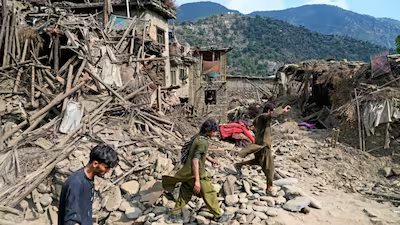
Rescue agencies have struggled to reach many affected communities due to the rugged mountainous terrain and blocked roads. Efforts to airlift injured people and deliver aid have been complicated by narrow valleys and harsh weather. Helicopter missions have been critical, with dozens of commandos air-dropped into areas where planes cannot land. Despite these efforts, many remote villages remain inaccessible.
The Taliban government has appealed for international assistance amid the crisis. The United Nations has released emergency funds to support rescue and relief efforts, and countries including the UK have pledged aid. Given the impacted population’s susceptibility to additional shocks and the difficulties in providing humanitarian relief in the face of Afghanistan’s persistent turmoil and drought, UN officials worry that the death toll might rise rapidly.
Survivors recount harrowing stories of nights spent trapped beneath collapsing roofs, painful losses, and the desperate search for missing family members. Many are forced to live in temporary shelters or outdoors due to the destruction of their homes, facing harsh weather and inadequate resources.
Experts highlight that Afghanistan lies in a seismically active zone where the Indian and Eurasian tectonic plates converge, making the region susceptible to deadly earthquakes. While the 6.0 quake was one of the strongest in years, its timing at night when people were asleep combined with fragile construction led to enormous casualties.
In the aftermath, local authorities focus on search-and-rescue operations, clearing debris, and establishing safe shelters for displaced families. Efforts to rebuild will take months amid continued seismic risks and limited infrastructure.
This series of earthquakes underscores Afghanistan’s vulnerability to natural disasters and the urgent need for robust disaster preparedness, improved building practices, and international support to mitigate future tragedies. With thousands still injured and unaccounted for, the situation remains grave as responders race against time to save lives.
This comprehensive report covers the scale of destruction, human toll, rescue challenges, government and international responses, and the geological context behind the devastating earthquakes in Afghanistan in September 2025
Devastating 6.0 Magnitude Earthquake Strikes Eastern Afghanistan in August 2025, Killing Over 1,400
Afghanistan earthquake/sbkinews.in
On August 31, 2025, a powerful 6.0 magnitude earthquake struck the eastern provinces of Afghanistan near the Pakistan border, causing massive destruction and loss of life. The epicenter was approximately 27 kilometers east-northeast of Jalalabad city in Nangarhar Province and about 8 kilometers deep beneath the surface. This shallow depth led to severe shaking and extensive damage over a wide region.
According to Taliban officials, the death toll from this earthquake rose rapidly to at least 1,400 people, with over 3,000 injured. The hardest-hit areas were the mountainous districts of Kunar and Nangarhar provinces, where entire villages were destroyed, leaving thousands homeless and cut off from rescue teams. The quake struck late at night, when many people were indoors and asleep, aggravating the casualty rate.
Most homes in the area are constructed from mud bricks and timber, which made them highly vulnerable to collapse. The resulting devastation left many trapped under rubble, and rescue operations were hampered by difficult terrain, blocked roads, and aftershocks. Multiple aftershocks including magnitudes of 5.2, 4.7, and 4.6 continued to rattle the region in the following days, further destabilizing damaged buildings.
Rescue efforts involved airlifting commandos and medical teams into isolated areas via helicopters, although many remote villages remained inaccessible due to landslides and flooding. The Taliban government appealed for international assistance, and aid agencies including the United Nations mobilized emergency funds and personnel to support survivors.
This quake is among the deadliest to strike Afghanistan in recent years, marking the seismic vulnerability of the region where the Indian and Eurasian tectonic plates converge beneath the Hindu Kush mountains. Past earthquakes in 2022 and 2023 also caused over 1,000 deaths, highlighting the ongoing risk to the population living in poorly constructed homes in seismically active zones.
The disaster left widespread destruction and humanitarian challenges as thousands remain displaced, facing urgent needs for shelter, medical aid, and reconstruction support amid ongoing seismic aftershocks.
This English summary encapsulates the key facts about the August 2025 Afghanistan earthquake including its magnitude, location, death toll, rescue operations, and geological context.