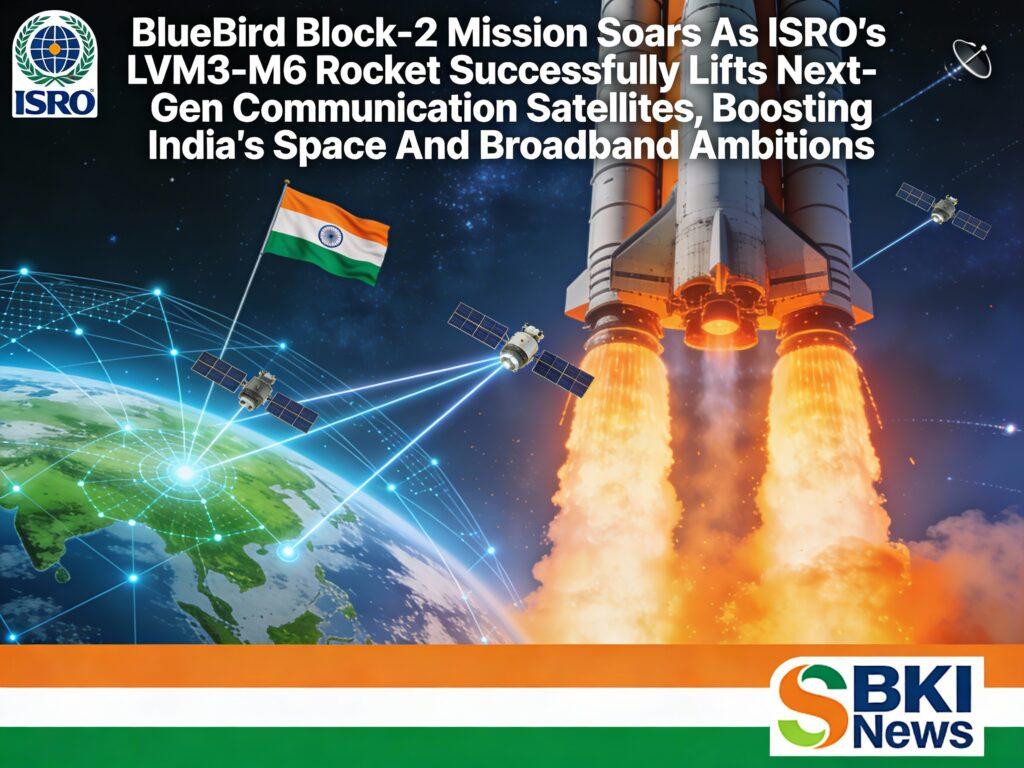
BlueBird Block-2 mission /sbkinews.in
ISRO’s LVM3-M6 launch of the BlueBird Block‑2 mission marks another significant step in India’s growing commercial and strategic presence in space, showcasing reliable heavy‑lift capability and strengthening partnerships with global satellite operators. The mission builds on earlier LVM3 successes, demonstrating ISRO’s capacity to deploy multiple communication and broadband satellites into orbit while supporting the expanding NewSpace ecosystem.
BlueBird Block‑2 mission overview
The BlueBird Block‑2 mission involves a new batch of communication and broadband satellites designed to enhance high‑speed internet connectivity and data services across large geographic regions. By placing these satellites in a carefully planned orbit, ISRO enables improved coverage for remote and underserved areas, supporting applications from streaming and enterprise connectivity to emergency communications.
LVM3, ISRO’s heaviest operational launch vehicle, is specifically engineered to carry such high‑capacity payloads to geostationary transfer orbit and beyond. The successful M6 flight further validates its design, propulsion systems and guidance accuracy, which are critical for India’s future deep‑space and crewed‑mission ambitions.
Significance for India’s space programme
This mission reinforces India’s reputation as a dependable, cost‑effective launch service provider in the global market. By consistently delivering commercial satellites to orbit on schedule, ISRO attracts foreign clients, brings in valuable revenue, and helps fund indigenous research and technology upgrades.
The BlueBird Block‑2 launch also aligns with the government’s vision of expanding digital infrastructure and bridging the connectivity gap between urban centres and rural or remote regions. Enhanced satellite broadband capacity supports initiatives in digital education, telemedicine, precision agriculture and disaster‑management communications, directly impacting everyday life.
Technical highlights of LVM3‑M6
LVM3 is a three‑stage vehicle powered by two large solid strap‑on boosters, a liquid‑propellant core stage, and a high‑performance cryogenic upper stage using liquid oxygen and liquid hydrogen. This configuration allows it to lift heavy communication satellites or multi‑satellite stacks like BlueBird Block‑2, while maintaining precise orbital insertion.
The M6 mission featured a complex deployment sequence to release the satellites safely without collision risk and with minimal fuel penalties for the payloads. Mission planners carefully designed the trajectory, separation timings and attitude maneuvers to maximise payload life and operational efficiency once in orbit.
Growing commercial and international collaboration
BlueBird Block‑2 mission reflects the increasing role of international and private‑sector partnerships in Indian launches. Foreign operators and NewSpace companies are turning to ISRO for dependable, competitively priced access to space, often combining multiple satellites on a single flight to reduce costs.
Such collaborations encourage technology sharing, joint ventures and co‑development of next‑generation platforms, further integrating India into global supply chains for space hardware and services. They also open opportunities for Indian startups in satellite manufacturing, ground‑segment solutions and downstream applications like geospatial analytics and IoT connectivity.THE HINDU
Future prospects after BlueBird Block‑2
With each successful LVM3 mission, ISRO moves closer to ambitious goals such as more frequent commercial launches, advanced communication constellations, and potential crewed flights under the Gaganyaan programme. The proven reliability of LVM3 is expected to underpin upcoming flagship missions involving heavier scientific payloads, lunar and planetary probes, and larger communication satellites.
For India’s broader space economy, BlueBird Block‑2 represents both a technological milestone and a market signal that the country is ready to support complex, high‑value missions at scale. As demand for satellite broadband and data grows worldwide, missions like LVM3‑M6 position India to capture a larger share of global launch and space‑services business.
India’s leadership has framed missions like BlueBird Block‑2 as proof that the country can combine low‑cost engineering with high reliability to serve both national and global needs. Policy reforms that opened the space sector to private investment are now bearing fruit, with more domestic companies building satellites, subsystems and applications that ride on ISRO’s launch capability. Over time, experts expect a virtuous cycle: successful LVM3 flights attract more commercial contracts, which in turn fund further innovation in propulsion, navigation and reusable systems, strengthening India’s competitive edge in the fast‑evolving global space economy.
SBKI News