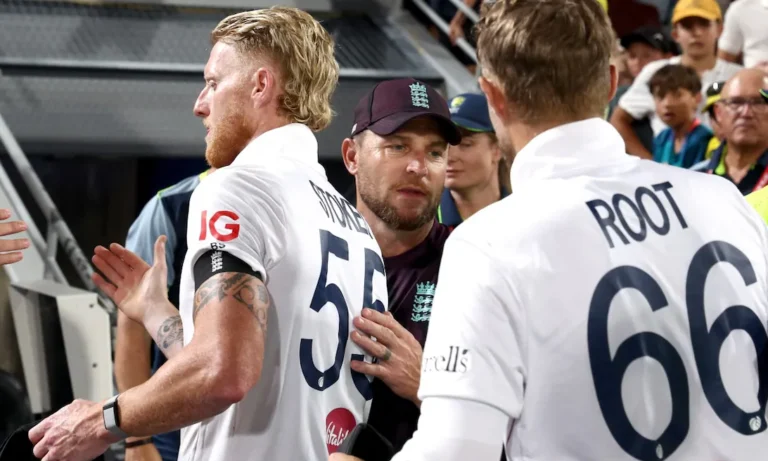
Brendon McCullum/sbkinews.in
England’s dramatic four‑wicket victory over Australia in the two‑day Boxing Day Test at the MCG ended a 5,468‑day wait for a Test win on Australian soil, but former captain Michael Vaughan has warned that the result cannot be used to justify continuing unchanged with the Ben Stokes–Brendon McCullum project. Calling the match a “complete lottery” on an “unacceptable” pitch, Vaughan said England must avoid a heavy defeat in the fifth Ashes Test in Sydney if the Bazball era is to remain truly secure.
Melbourne win, but on a ‘lottery’ pitch
England chased 175 in 32.2 overs to win the fourth Ashes Test, snapping an 18‑match winless run in Australia dating back to January 2011. The match lasted just two days, with 36 wickets falling in six sessions and no batter from either side reaching a half‑century as fast bowlers dominated on a green, seaming surface with 10mm of grass left on.
The ICC match referee Jeff Crowe rated the MCG pitch “unsatisfactory,” noting that it was “excessively favourable to the bowlers” and failed the standard expected for a five‑day Test. Former England opener Geoffrey Boycott wrote that batting had become a “lottery” where seamers only had to bowl full and straight and let the pitch do the rest.
Vaughan echoed that view, saying: “It’s nice to win a game of cricket, but let’s be honest, it was a complete lottery in Melbourne. It wasn’t a proper game of Test match cricket.” Analysts have suggested that the “MCG farce” effectively handed Bazball a lifeline in a dead rubber after Australia had already sealed the series 3‑0.
Vaughan’s warning to Stokes and McCullum
Looking ahead to the fifth Test in Sydney, Vaughan argued that England now need to prove their methods on a fair surface rather than hiding behind the chaos of Melbourne.
Key points from Vaughan’s comments:
The Sydney Test is a “massive game” for the current management.
Stokes and McCullum “need to win a strong game of cricket … that’s not a two‑dayer.”
If England are “pummelled in Sydney, there needs to be some honest conversations” about the way forward.
Vaughan stressed he is not advocating knee‑jerk sackings, but insisted that continuing without acknowledging mistakes would be dangerous: “Whatever happens at the end of this tour, they’ve got to accept that they got a lot of things wrong. If they’re going to be so stubborn to think that they were a bit unlucky … we have a problem going forward.”
He called for more maturity in how England play and talk about Bazball, urging them to refine rather than blindly defend their ultra‑attacking identity.
Context: Ashes lost, questions piling up
By the time they reached Melbourne, England had already lost the Ashes, going 0‑3 down after heavy defeats in Perth, Brisbane and Adelaide. Critics including Boycott and others had branded the tour a “horror show,” accusing Stokes and McCullum of tactical naivety, poor selections and stubborn adherence to Bazball even when conditions demanded pragmatism.
The chaotic MCG win:
Ended a 15‑year, 18‑match winless streak in Australia (16 losses, 2 draws).
Prevented a 5‑0 whitewash and gave England a 3‑1 scoreline heading into Sydney.
Was widely celebrated by players and fans, but simultaneously undercut by the pitch verdict and the sense that skill had been overshadowed by luck.
Australian and English commentators alike labelled the surface a “lottery”, with Kevin Pietersen and Dinesh Karthik also using it to highlight what they see as “selective criticism” when sub‑continental spinning tracks produce similarly skewed contests.
Is it really the ‘end of Bazball’?
Talk of the “end of Bazball” has been brewing since the series defeat was confirmed, with some former England greats even calling for McCullum’s sacking and warning Stokes to change his “attitude” or risk following him out. Vaughan’s stance is more nuanced:
He believes “chopping and changing is not necessarily the right thing” for English cricket.
He accepts there is still “huge appetite within the group to keep [McCullum] on.”
But he insists that if England are thrashed again in Sydney, “fundamentally … there needs to be some honest conversations.”
In short, Melbourne has not saved Bazball; it has merely postponed a full reckoning. The philosophy now faces a more rigorous test on a traditional SCG surface expected to offer more balanced conditions over four to five days.
Melbourne: milestone win, but incomplete answer
For Stokes’ side, the Melbourne victory remains historically significant:
First Test win in Australia since January 2011 in Sydney.
End of a 5,468‑day drought and 18‑match winless run down under.
Psychological release after weeks of criticism over mid‑series “beach breaks” and perceived lack of intensity.
Yet the manner of the win—36 wickets in six sessions, all to fast bowlers, no half‑centuries, ICC “unsatisfactory” rating—means it cannot, in Vaughan’s words, be taken as “a proper game of Test match cricket” that validates the project.
The blunt warning, then, is clear: Bazball is not dead, but the free pass is over. Sydney, not Melbourne, will be the real examination of whether Stokes and McCullum can evolve their high‑risk style into a sustainable, mature Test blueprint.