
#Chaos in Bangladesh#Chaos in Bangladesh#Chaos in Bangladesh#Chaos in Bangladesh#Chaos in Bangladesh#Chaos in Bangladesh
Chaos in Bangladesh
Dhaka | December 20, 2025/sbkinews.in
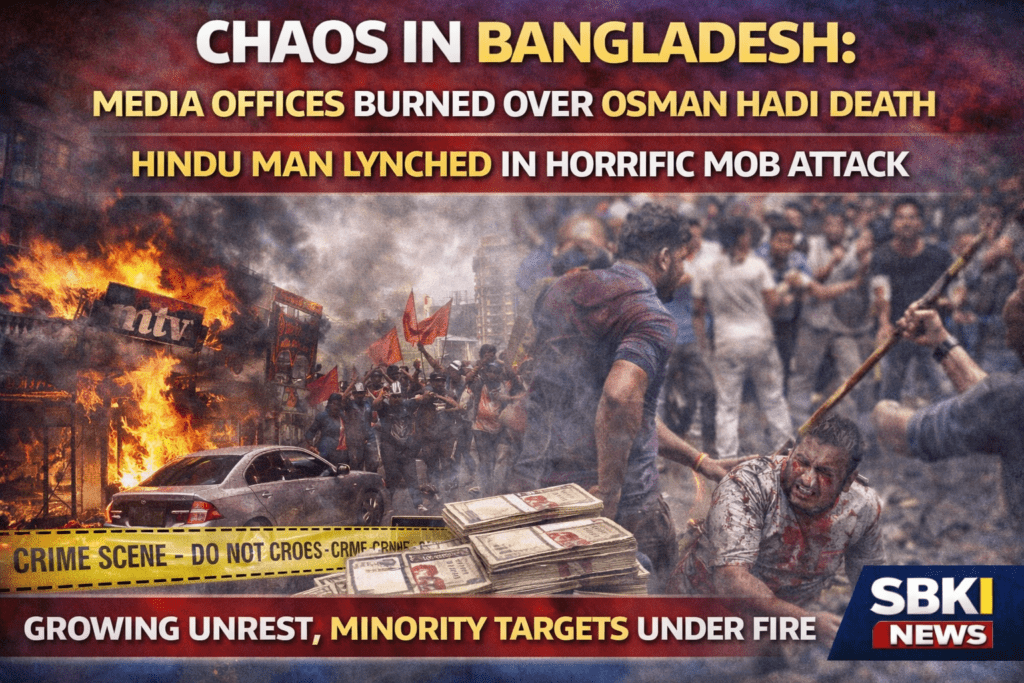
Bangladesh teeters on the brink of chaos as violent mobs torched newspaper offices following the death of prominent figure Osman Hadi, while a Hindu man was brutally lynched and set ablaze in a separate incident. These back-to-back attacks have ignited fears of widespread communal unrest, exacerbating the country’s fragile political landscape post recent regime changes.
Eyewitnesses reported that enraged protesters targeted media outlets in Dhaka and surrounding areas, accusing them of biased coverage surrounding Hadi’s mysterious demise. The violence marks a dangerous escalation in public anger, with authorities struggling to contain the fallout.
Mob Fury Targets Press After Osman Hadi’s Death
Osman Hadi, a influential local leader and activist known for his vocal stance on governance reforms, was found dead under suspicious circumstances late Friday. Initial reports suggest foul play, though police have yet to confirm the cause. Hadi’s supporters swiftly blamed “corrupt media” for spreading disinformation about his activities, leading to coordinated attacks on at least three newspaper offices.
Flames engulfed the headquarters of a major Bengali daily in central Dhaka, with rioters hurling Molotov cocktails and smashing windows. Firefighters battled blazes for hours, rescuing staff trapped inside. Similar assaults hit printing presses in Chittagong and Sylhet, destroying equipment worth millions. No casualties were reported from these arson attacks, but the incidents have crippled local journalism operations.
Local journalists condemned the violence, calling it an assault on press freedom. “This is not journalism’s fault; it’s a symptom of deeper societal fractures,” said a veteran editor who escaped the inferno narrowly. The attacks come amid ongoing tensions following the ouster of former Prime Minister Sheikh Hasina in August 2024, during which media outlets faced accusations of partisanship from all sides.
Hindu Man Lynched and Burnt in Shocking Communal Attack
In a parallel horror unfolding in rural Kushtia district, a Hindu man identified as Rajesh Kumar was dragged from his home, beaten to death by a mob, and his body set on fire. The 42-year-old shopkeeper was accused by attackers of “blasphemy” over a trivial dispute involving social media posts. Witnesses described a frenzied crowd of over 100 people chanting religious slogans as they perpetrated the lynching.
Video footage circulating on social media shows Kumar’s charred remains beside his torched residence, with neighbors too terrified to intervene. Police arrived over an hour later, citing road blockades by protesters. Three suspects have been arrested, but community leaders demand a thorough probe into what they term a “premeditated hate crime.”
This incident revives memories of sporadic anti-minority violence that surged after Hasina’s fall, when interim authorities struggled to maintain law and order. Human rights groups report over 50 attacks on Hindu properties since October, often linked to rumors amplified on platforms like Facebook and WhatsApp.
Roots of Unrest: Political Vacuum and Social Media Flames
Bangladesh’s current turmoil stems from a power vacuum created by student-led protests that toppled the long-ruling Awami League government. The interim administration under Muhammad Yunus has faced criticism for slow reforms and inability to curb vigilante justice. Osman Hadi’s death—rumored to involve political rivals—has become a flashpoint, with his family alleging a cover-up by media aligned with old regime elements.
Social media has played a incendiary role, with viral posts falsely claiming Hadi was murdered by journalists and that Hindu communities were celebrating. Fact-checkers debunked these narratives within hours, but not before mobs mobilized. Cybersecurity experts warn of coordinated disinformation campaigns exploiting ethnic and religious divides.
Government Response and Security Crackdown
Authorities have imposed curfews in affected districts and deployed the Rapid Action Battalion (RAB) to guard media houses and minority neighborhoods. Prime Minister Yunus condemned the violence in a televised address, vowing “swift justice” and promising compensation for victims. “Bangladesh will not tolerate anarchy; unity is our strength,” he stated.
Over 200 arrests have been made, including alleged instigators. The government announced a high-level inquiry into Hadi’s death and plans to regulate online content more stringently. International observers, including the UN Human Rights Office, urged de-escalation and protection for minorities and press workers.
Broader Implications for Bangladesh’s Stability
These events signal deepening polarization in a nation already grappling with economic woes, youth unemployment, and refugee pressures from neighboring Myanmar. Analysts fear copycat attacks could spread to border regions near India, straining bilateral ties given the large Hindu expatriate community.
Hindu advocacy groups like the Bangladesh Hindu Buddhist Christian Unity Council have appealed to New Delhi for intervention, highlighting risks to 1.5 million minorities. Economically, the violence threatens investor confidence, with stock markets dipping 3% on Monday.
Legal experts emphasize the need for robust hate speech laws, noting existing statutes like the Digital Security Act have been inconsistently enforced. “Without addressing root causes like misinformation and impunity, Bangladesh risks descending into cycles of retribution,” observed Dhaka University professor Ayesha Siddiqa.
Path Forward Amid the Ashes
As smoke clears from torched offices and grieving families mourn, Bangladesh stands at a crossroads. Restoring trust in institutions demands transparent investigations, media safeguards, and community dialogues. The international community watches closely, ready to support reconstruction but wary of endorsing instability.
Civil society leaders call for nationwide restraint, urging citizens to verify facts before acting. “Violence solves nothing; dialogue builds nations,” tweeted prominent activist Ziaur Rahman. With elections looming in 2026, these incidents could reshape the political narrative, testing the resilience of Bangladesh’s democracy.
In the coming days, expect heightened security and potential internet shutdowns to prevent further escalation. The nation that rose through resilience now battles its demons—will it emerge united or fractured?Altnews
SBKI News – Your Trusted Source for Regional and National Updates. Stay Informed with Authentic Reporting from Delhi, Punjab, Uttarakhand, and Uttar Pradesh.
For the latest on Bangladesh unrest and minority safety concerns, follow SBKI News on social media and visit sbkinews.in.