#Delhi Air Pollution#Delhi AQI#Delhi Severe AQI/sbkinews.in
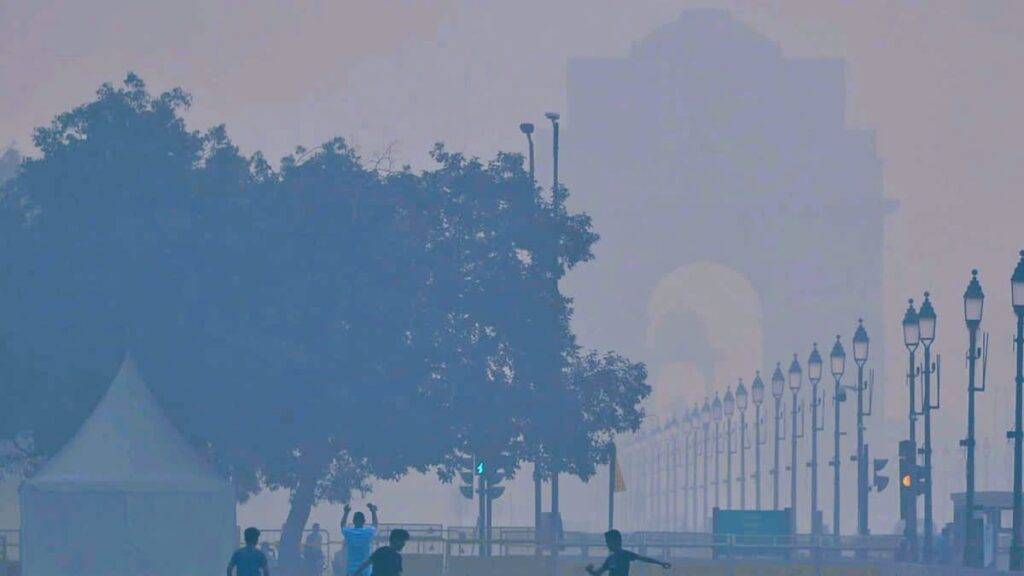
New Delhi: The national capital once again found itself under a dense layer of toxic haze on Sunday morning as air pollution levels rose sharply before showing modest improvement by evening. Residents of Delhi woke up to a choking layer of smog that blanketed the city, pushing the Air Quality Index (AQI) into the ‘severe’ category. However, as wind conditions changed later in the day, visibility improved slightly, bringing temporary relief.
According to the Air Quality Early Warning System (AQEWS) run by the Union Ministry of Earth Sciences, the fluctuations in Delhi’s air pollution levels were mainly due to varying meteorological conditions, particularly stagnant morning winds and high humidity that trapped pollutants close to the ground. Experts at the ministry cautioned that while there was an evening dip in pollution levels, a sustained improvement remains unlikely in the near term.
Morning Smog Turns the Capital into a Gas Chamber
At around 10 a.m., Delhi’s AQI on the Swiss air quality monitoring platform IQAir recorded a hazardous level of 467, which falls under the ‘severe’ category. This made Delhi one of the most polluted major cities in the world on Sunday morning. The thick smog led to low visibility conditions on several roads, causing commuter delays and triggering respiratory discomfort among vulnerable groups including children, senior citizens, and asthma patients.
Environmental scientist Dr. Rakesh Garg explained that slow wind movement during early hours prevented pollutant dispersion. “The calm weather allowed particulate matter such as PM2.5 and PM10 to accumulate. The situation improved when wind speeds picked up later in the day,” he said.
The Central Pollution Control Board (CPCB) reported that the 24-hour average AQI at 4 p.m. stood at 366, falling under the ‘very poor’ category — around 63 points higher than Saturday’s 303. At 10 a.m., the AQI had reached 388, nearing the upper limit of ‘very poor’. Data from CPCB’s 38 active monitoring stations revealed that 13 areas, including Anand Vihar, Jahangirpuri, and Mundka, continued to record ‘severe’ AQI levels above 400.
Evening Brings Brief Respite, But Air Still Unhealthy
By 5 p.m., the AQI dropped to 180, categorized as ‘moderate’, offering Delhiites a short-lived reprieve. Evening winds improved air circulation slightly, helping disperse surface-level pollutants. However, as temperatures dropped after sunset, pollutants began to settle again, pushing the AQI back up to 208 (‘poor’) by 8 p.m.
Experts said that while Delhi saw some improvement in the evening due to increased horizontal wind flow, the gains were minimal. Meteorological factors such as temperature inversion and persistent calm conditions are expected to worsen pollution levels again overnight. “This cyclical rise and fall will likely continue until there is a significant change in wind direction or speed,” an official from IMD noted.
Forecast Predicts No Major Improvement Soon
The Air Quality Early Warning System forecast indicated limited chances of substantial improvement in the next few days. With continued low wind speeds, stable atmospheric conditions, and ongoing stubble burning in neighboring Punjab and Haryana, Delhi’s air quality is expected to remain in the ‘very poor’ to ‘severe’ range through the week.
According to system projections, northwesterly winds may bring additional smoke and particulate matter into Delhi’s atmosphere, further worsening the condition. Experts have advised residents to minimize outdoor activities, especially during morning and late-night hours when pollution concentrations are at their peak.
Health Impact and Government Measures
Health experts issued renewed warnings, urging citizens to wear N95 masks and avoid morning walks in high-pollution zones. The Delhi government maintained its Graded Response Action Plan (GRAP) at Stage IV, the highest alert level, allowing the closure of construction sites, restriction of entry for heavy diesel vehicles, and the promotion of public transport.
Dr. Seema Bhagat, a pulmonologist at AIIMS, said prolonged exposure to such pollution levels can worsen existing respiratory diseases. “Even short-term exposure to severe AQI can cause coughing, throat irritation, and lung inflammation. The particulate matter is so fine it enters deep into the lungs,” she warned.
Environmental groups have called for urgent long-term interventions, including stricter vehicle emission norms, promotion of electric mobility, and enhanced green cover to combat the recurring winter smog crisis.
Citizens Demand Sustainable Solutions
Residents expressed frustration over repeated air pollution episodes that come every winter. Social media platforms were flooded with images showing Delhi’s skyline completely obscured by smog. Many citizens urged authorities to focus on preventive measures rather than seasonal firefighting.
Urban planner Arun Chopra emphasized that local emissions from traffic and construction contribute significantly to daily fluctuations. He advocated for better city-level emission inventories and stricter construction dust management rules.
While Delhi briefly experienced clearer skies in the evening, experts believe the relief won’t last long. Until drastic reductions in both local and external pollution sources occur, the city will likely continue to battle dangerous air quality swings that threaten public health and daily life. For ongoing updates on Delhi’s air quality and in-depth coverage of pollution trends, readers can refer to the recent detailed report by News18.
For the latest updates and comprehensive coverage of Delhi’s air quality and other regional news, visit our dedicated Delhi news section at Delhi News on SBKiNews.