EU Deal India
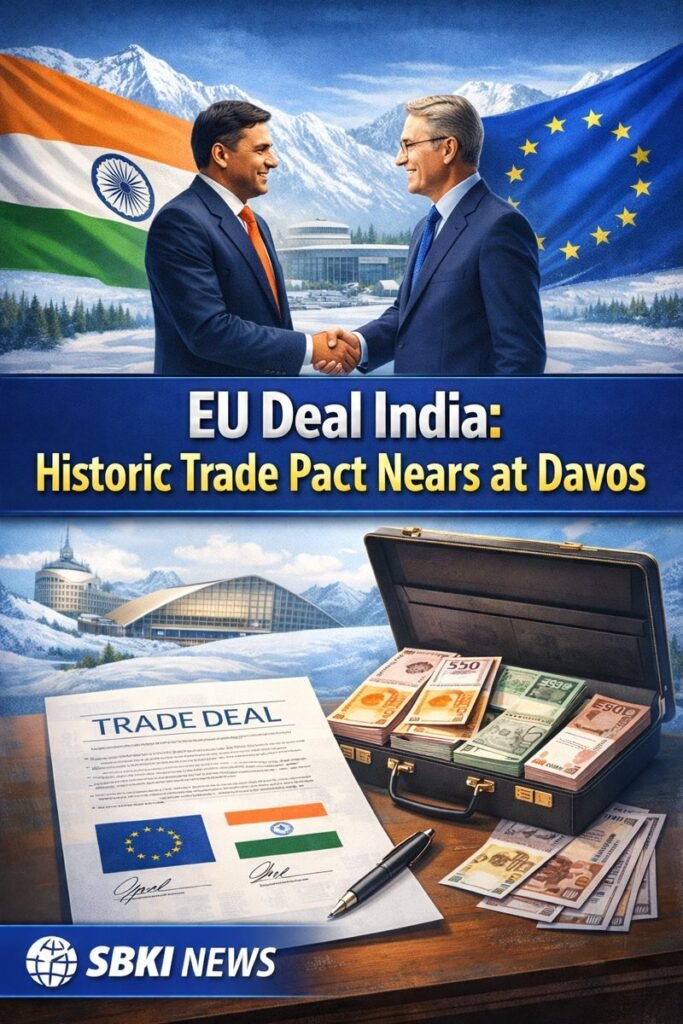
India and the European Union edge closer to a landmark free trade agreement (FTA), with European Commission President Ursula von der Leyen confirming near-finalization at the World Economic Forum (WEF) Davos 2026. Amid live sessions under the theme “A Spirit of Dialogue,” 20 of 24 chapters stand completed, targeting a January 27 signing ahead of leaders’ summits. This breakthrough accelerates India’s export ambitions while US trade talks falter under tariff pressures.
Davos 2026 Momentum
The 56th WEF Annual Meeting (January 19-23) gathers 2,500 leaders in Davos-Klosters, Switzerland, tackling trade fragmentation and geopolitical risks. Von der Leyen’s announcement during a high-profile panel highlights intensive post-2025 relaunch efforts. EU views India as a strategic partner for supply chain diversification, especially in renewables, EVs, and pharmaceuticals. Bilateral trade reached ₹11.44 lakh crore in FY24, with the pact poised to unlock duty-free access for labor-intensive sectors.
Commerce Minister Piyush Goyal’s Brussels engagements and daily virtual rounds sealed goods, services, investments, and sustainability chapters. Agriculture exclusions safeguard Indian farmers, while EU gains market access for machinery and chemicals.
Key Negotiation Wins
Finalized chapters cover rules of origin, technical barriers, intellectual property, and sustainable development. India secures easier professional visas for IT talent; EU eases non-tariff barriers on textiles and leather. Remaining hurdles include critical minerals quotas and the EU’s Carbon Border Adjustment Mechanism (CBAM), with optimism for swift resolution. Signing could occur January 25-27 in New Delhi with PM Modi, Von der Leyen, and EU Council President António Costa.
US Talks Lag Behind
In stark contrast, India-US bilateral trade negotiations drag, with no firm timeline despite “first tranche near” signals. President Trump’s 50% tariff threats on $48B Indian exports—pharma, gems, steel—complicate progress. US demands include higher oil/defense purchases, data localization rollbacks, and Russia distancing. Davos underscores EU’s faster track as India’s hedge against US protectionism.
Davos 2026 India EU trade deal
Sectoral Impact Table
| Sector | Projected Gains | Economic Boost [conversation_history] |
|---|---|---|
| Textiles/Leather | Zero duties to EU | $10B annual exports |
| IT/Services | Mobility for 1L professionals | 20% growth in remittances |
| Pharmaceuticals | IP harmonization | $5B new market access |
| Autos/Engineering | Standards alignment | SME competitiveness up 15% |
Strategic Edge for India
The EU pact marks India’s 20th FTA by 2030 goal, elevating it to EU’s top 10 partners. It counters China in green tech via Production-Linked Incentive (PLI) synergies. Post-Ukraine energy shifts make India a reliable EU alternative; FICCI forecasts 1 million jobs and 1% GDP addition. MSMEs benefit from 10-15% logistics savings.
Modi 3.0’s multi-alignment shines: UAE/Australia pacts operational, UK/Canada advancing. EU deal buffers $10B US tariff losses.THE HINDU
Davos Broader Highlights
Von der Leyen’s session emphasized “rules-based trade” amid Red Sea disruptions and US-EU frictions. Expected Modi bilaterals with EU leaders; Fed Chair Powell’s tariff comments loom. Other foci: AI ethics, climate finance, with India pitching Global South priorities.
Expert Insights
Trade analyst Rajiv Kumar: “EU momentum validates India’s pragmatic diplomacy; US will follow suit.” CII’s Director General Chandrajit Banerjee hails job creation potential. Challenges: EU Parliament ratification (6-12 months), domestic lobbying on dairy/chemicals.
Economic Backdrop
India’s December trade deficit widened amid US duties; EU surplus potential offsets this. Global fragmentation favors bilateral pacts—India’s FTA spree counters slowdown. PLI schemes align with EU Green Deal for solar modules, batteries.
Davos 2026 India EU trade deal
Global Relevance
WEF 2026 fosters dialogue as Trump 2.0 tests alliances. EU-India pact signals Europe’s pivot east; Denmark’s Greenland stance adds transatlantic tension. India’s rising clout positions it centrally in reshaping trade blocs.
Davos 2026 India EU trade deal
Implementation Roadmap
January 27: Potential ink-signing.
Q2 2026: Ratification process.
2027: Phased tariff reductions.
Monitoring: Joint committee for disputes.
Long-term: $1 trillion exports by 2030, with EU as pillar.
Risks & Mitigations
CBAM compliance costs Indian steel ₹5,000/tonne initially; green tech transfers ease this. Political shifts—EU elections, US midterms—could delay. India’s diversified portfolio minimizes single-market reliance.
Davos 2026 cements EU Deal India as a diplomatic triumph, blending economic ambition with strategic autonomy.
Stay connected to global trade triumphs – SBKI News, powering India’s economic future.