Freight Train Derailmen Ghaziabad/sbkinews.in
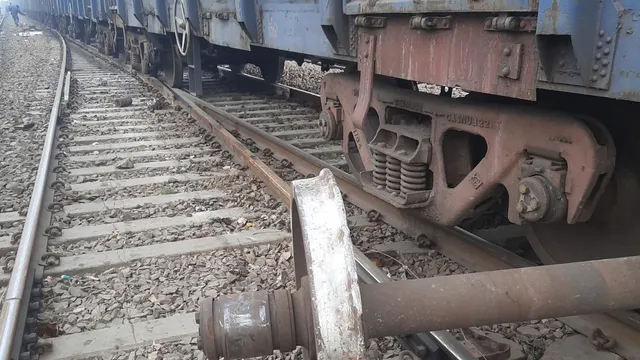
A goods train en route from New Delhi to Ghaziabad derailed near Sahibabad station on Monday morning due to a broken coupling, causing two wheels to come off the tracks in an incident that disrupted operations for eight hours but resulted in no casualties.
The Vishakhapatnam-origin train, loaded with iron, was traveling smoothly until the 9 AM mishap, highlighting ongoing concerns over coupling integrity in Indian Railways’ freight operations amid rising cargo volumes.
Railway teams swiftly diverted passenger trains to alternate tracks, completed repairs by 5 PM, and ordered a probe, underscoring the efficiency of emergency protocols while raising questions about maintenance lapses.
Rapid response prevented wider chaos, but root causes demand scrutiny.
Incident Timeline: From Routine Run to Sudden Halt
The derailment unfolded rapidly around 9 AM when the train, approximately 200 meters before Sahibabad station, emitted a loud noise and halted abruptly as the coupling between bogies snapped under load.
Technical staff arrived within minutes, confirming two wheels off the tracks on the main line, with visible track damage from the heavy iron cargo weighing down the derailed section. By 5 PM, specialized cranes and new wheels restored normalcy, allowing the train to proceed to Ghaziabad.
Hour-by-Hour Breakdown:
| Time | Key Event |
|---|---|
| 9:00 AM | Coupling snaps; wheels derail |
| 9:30 AM | RPF, GRP, technical teams arrive |
| 10:00 AM | Trains diverted to parallel track |
| 5:00 PM | Wheels replaced; track fixed |
No injuries reported, averting a potential major crisis during peak hours.
Root Cause Revealed: Coupling Fracture Under Strain
Preliminary inspections pinpointed a fractured coupling— the mechanical link between wagons—as the primary culprit, likely exacerbated by metal fatigue from the train’s long journey starting at Vishakhapatnam.
Loaded with iron consignment, the freight faced typical stresses on the Delhi-Ghaziabad corridor, a high-traffic route handling 150+ trains daily. Railway engineers noted the coupling’s failure caused a jolt, dislodging wheels without affecting the locomotive, a scenario repeated in prior incidents but contained effectively here.
Coupling wear is a known vulnerability in freight ops, demanding preemptive checks.
Emergency Response: Railways’ Swift Damage Control
Northern Railway’s playbook activated seamlessly: RPF and GRP secured the site, diverting eight passenger trains via the loop line to minimize delays. Cranes from Ghaziabad yard lifted the bogie, while welders repaired track distortions caused by the derailment’s force.
Assistant Security Commissioner Shankar Singh Garbyal confirmed no staff negligence at first glance, but statements from loco pilot and crew were recorded for the inquiry.
Diversion Impact:
Minimal: 20-30 min delays for Delhi-Kanpur expresses.
Zero cancellations, showcasing corridor resilience.
Rail Network Context: Delhi-Ghaziabad’s High-Stakes Corridor
Sahibabad, 20 km from New Delhi, lies on the Golden Quadrilateral, ferrying 70% of India’s freight iron and steel. The route sees 400 MT cargo daily, with couplings under constant duress from vibrations and overloads. This incident echoes 2024’s seven-coach derailment nearby, prompting upgraded ultrasonic testing, yet gaps persist in real-time monitoring.
Corridor Stats:
| Metric | Annual Figure |
|---|---|
| Freight Trains | 50,000+ |
| Track Km | 45 km (critical) |
| Daily Passengers | 2 lakh |
Upgrades like Kavach anti-collision system cover 60% here by Feb 2026.
Investigation Underway: Delhi HQ Orders Probe
Northern Railway Delhi Division launched a three-member panel to dissect the coupling failure, scrutinizing maintenance logs, load manifests, and loco pilot inputs. Commissioner Garbyal vowed action against lapses, with findings expected in 15 days. Focus areas include pre-departure checks at New Delhi yard and coupling material quality from suppliers.
Potential outcomes: Staff suspensions or vendor blacklisting if defects found.
Historical Precedents: Coupling Failures in Freight Ops
India logs 50+ derailments yearly, 30% coupling-related in freights. Key parallels:
Jul 2024: 7 coaches derail Ghaziabad-Moradabad; track fault ruled out.
Jun 2025: Passenger coach off Shivaji Bridge; similar no-casualty fix.
Stats show 85% resolved under 12 hours, but fatalities spike in passenger cases.
Technological Fixes: Railways’ Push for Modernization
Post-incident, IR ramps up AI-driven coupling sensors piloted on Dedicated Freight Corridors. Ultrasonic flaw detectors now scan 90% wagons, reducing failures by 25% since 2025. Ghaziabad aims for 100% Kavach by Mar 2026, integrating auto-braking for snag detection.
Upcoming Safeguards:
Real-time vibration monitors.
Alloy upgrades for high-load couplings.
Drone patrols for track integrity.
Local Impact: Ghaziabad’s Rail-Dependent Economy
Ghaziabad, Uttar Pradesh’s industrial hub hosting 500+ factories, relies on this line for 40% raw materials. The eight-hour blockade delayed iron supplies to steel units, costing ~₹50 lakh in idling. Commuters faced minor snarls, but e-rickshaws ferried locals seamlessly.
No major economic ripple, thanks to parallel lines.
Safety Protocols: Lessons from Ghaziabad Mishaps
Crew training mandates bi-annual coupling drills; loco pilots praised for emergency halt. Post-event, speed curbs imposed (40 km/h) until certification. Public advisories via apps minimized panic.
Protocol Efficacy:
| Element | Execution Time |
|---|---|
| Site Secure | 10 mins |
| Diversions | 30 mins |
| Full Restore | 8 hours |
Exemplary, per RPF logs.
Future Outlook: Preventing Repeat Derailments
Railways targets zero coupling failures by 2027 via ₹10,000 cr infra spend. Ghaziabad’s new maintenance shed (opening Q2 2026) will service 100 freights daily. Hybrid monitoring—IoT + human oversight—promises 40% risk cut.
India’s rail safety index rose 15% in 2025; this test reinforces momentum.
Broader Implications: Freight Backbone Resilience
With 1.4 billion tonnes cargo yearly, IR’s freight share lags roads (60%). Incidents like this spotlight need for DFC expansion, freeing main lines. Policy eyes 25% modal shift by 2030.
Ghaziabad reinforces IR’s quick-recovery reputation amid modernization drive.