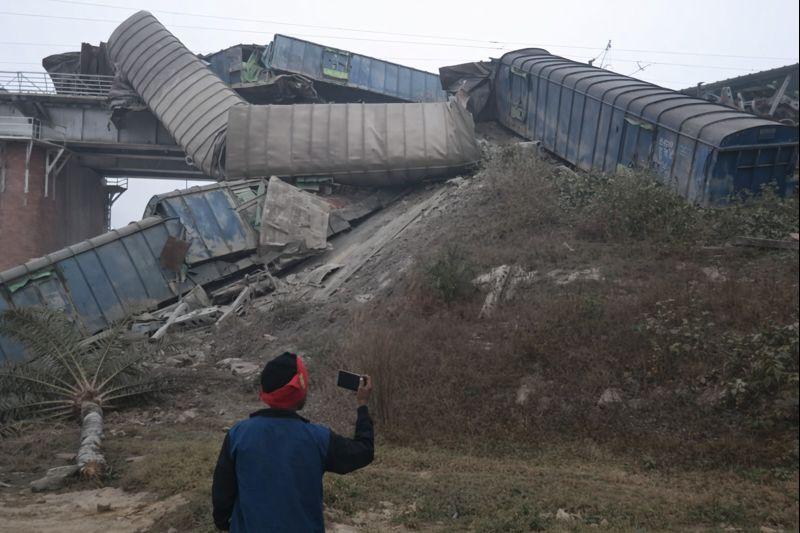
Eight wagons of a goods train derailed in Bihar’s Jamui district late on Saturday night, disrupting railway services on the crucial Howrah–Patna–Delhi route and affecting interstate rail traffic across multiple states. The incident, which occurred between Lahabon and Simultala railway stations under the Asansol division of Eastern Railways around 11.25 pm, led to a complete blockage of the affected section and forced large-scale operational changes for passenger trains.
Location and timing of the accident
According to Eastern Railway officials, the derailment took place on a busy stretch that handles significant long-distance and interstate traffic daily. The affected section lies within the Asansol division, a key corridor connecting eastern India with important destinations in northern and central regions. The timing of the mishap, close to midnight, meant that a large number of overnight trains were on the move, increasing the operational challenges for railway controllers and ground staff.
Immediate impact on rail traffic
The derailment of eight wagons caused the disruption of movement for nearly two dozen trains overnight, severely inconveniencing passengers traveling on the route. A number of express services were either cancelled or partially cancelled, while several others were diverted via alternative routes to keep traffic flowing. Officials stated that routes through Dhanbad–Gaya and other connecting sections were used to divert long-distance trains and reduce congestion on the blocked line.
Among the trains affected were the 12305 Howrah–New Delhi Rajdhani Express, 22347 Howrah–Patna Vande Bharat Express, 22500 Varanasi–Deoghar Vande Bharat Express, 22499 Deoghar–Varanasi Vande Bharat Express and 13332 Patna–Dhanbad Intercity Express, all of which were diverted from their usual paths. In addition, services like the 12369 Howrah–Dehradun Kumbha Express, 13105 Sealdah–Ballia Express, 13030 Mokama–Howrah Express and several MEMU trains were cancelled or rescheduled due to the blockage.
Relief and restoration efforts
Railway authorities responded quickly by dispatching accident relief trains and technical teams from Asansol, Madhupur and Jhajha to the site of the derailment. These teams began work through the night to rerail the derailed wagons, clear debris and repair damaged track infrastructure. Officials said that restoration activities were being carried out on a “war footing” to reopen the line for normal operations as early as possible.
While the exact duration of the disruption will depend on the progress of track and overhead equipment restoration, officials indicated that partial movement may be allowed first, followed by full normalization once safety checks are completed. Passengers were advised to check the latest status of their trains through official railway channels before starting their journey.
No casualties, inquiry ordered
Eastern Railway confirmed that there were no casualties or major injuries reported in connection with the derailment, offering significant relief in what could have been a much more serious disaster. However, the scale of operational disruption and the damage to rolling stock and infrastructure prompted the railway administration to order a detailed inquiry into the incident.
An inquiry committee has been tasked with determining the exact cause of the derailment, examining factors such as track condition, wagon fitness, speed, signaling, and possible human error. Officials said that the findings would be used to strengthen safety protocols and prevent similar occurrences in the future on this and other high-density routes.
Passenger inconvenience and advisory
Thousands of passengers faced delays, missed connections and extended travel times due to diversions and cancellations triggered by the derailment. Railway officials acknowledged the inconvenience and highlighted that the decision to divert or cancel trains was taken in the interest of safety and efficient crowd management on unaffected corridors.
Passengers have been urged to stay updated through railway helplines, station inquiry counters, mobile applications and official websites for real-time information on rescheduled or diverted services. Those with flexible travel plans have been advised to postpone non-essential journeys on the affected route until full restoration is achieved.
#Goods Train Derail In Bihar
Broader implications for rail safety
The incident underscores the vulnerability of high-density freight and passenger corridors, where even a single derailment can have a cascading impact on interstate mobility. With a growing dependence on railways for long-distance travel and freight movement, experts stress the importance of continuous track monitoring, timely maintenance and the use of advanced detection technologies to minimize such disruptions. Read full report here.
Railway authorities are expected to review maintenance schedules and operational practices in the Asansol division and other critical sections following the inquiry, with the aim of further enhancing safety and reliability for both passenger and freight services. .Recent derailments highlight the need for upgraded signalling, anti-collision devices and real-time wagon health monitoring to prevent recurrence. For more Bihar developments, check our Bihar News Updates.