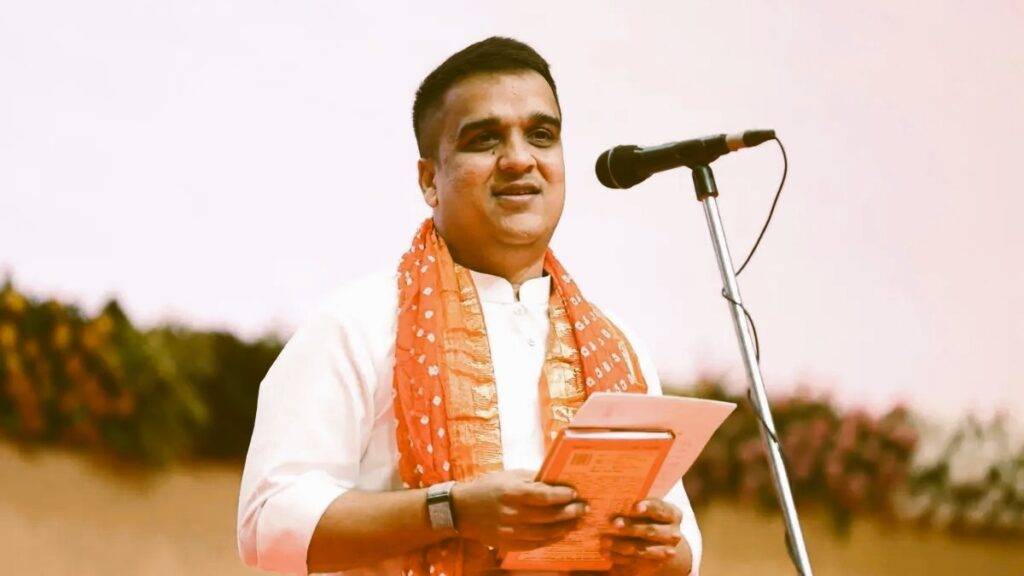
Four years after Bhupendra Patel’s surprise elevation as Chief Minister of Gujarat, the political landscape of the state is witnessing a subtle yet significant shift. The spotlight, once firmly fixed on Patel, now seems to be gradually tilting toward his young deputy, Harsh Sanghavi. The recent cabinet reshuffle has amplified this perception, giving rise to speculation about whether the BJP’s internal power equations in Gujarat are quietly being redrawn.
In a move that surprised many political observers, the number of portfolios under Chief Minister Patel has reduced from 15 to just 9. Meanwhile, Deputy Chief Minister Harsh Sanghavi’s responsibilities have skyrocketed from eight to an unprecedented seventeen. This numerical imbalance, while administrative on the surface, carries deeper political meaning—one that points toward Sanghavi’s expanding stature within the state government and possibly within the party’s future plans.
The Rise of a Dynamic Deputy
Harsh Sanghavi, a young and energetic leader known for his grassroots engagement and organizational skills, has been a rising star in Gujarat’s BJP circles for years. Considered the face of the party’s youth brigade, Sanghavi’s leadership style is marked by quick decision-making, active field presence, and a strong digital outreach strategy. His steady ascent from an MLA to Home Minister and now Deputy Chief Minister speaks to his growing influence within both the party and the administrative machinery.
The most notable shift lies in the portfolios themselves. Patel, once handling key departments such as Home, Finance, and Urban Development, is now left largely with the Revenue Department. Sanghavi has taken over the crucial Home portfolio — a coveted position that often defines administrative control and political strength. Patel’s long-preferred Urban Development wing, one that had allowed him to shape Gujarat’s infrastructure vision, is now under Kanubhai Desai, adding another layer to this evolving power puzzle.
Reading the Cabinet Equation
Cabinet reshuffles are not new in Indian politics, but the scale of Sanghavi’s empowerment has stirred quiet debates in Gandhinagar. Power in governance often lies in the distribution of portfolios, and in Gujarat’s case, Sanghavi’s leap to 17 portfolios hints at a calculated move by the BJP’s central leadership to balance experience with youthful assertiveness.
While Bhupendra Patel remains the face of the state government, Sanghavi’s growing clout within both the administration and the party cadre suggests that he is no longer confined to a secondary role. Political analysts believe this rearrangement could be designed to prepare Sanghavi for a larger leadership position in the future, especially as the BJP looks to reinforce its dominance in the state ahead of the next Assembly elections.
Background of Two ‘Surprise’ Appointments
Both leaders share a common thread — they were surprise appointments. Bhupendra Patel’s selection in 2021 had raised eyebrows as he was a low-profile legislator with minimal administrative experience compared to other senior BJP faces. Yet, he managed to maintain a calm, non-confrontational image and presided over the state during critical periods, including the 2022 Assembly elections which delivered another massive mandate for the BJP.
Sanghavi’s appointment as Deputy Chief Minister a month ago was equally surprising. However, the move was interpreted as a strong generational shift signaling the BJP’s willingness to invest in youth-led governance. His growing imprint is already visible in administrative terms — reports suggest he has appointed several IAS officers to strengthen his office, while Patel has streamlined his team, reducing the number of officials in his own secretariat.
Speculation and Strategy
In Gujarat’s highly disciplined BJP ecosystem, visible shifts in influence often stem from well-planned strategic objectives. Party insiders point out that this redistribution of power is unlikely to indicate factionalism. Instead, it may represent the party’s evolving governance model — one that seeks to balance continuity with reform, and seniority with innovation.
Sanghavi’s growing list of portfolios includes key sectors like Home, Industry, Ports, and Youth Affairs. Each of these areas plays a critical role in shaping Gujarat’s economic and political narrative. His handling of the Home Department, in particular, will be closely watched as it comes with both administrative challenges and the responsibility of maintaining public order in one of India’s most politically active states. For deeper insights into the shifting power dynamics in Gujarat and the implications of Harsh Sanghavi’s rise, read India Today here.
The Road Ahead
Bhupendra Patel, by contrast, remains the face of administrative stability and consensus. His loyal image and proximity to Prime Minister Narendra Modi and Home Minister Amit Shah continue to ensure his political security. However, the reshuffle paints a layered picture of a state leadership that now operates with dual centers of gravity — a seasoned CM steering policy continuity, and a dynamic deputy reshaping the state’s governance priorities.
As the BJP navigates both governance and electoral strategy for the coming years, the interplay between Patel and Sanghavi will be important to watch. Whether this evolving dynamic leads to a redefined leadership structure or simply a more efficient power-sharing arrangement remains to be seen.
For now, it is clear that Harsh Sanghavi’s swift rise marks a new phase in Gujarat’s political journey — one that could well redefine the balance between experience and energy in the state’s corridors of power.
For more on the latest developments in Gujarat, check out the top 10 updates on “Gujarat News” here.