Harish Rana Biopic
After 13 years in a vegetative state and a historic Supreme Court judgment allowing “passive euthanasia”, Harish Rana’s painful yet inspiring life journey is now set to be told on the big screen through a biopic.
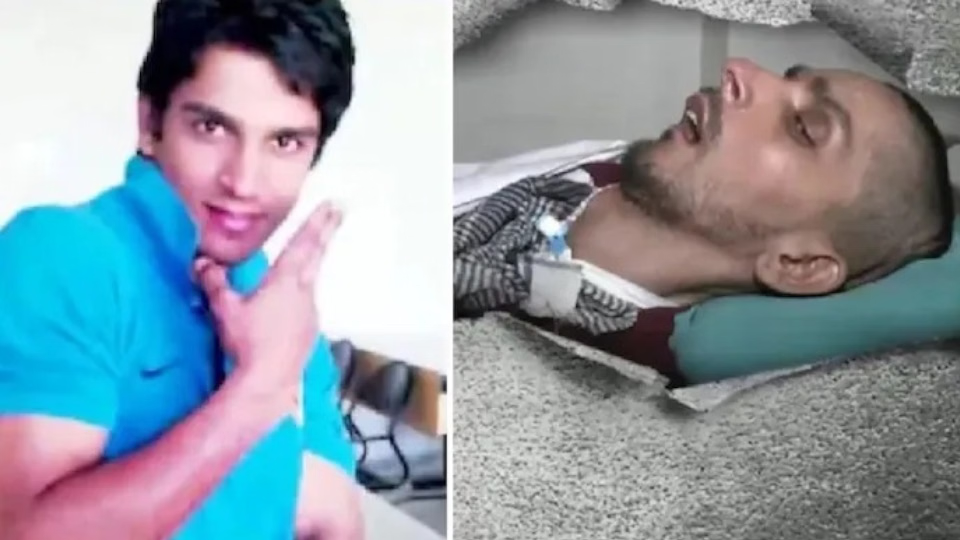
“Portrait of Harish Rana with his parents Ashok Rana and Nirmala Devi, highlighting more than a decade of silent suffering and the Supreme Court’s landmark decision to allow dignified end‑of‑life care.”
Harish Rana of Rajnagar, Ghaziabad, spent 13 years in a coma, trapped between life and death, but now his story is moving beyond hospitals and courtrooms. Following the Supreme Court’s compassionate judgment permitting withdrawal of life‑support, preparations have begun to turn his ordeal into a biopic. The film will portray a father’s 13‑year struggle, a lawyer’s selfless fight, and the judiciary’s emotional yet principled stand on “dignified death”.
How the biopic idea took shape
Born in Plaitar village of Kangra district, Himachal Pradesh, Harish Rana moved with his family to Delhi/NCR in search of better education and work. In 2013, while studying at a university in Delhi, the 18‑year‑old Harish fell from the fourth floor of a PG hostel, suffering a severe and irreversible brain injury. Doctors declared him in a permanent vegetative state, and he remained dependent on ventilators, feeding tubes, and constant medical care for 13 years.
During this long wait, his parents, Ashok Rana and Nirmala Devi, stayed by his side in their Rajnagar home, turning daily care into a lifelong duty. Medical experts repeatedly confirmed that there was no realistic hope of recovery, which led the family to approach the courts seeking passive euthanasia—the withdrawal of life‑support in a permanent vegetative state.
The case reached the Supreme Court of India, where a bench led by Justice J.B. Pardiwala and Justice J.V. Vishwanathan heard the plea. The court ruled that Harish must be shifted to the Palliative Care Ward at AIIMS Delhi, where life‑support measures would be gradually withdrawn in a controlled, humane manner. This verdict is being widely described as India’s first fully implemented “passive euthanasia” order based on the 2011 Aruna Shanbaug‑style guidelines.
After the judgment, the emotional story of Harish’s 13‑year struggle, his father’s courage to agree to organ donation, and the legal battle led by senior advocate Manish Jain caught national attention. A well‑known Mumbai‑based film writer–director, who has requested anonymity, contacted Manish Jain expressing interest in turning Harish’s life into a feature film.
Nirmala Devi (Harish’s mother):
“Sitting in that room every day for 13 years, watching my son with closed eyes and no movement, was incredibly painful. When the Supreme Court finally allowed him to leave with dignity, it felt as if his soul was finally at peace.”
Advocate Manish Jain:
“Harish’s case was not just a legal petition—it was about human dignity in the face of unending suffering. The judgment sends a message that life’s dignity lies not only in breathing, but also in having a respectful and pain‑free end.”
Mumbai‑based film writer (speaking on condition of anonymity):
“Harish Rana’s story is heartbreaking, yet it carries a quiet strength. The biopic will not only make audiences cry, but will also push them to rethink what justice, mercy, and ‘dignified death’ really mean in modern India.”
Why this case is historic
Harish Rana’s case is often compared to the Aruna Shanbaug matter, in which the Supreme Court in 2011 laid down broad guidelines for passive euthanasia and the use of living wills. However, in Aruna’s case, the required safeguards and documentation were not fully met, so the order could not be fully executed. Harish’s case is therefore being seen as the first instance where the court’s euthanasia‑related framework has been practically applied.
Medical and legal experts point out that Harish’s verdict sets an important precedent for patients in permanent vegetative states where doctors have ruled out any chance of recovery. In such situations, continuing life‑support indefinitely only prolongs suffering without improving quality of life. The Supreme Court’s guidance—moving the patient to a palliative‑care ward for gradual withdrawal of support—balances compassion with strict medical and procedural discipline.
What the biopic aims to show
According to the filmmaker, the Harish Rana biopic will begin with his childhood in the small village of Plaitar, where life was simple and filled with hope. The narrative will then trace the family’s move to Delhi/NCR, Harish’s student life, the tragic fall, and the sudden collapse of an ordinary middle‑class dream into a nightmare of coma and ventilators.
The film will pay special attention to the emotional and ethical turning point when Ashok Rana consented to organ donation—a decision that transformed his son’s pain into a gift for others. The screen will also highlight the long legal battle, with Manish Jain fighting the case pro‑bono, and the courtroom scenes where the Supreme Court delicately balanced the sanctity of life with the reality of endless suffering.
The production team is reportedly working closely with the family, doctors, and legal experts to ensure the portrayal is not just dramatic but also clinically and legally accurate. The goal is to use real photographs, medical records, and personal accounts to build a story that feels authentic and respectful, rather than sensational.
Conclusion
The Supreme Court’s decision in Harish Rana’s case has already reshaped the legal and ethical conversation around passive euthanasia in India. As the country slowly builds clearer protocols for “living wills” and end‑of‑life decisions, this judgment may serve as a benchmark for future cases.
Now, with a planned biopic on Harish’s life, his 13‑year ordeal has the potential to reach millions beyond legal textbooks and courtrooms. Through the emotional power of cinema, his story could spark a wider public debate on mercy, dignity, and the right to die with respect—making Harish Rana’s pain a catalyst for deeper social and legal reflection in India.
for more in depth click here
“SBKI News – Fast, Fair, and First with Local Stories That Matter.”