
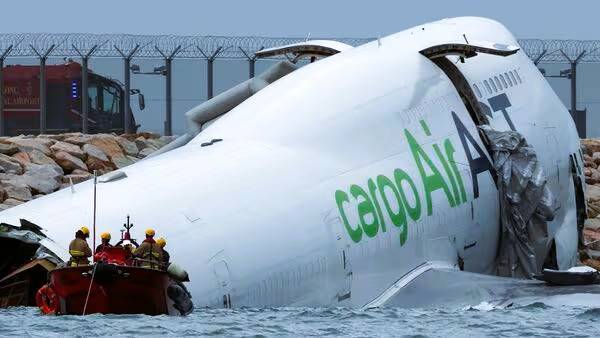
#Dubai cargo plane crash in Hong Kong/sbkinews.in
In a devastating accident early Monday morning, a cargo plane arriving from Dubai skidded off the runway at Hong Kong International Airport and plunged into the sea, resulting in two confirmed fatalities. The incident occurred at approximately 3:50 am local time, shaking the aviation community and highlighting the critical challenges of airport safety near busy maritime surroundings.
The aircraft, part of a Dubai-based cargo fleet, was on a routine flight to Hong Kong, one of the world’s busiest logistics hubs. Eyewitnesses report that the plane appeared to lose control during the final moments of landing, veering off the paved runway and into the adjacent waters before emergency crews could intervene.
Immediate Response and Rescue Efforts
Authorities promptly dispatched rescue and recovery teams to the crash site, battling rough early morning conditions. Despite their swift actions, two crew members were tragically confirmed dead, with several others feared injured but still pending official reports. The identities of the deceased have not yet been released, pending next-of-kin notifications.
The airport’s emergency services coordinated efforts with maritime rescue units due to the plane’s partial submersion in the sea. The affected runway was temporarily closed, leading to significant flight delays and diversions as safety investigations kicked off.
#Dubai cargo plane crash in Hong Kong/sbkinews.in
Hong Kong International Airport: A Critical Global Cargo Hub
Hong Kong International Airport (HKIA) stands as one of the busiest and most important cargo airports in the world. In 2024 and 2025, it consistently handled nearly 5 million tonnes of air freight annually, serving as a key nexus for goods flowing between Asia, the Middle East, Europe, and the Americas.
The airport’s strategic location and state-of-the-art facilities have earned it international accolades, including the “Airport of the Year – Major Cargo Hub” award at the 2025 World Air Cargo Awards. Despite these accolades, the tight proximity of the runway to water coupled with intense flight traffic presents ongoing challenges for operational safety.
HKIA processed over 56 million passengers and more than 379,000 flight movements on a rolling 12-month basis leading up to 2025, reflecting its status as a global transportation hub. Cargo volumes, bolstered by transshipments, grew 7.8% year-on-year to nearly 5 million tonnes.
#Dubai cargo plane crash in Hong Kong/sbkinews.in
Investigative Efforts and Aviation Safety Protocols
In the accident’s aftermath, the Civil Aviation Department of Hong Kong has launched a comprehensive investigation in coordination with international safety authorities and the airline operator. The primary objective is to establish the precise cause of the runway excursion, examining factors such as weather conditions, mechanical integrity, pilot actions, and air traffic control protocols.
Preliminary analysis will rely heavily on flight data recorders (black boxes), cockpit voice recordings, and radar surveillance logs. Experts stress that runway overruns and excursions often result from a combination of factors including adverse weather, pilot misjudgment, or mechanical failure, underscoring the importance of layered safety measures.
Industry analysts underscore the ongoing global need to enhance runway safety zones and implement advanced landing assistance technologies such as radio altimeters, runway status lights, and automated braking systems to reduce similar accidents.
#Dubai cargo plane crash in Hong Kong/sbkinews.in
Emotional Impact and Broader Implications
The human toll of this tragedy has reverberated beyond the aviation sector. Family members of the victims face immense loss, while airport staff and first responders grapple with the trauma of the crash site. Local communities expressed shock and sorrow, with condolences pouring in via social media and official statements.
The incident raises renewed concerns about the safety of cargo flights in an era of expanding global trade. Cargo flights, which operate on tightly scheduled routes often during nighttime or early-morning hours, face heightened risks due to visibility and fatigue factors.
Hong Kong International Airport plays an indispensable role in global logistics, with goods ranging from perishable pharmaceuticals to electronics passing through its terminals daily. Hence, maintaining rigorous safety standards is vital not only for human lives but also for global commerce continuity.
#Dubai cargo plane crash in Hong Kong/sbkinews.in
Key Facts and Statistics About HKIA and the Incident
The incident occurred at 3:50 am on Monday, involving a Dubai cargo aircraft skidding off the runway into sea.
Two crew members died; rescue efforts were hampered by sea conditions.
HKIA handles approximately 5 million tonnes of cargo annually, making it the world’s busiest cargo airport.
The airport serves over 56 million passengers annually and operates nearly 380,000 annual flights.
Cargo movements grew by 7.8% year-on-year as of 2025.
The investigation will assess weather, technical, and human factors contributing to the accident.
According to a detailed LiveMint report, the cargo aircraft, operated by AirACT for Emirates.
Visit our dedicated world news section on sbkinews.in.