#India-US Defence Pact#Delhi and Washington News/sbkinews.in
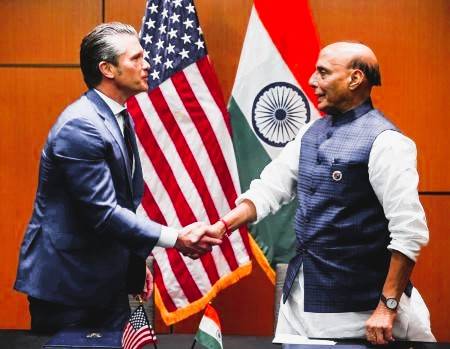
New Delhi: In a historic move symbolizing deepening strategic ties, India and the United States have signed a landmark 10-year Defence Framework Agreement to boost their military cooperation, joint defence production, and regional security. The signing took place in Kuala Lumpur on Friday during the 12th ASEAN Defence Ministers’ Meeting-Plus (ADMM-Plus), attended by Indian Defence Minister Rajnath Singh and US Defence Secretary Pete Hegseth.
Rajnath Singh hailed the pact as “the beginning of a new era of defence partnership,” emphasizing that the long-term framework will redefine collaboration between the two nations in defence technology, intelligence sharing, and industrial innovation. He stated that the new framework aims to enhance interoperability and stability in a rapidly evolving global security environment.
The new agreement replaces the earlier 2015 defence framework, which expired this year. It embodies the shared ambition of Delhi and Washington to deepen cooperation in cutting-edge defence technologies, including aerospace innovation, intelligence exchange, and maritime security. The pact also signals India’s growing role in regional and global defence networks, particularly within the Indo-Pacific region.
Strengthening Bilateral Ties and Strategic Convergence
Defence Minister Rajnath Singh underscored the importance of the agreement, describing it as “a sign of strategic convergence” between the two world’s leading democracies. He explained that this 10-year roadmap would provide a structured mechanism for cooperation across defence production, research, and policy.
US Defence Secretary Pete Hegseth echoed similar sentiments, calling the agreement “a foundation for regional stability and deterrence.” Highlighting the depth of India-US cooperation, Hegseth said that bilateral defence relations are now “at their strongest level ever.” He added that greater coordination in information-sharing, technical collaboration, and capability-building would define the next phase of this partnership.
Hegseth noted that Washington remains committed to working closely with New Delhi to uphold freedom of navigation and a rules-based order in the Indo-Pacific. The shared vision, he said, extends beyond defence into technology partnerships and resilience against emergent security challenges in the region.
Focus on Joint Production and Defence Innovation
One of the critical components discussed during the high-level talks was the joint production of the F414 jet engine between India’s Hindustan Aeronautics Limited (HAL) and the US aerospace giant GE Aerospace. The collaboration aims to enhance India’s domestic manufacturing capacities under the ‘Make in India’ initiative while integrating advanced US technology into indigenous platforms.
The Defence Framework also seeks to expand cooperation in cybersecurity, artificial intelligence in defence systems, and maritime awareness. Both leaders stressed the importance of aligning industrial policies to support startups, innovation hubs, and cross-border partnerships in defence manufacturing.
Indo-Pacific Commitment and Regional Focus
Rajnath Singh reaffirmed India’s commitment to maintaining a “free, open, and rules-based Indo-Pacific region.” The defence partnership framework will act as a key instrument in bolstering maritime security architecture and promoting trust-based collaboration among ASEAN partners.
During the Kuala Lumpur meeting, Rajnath Singh also held bilateral discussions with Malaysian Defence Minister Mohd Khalid Nardin and Singaporean Defence Minister Chan Chun Sing. The talks focused on expanding defence cooperation, regional peace, and strengthening joint exercises among friendly nations in the Indo-Pacific.
Defence experts observe that the updated framework offers a blueprint to navigate future challenges through joint training, intelligence sharing, and technology transfer. They believe it sets the tone for a more dynamic strategic partnership designed to promote stability at both regional and global levels.
Looking Ahead: A Decade of Defence Progress
As both nations embark on this 10-year journey, the focus remains on transforming shared democratic values into a resilient and forward-looking defence partnership. The agreement highlights mutual recognition of India’s growing defence capabilities and the US’s willingness to support its modernization goals.
Analysts view the framework as a significant step aligning with India’s goal of achieving self-reliance in critical defence technologies. It represents a long-term commitment from both sides to strengthen supply chain resilience, intelligence partnerships, and defence infrastructure investment.
In an era of shifting geopolitical balances, the India-US defence partnership positions both nations as vital pillars of peace and security in the Indo-Pacific. The agreement’s enduring vision ensures continuity in collaboration and sets the stage for a decade of innovation, trust, and shared prosperity.
Rajnath Singh’s strong diplomatic engagements in Kuala Lumpur, particularly his meetings with regional counterparts, signal India’s proactive role in shaping a stable and transparent security order. With this renewed momentum, experts believe the India-US defence partnership will redefine the next chapter of global strategic cooperation.
For more detailed coverage on the India-US 10-year defence agreement and its geopolitical implications, readers can refer to the comprehensive report by Hindustan Times here.
For the latest updates and detailed news from Delhi, visit our dedicated Delhi News section.