#elderly population 2036 projection#elderly population 2036 projection#elderly population 2036 projection
Elderly Population/Sbkinews.in
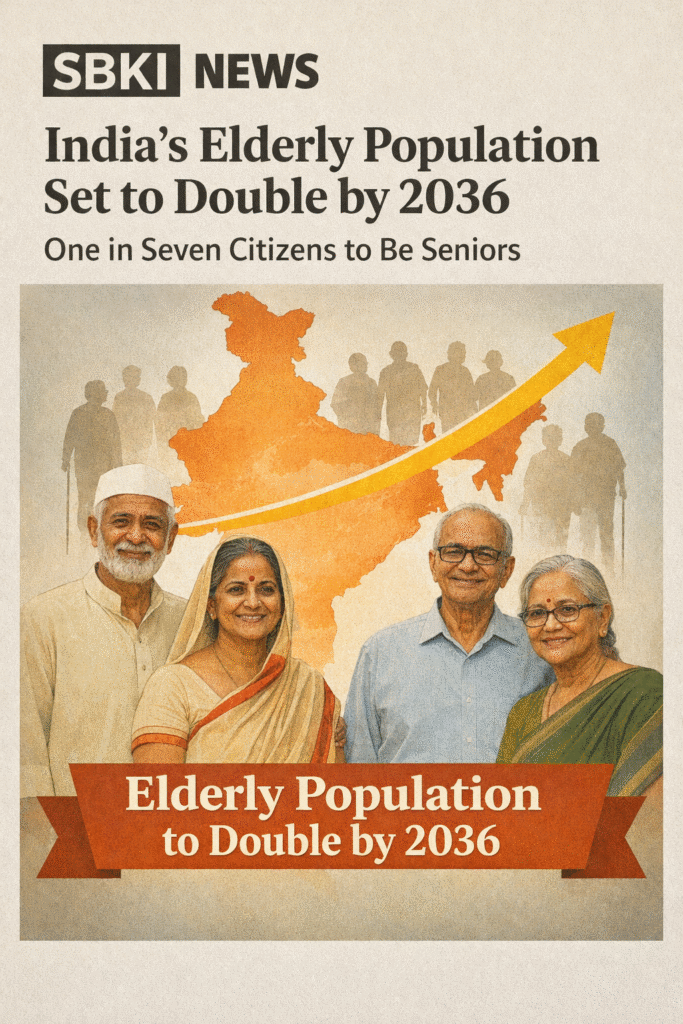
India’s population is ageing rapidly, and official projections show that by 2036 every seventh Indian will be a senior citizen aged 60 years or above. This demographic shift is expected to touch nearly 22.74 crore elderly people, posing major challenges for the country’s health system, social security net, economy and digital inclusion.
Senior population set to double by 2036
Answering a question by Congress MP Gautham Sigamani (name can be localized to your edition), Minister of State for Home Affairs Nityanand Rai referred to projections prepared by the Technical Group on Population Projections set up by the National Commission on Population. According to these estimates, India’s elderly population (60+) is likely to grow from 10.16 crore in 2011 to about 22.74 crore by 2036. In the same period, the share of senior citizens in the total population is expected to rise from 8.4% to around 14.9%, meaning that one in every seven Indians could be a senior citizen by 2036.
The overall population of India is projected to reach around 153 crore by 2036. An ageing curve of this scale will fundamentally change the country’s demographic profile, which for decades has been defined by a “youth bulge”. The rapid increase in the elderly population will require governments to rethink priorities in healthcare, pensions, housing and urban planning to ensure that seniors are not left behind.
Health, social and economic challenges
Experts point out that a higher share of older people will inevitably increase the burden of non‑communicable diseases such as diabetes, hypertension, heart problems, cancers and age‑related disabilities. Public hospitals and primary health centres will need more geriatric departments, long‑term care facilities and trained caregivers who can handle chronic, multi‑morbidity cases. The stress on the healthcare system will also mean higher public expenditure and sharper focus on preventive care, early diagnosis and home‑based services.
Beyond medical needs, the rise in elderly numbers raises serious questions about social security and economic dependence. A large section of India’s seniors still works in the informal sector without any formal pension or provident fund. As they age, many will depend heavily on family support or state schemes for survival. Policymakers warn that without adequate pensions, insurance coverage and targeted welfare programmes, millions of elderly could face income insecurity, social isolation and greater vulnerability to exploitation or neglect.
Digital divide and inclusion concerns
The ageing trend also intersects with India’s rapid digitalisation. From banking and welfare transfers to health records, most essential services are moving online. However, many senior citizens struggle with smartphones, apps and biometric‑based systems, which can exclude them from benefits meant for them. With more than 22 crore elderly projected by 2036, closing the digital divide will become a critical governance challenge.
Digital literacy campaigns tailored for older adults, age‑friendly user interfaces, multilingual helplines and assisted service centres at panchayat and ward levels will be essential. Without such measures, senior citizens may become dependent on middlemen or younger relatives to access basic services, undermining both their autonomy and privacy.Danic Jagran
Atal Vayo Abhyuday Yojana: Government response
To respond to these emerging needs, the Ministry of Social Justice and Empowerment implemented the Atal Vayo Abhyuday Yojana (AVYAY) from 1 April 2021. The scheme aims to improve the quality of life of senior citizens by ensuring a basic package of services that includes shelter, food, medical care and opportunities for recreation and social engagement. Under AVYAY, the Centre supports old‑age homes, day‑care centres, continuous healthcare facilities and helplines dedicated to senior citizens, in partnership with state governments and civil‑society organisations.
The objective is not only to provide safety nets for vulnerable elderly but also to promote “active and productive ageing”. By encouraging seniors to stay engaged in community work, skill sharing and part‑time economic activities, the government wants to reduce the sense of dependence and isolation that often accompanies old age. Officials emphasise that as life expectancy rises, policies must treat older persons as assets with experience and knowledge, rather than purely as a welfare burden.
Policy directions and advisory bodies
To coordinate policy efforts, the government has also constituted the National Council for Senior Citizens. Chaired by the Union Minister for Social Justice and Empowerment, the council includes experts and representatives from different sectors who advise on issues such as healthcare, housing, social protection, legal safeguards and senior‑friendly infrastructure. Their recommendations are expected to inform revisions to schemes, the implementation of the Maintenance and Welfare of Parents and Senior Citizens Act, and the framing of age‑sensitive urban and transport policies.
In parallel, several states are drafting or updating their own policies for older persons, focusing on subsidised public transport, concessions in utilities, age‑friendly public spaces and community‑based care models. Analysts say timely implementation and adequate funding will be key, as the window to prepare for the demographic transition is shrinking rapidly.
Looking ahead: 2050 and beyond
The transformation will not end in 2036. Earlier estimates cited by the government and NITI Aayog indicate that by 2050, around 19.5% of India’s total population could be senior citizens—nearly double the present proportion. If these projections hold, every fifth Indian may be an older person by mid‑century, a scenario that will bring India closer to ageing societies in East Asia and Europe.
Demographers argue that India must use the remaining years of its demographic dividend to invest in robust pension systems, universal health coverage, long‑term care infrastructure and inclusive digital public platforms. Families, too, will have to adapt to smaller household sizes and longer life spans, with a greater emphasis on caregiving support and community networks. For policymakers, the message is clear: preparing for an older India is no longer a distant concern but an urgent national priority.
#Elderly Population#Elderly Population#Elderly Population#Elderly Population
Stay updated with SBKI News – Your trusted source for India breaking stories 24/7!