
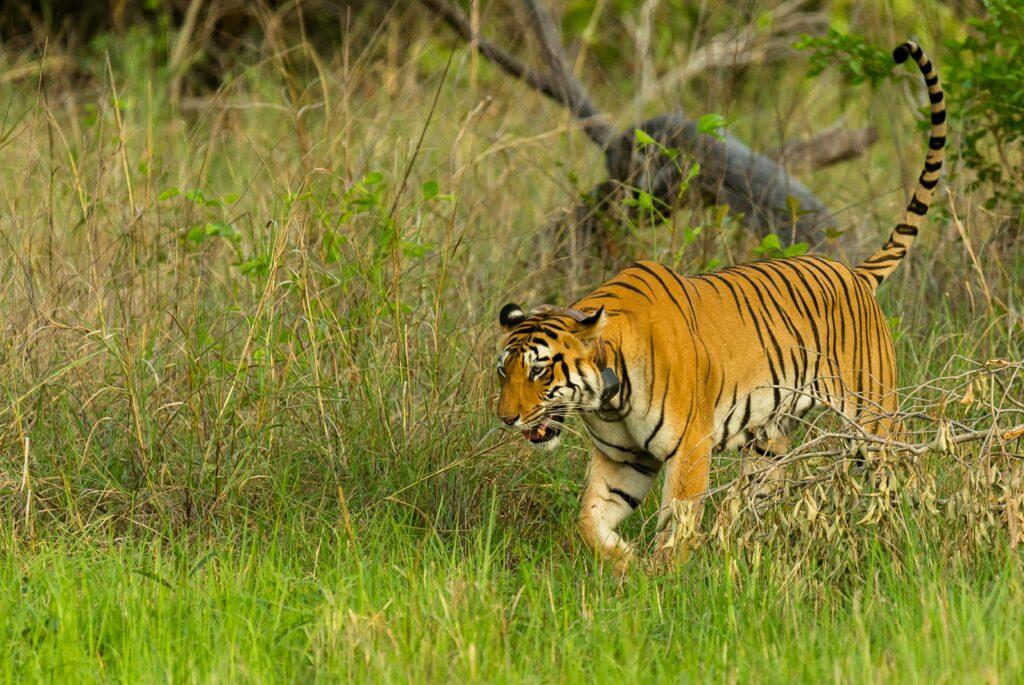
A landmark wildlife operation has seen tigress PN-224 relocated from Madhya Pradesh’s Pench Tiger Reserve to Rajasthan’s Ramgarh Vishdhari Tiger Reserve using an Indian Air Force MI-17 helicopter, marking a major step for tiger conservation and genetic diversity in India. The three-year-old tigress had been giving tracking teams the slip for nearly 24 days before she was finally darted, medically assessed, and moved under a tightly coordinated inter-state plan.
Capture after 24-day search
Forest officials in Pench relied on AI-enabled camera traps, motion-sensor cameras and intensive ground patrols to monitor PN-224’s movement in dense forest terrain. Around 50 personnel from the Kurai and Rukhad ranges patrolled the area daily from morning to evening, gradually narrowing down the tigress’s location before the capture team moved in.
On the day of the operation, trained elephants were deployed to gently herd the tigress into a safe zone so veterinarians could fire a tranquiliser dart under controlled conditions. Once sedated, PN-224 underwent a thorough health check, with her temperature, heartbeat and respiration recorded as normal before clearance was granted for air transfer.
Airlift in Indian Air Force MI-17
After vet clearance, PN-224 was loaded into a specially designed cage and moved by rescue vehicle to Sukatra airstrip in Seoni district, where an Indian Air Force MI-17 helicopter was stationed. The chopper took off at around late afternoon, flying roughly two and a half hours before its first halt at Jaipur in view of security and operational requirements.
From Jaipur, the tigress continued her journey by road under heavy security to Ramgarh Vishdhari Tiger Reserve in Bundi district, arriving in the early hours of Monday. Officials said this is the first time a tigress from Pench has been relocated to Rajasthan using an armed forces helicopter, showcasing high-level coordination between forest departments and defence authorities.
New home at Ramgarh Vishdhari
On arrival, PN-224 was released into the Bajalia acclimatisation enclosure, a secure one-hectare facility inside Ramgarh Vishdhari Tiger Reserve designed to help relocated big cats adjust to local terrain, climate and prey. Forest officials reported that the tigress has started responding well, displaying normal behaviour and gradually exploring her new surroundings.
Ramgarh Vishdhari currently hosts a small but growing tiger population, and authorities expect PN-224 to play a key role in strengthening the reserve’s genetic pool once she is released into the larger forest landscape. Until then, teams will continue round-the-clock monitoring using camera traps and direct observation to ensure her smooth acclimatisation.
Conservation goals and expert team
Pench Tiger Reserve deputy director Rajneesh Singh described the relocation as an “excellent example of scientific wildlife management and technical prowess,” highlighting that the move will boost tiger numbers in Rajasthan while improving genetic diversity across interconnected tiger habitats. Officials added that long-term plans include more such carefully evaluated translocations to stabilise tiger populations and reduce inbreeding in isolated reserves.
A multi-disciplinary expert team accompanied PN-224 during capture and transfer, including Pench wildlife veterinarian Dr Akhilesh Mishra, assistant director Gurleen Kaur, ranger Lokesh Pawar, Wildlife Conservation Trust vet Dr Prashant Deshmukh and senior forest officers from both states. Their responsibilities ranged from anaesthesia management and in-flight monitoring to overseeing unloading, transport by road and release into the enclosure.
Operation planning and ongoing monitoring
Authorities revealed that preparations for PN-224’s relocation had been underway for several weeks, with detailed protocols drawn up for safety, tranquillisation, transport and emergency response. Rajasthan’s senior forest officials, including the Chief Conservator of Forests and designated veterinarians, camped in Pench for days before the operation to coordinate on-ground logistics. For in-depth report read here.
Post-relocation, the tigress’s vital parameters continue to be checked regularly, and her health is reported to be stable. Officials emphasised that continuous monitoring and adaptive management will guide the next steps, including the timing of her eventual release from the enclosure into the wider Ramgarh Vishdhari landscape.
For more impactful updates from the state, follow our dedicated coverage here: Rajasthan News.