Jaipur: The Rajasthan government has launched a new digital communication platform, e-Swasthya Samvad, to improve governance, transparency, and coordination in the medical education department, officials announced on Sunday. Introduced under the direction of Chief Minister Bhajan Lal Sharma and Medical Education Minister Gajendra Singh Khimsar, the initiative aims to strengthen health services through technology-driven reforms.
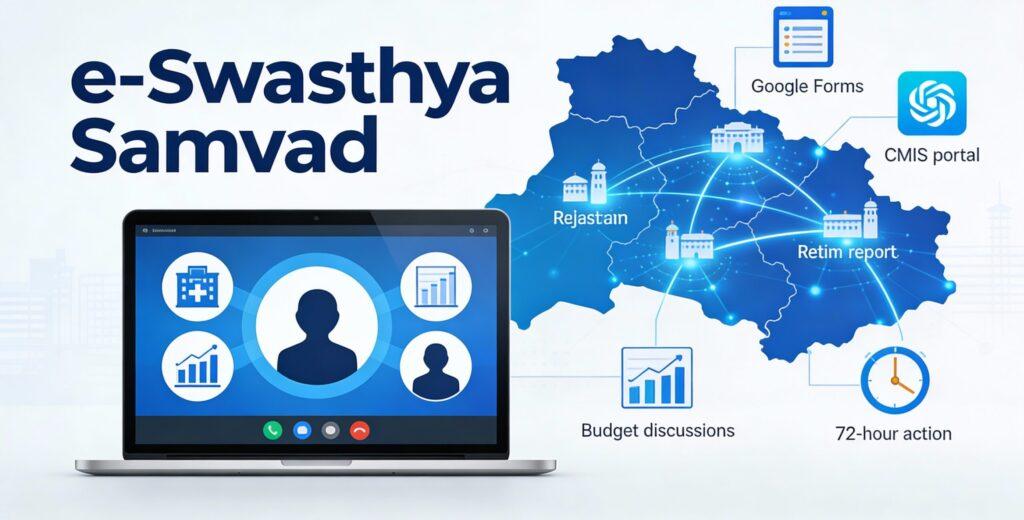
Medical Education Commissioner Naresh Goel announced that e-Swasthya Samvad will be conducted twice a week—every Tuesday and Thursday—through video conferencing. The platform will facilitate discussions on budget announcements, directives from the Chief Minister’s Office, grievance redressal through portals such as CMIS and CP-Grams, implementation of health schemes, infrastructure projects, procurement of equipment, and day-to-day operational issues of medical colleges.
Platform Structure and Participation
The meetings will occur in two phases: from 5 pm with heads of departments, followed by an open interaction with faculty members, doctors, superintendents, POs, nursing staff, students, and the public from 6 pm. Principal Secretary Medical Education Gayatri Rathore stated that the platform would function as a dedicated digital interface for connecting all stakeholders associated with medical education and health services, enabling faster decision-making and effective implementation of health programs.
Stakeholders can submit issues and suggestions in advance through a Google form, with participation prioritized during meetings. Decisions taken during the meetings will be recorded instantly, and concerned officials will be required to submit action taken reports within 72 hours, Goel said. This mechanism aims to ensure accountability, reduce delays, and strengthen coordination across all levels of the medical education system.
Objectives and Expected Impact
The e-Swasthya Samvad platform addresses longstanding challenges in medical education governance, including delayed grievance resolution, fragmented communication, and slow implementation of health initiatives. By centralizing discussions and mandating timely action reports, the government seeks to create a more responsive and efficient ecosystem for medical colleges, hospitals, and associated health services across Rajasthan.
Commissioner Goel emphasized that the platform will particularly focus on critical areas such as budget utilization, CMO directives, and operational bottlenecks in medical institutions. The twice-weekly schedule ensures regular oversight, while the public participation phase from 6 pm democratizes access, allowing students, nursing staff, and citizens to voice concerns directly.
Technology-Driven Health Reforms
This launch aligns with Rajasthan’s broader push for digital governance in healthcare, building on existing portals like CMIS and CP-Grams for grievance redressal. The video conferencing format eliminates geographical barriers, enabling real-time engagement with stakeholders from remote medical colleges and district hospitals. Rathore highlighted its role in fostering effective implementation of health schemes and infrastructure projects, which have often faced delays due to coordination gaps.
The Google form for advance submissions streamlines the process, ensuring meetings remain focused and productive. Instant recording of decisions and the 72-hour action report deadline introduce strict accountability measures, a first for Rajasthan’s medical education sector.
Stakeholder Engagement and Accountability
Participation guidelines mandate departmental heads in the first phase at 5 pm, followed by broader stakeholder interaction. This structured approach ensures hierarchical oversight while incorporating ground-level feedback from doctors, faculty, and students. Goel noted that the platform will reduce bureaucratic delays and enhance transparency by making action reports publicly trackable.
The initiative reflects Chief Minister Sharma’s vision for technology-enabled governance, positioning Rajasthan as a leader in health sector reforms. Minister Khimsar’s involvement underscores the government’s commitment to elevating medical education standards statewide.
Broader Implications for Health Services
e-Swasthya Samvad is expected to accelerate procurement processes, infrastructure development, and scheme implementation, directly benefiting patients and medical professionals. By addressing day-to-day issues promptly, it could improve service delivery in Rajasthan’s 40+ medical colleges and hundreds of associated hospitals. For in-depth report read here.
Experts view this as a scalable model for other states, demonstrating how digital platforms can bridge gaps in large-scale public health systems. The government’s focus on accountability through timed reporting sets a new benchmark for administrative efficiency.
For the latest updates on Rajasthan government initiatives and health reforms, visit our Rajasthan News section.