
#Tensions in Bangladesh#Tensions in Bangladesh#Tensions in Bangladesh#Tensions in Bangladesh#Tensions in Bangladesh
Tensions in Bangladesh/SBKINEWS.IN
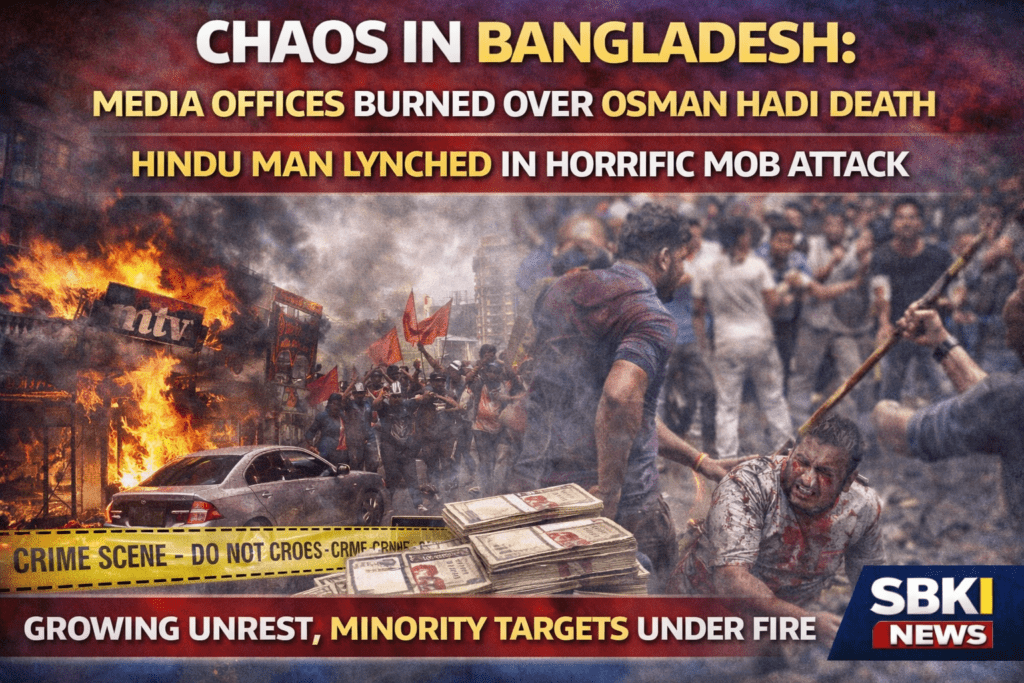
Bangladesh has been on edge after a Hindu youth was lynched over alleged blasphemy and a prominent student leader was assassinated in a separate incident, triggering days of communal violence and political tension. In a bid to restore order and signal accountability, the interim government has announced the arrest of 10 suspects in the lynching case and laid the slain leader to rest with full state honours under tight security. Together, the two cases highlight how religious fault lines and election‑season politics can combine to push the country towards instability if not handled firmly and transparently.
Ten arrested over lynching of Hindu youth
Interim government chief adviser Mohammad Yunus confirmed that police have arrested 10 accused in connection with the brutal killing of Dipu Chandra Das, a young Hindu man beaten to death by a mob over allegations of blasphemy. According to officials, Dipu was attacked on Friday after rumours spread that he had insulted religious sentiments, leading to a crowd assaulting him instead of handing him over to law enforcement. Despite efforts to rush him to hospital, he succumbed to his injuries, sparking outrage among minority rights groups and civil society.
The government has stated that more arrests are likely as investigators analyse video footage, social media posts and eyewitness testimonies to identify others who incited or joined the mob. Human‑rights advocates have pressed authorities to ensure that the case is tried swiftly in special courts and that those responsible for spreading hate speech and rumours are booked under stringent laws, not just for physical assault but also for abetting communal violence. Officials have promised a “zero‑tolerance” approach towards vigilantism carried out under the guise of defending faith.
Student leader Hadi buried with full state honours
Running parallel to the lynching case, the assassination of Sharif Usman Hadi, a prominent student leader and emerging political figure, has further inflamed tensions. Hadi was shot on 12 December in Dhaka’s Bijoynagar area while campaigning for the upcoming general election, in which he planned to contest the Dhaka‑8 seat as an independent candidate. He was airlifted to Singapore for treatment but died on Thursday, and his body was flown back to Dhaka for last rites.
On Saturday, Hadi was buried with full state honours amid massive security. The funeral procession drew a sea of supporters, students and sympathisers, turning the streets of Dhaka into a large, emotional gathering. Mohammad Yunus joined the janaza (funeral prayer), underlining the government’s acknowledgement of Hadi’s political and social influence. In accordance with his family’s wishes, Hadi was laid to rest beside the grave of national poet Kazi Nazrul Islam, a highly symbolic gesture that many supporters interpreted as recognition of his role in contemporary political activism. Time of India
Violence eases, but tensions remain high
Officials reported that the burial and the first wave of arrests have led to a slight easing of the communal violence that had flared across the country in recent days. Following Hadi’s killing and Dipu Chandra Das’s lynching, several districts witnessed arson, vandalism and targeted attacks. Among the most serious incidents were stone‑pelting at the residence of the Assistant Indian High Commissioner in Chattogram, attacks on offices of major newspapers, and damage to exhibits at the Bangabandhu Memorial Museum. These episodes raised concerns about diplomatic fallout and threats to free media.
Security forces have been deployed in sensitive areas, with additional patrols around minority localities, diplomatic premises and media houses. Curbs on gatherings, temporary restrictions on social media content that incites violence, and rapid‑response teams have all been part of the containment strategy. Authorities claim that the situation is now “largely under control”, though they admit that isolated incidents could still occur if political and religious leaders fail to appeal for calm.
‘Inquilab Manch’ threatens indefinite protest
Despite the state’s moves, Hadi’s own organisation, “Inquilab Manch”, has warned of an indefinite sit‑in protest if the masterminds behind his assassination are not arrested by Sunday evening. The group alleges that the killing was politically motivated and aimed at silencing a rising voice who challenged both mainstream parties and extremist outfits. Its leaders demand that an independent, time‑bound judicial inquiry be set up to probe possible involvement of powerful figures, rather than limiting action to the hired gunmen who pulled the trigger.
Analysts caution that if these demands are ignored or addressed only superficially, protests could intensify and merge with wider grievances about governance, economic hardship and minority insecurity. That risk is especially acute in the run‑up to national elections, when political rhetoric tends to harden and street mobilisation becomes more frequent. Ensuring a credible investigation and transparent communication about its progress may therefore be crucial to preventing further unrest.
Minority safety and rule of law under scrutiny
The lynching of a Hindu youth on allegations of blasphemy has once again put the spotlight on the safety of religious minorities in Bangladesh. Rights groups argue that mob violence in the name of religion has recurred too often, fueled by misinformation, inflammatory sermons and weak enforcement against previous offenders. They note that when perpetrators are seen to escape strict punishment, it emboldens others to take the law into their own hands.
In response, legal experts have renewed calls for better policing of hate speech, faster cyber‑crime responses to viral rumours, and community‑level early‑warning systems that can defuse tension before crowds gather. They also stress the need for political leaders across the spectrum to clearly denounce vigilante justice, rather than selectively condemning violence depending on the identity of victims or accused. Only a consistent, principled defence of rule of law, they argue, can rebuild trust among minorities who already feel vulnerable.
Political stakes for the interim government
For Mohammad Yunus and the interim administration, the twin crises represent a test of both governance and moral authority. Granting state honours at Hadi’s funeral and announcing multiple arrests in the lynching case are seen as efforts to signal decisiveness. Yet the ultimate measure of success will lie in whether the government can deliver impartial justice, prevent further attacks and shepherd the country safely through election season without allowing communal polarisation to spiral out of control.
If handled responsibly, the swift arrests and high‑profile funeral could mark a turning point, helping the country step back from the brink and reinforcing institutions of justice over street vengeance. If not, the deaths of Dipu Chandra Das and Sharif Usman Hadi may instead become rallying points for more polarised politics, deepening fault lines that have already cost too many lives.
SBKI News will continue to follow every development on this sensitive story, standing firmly for verified facts, communal harmony and justice for every affected family.