
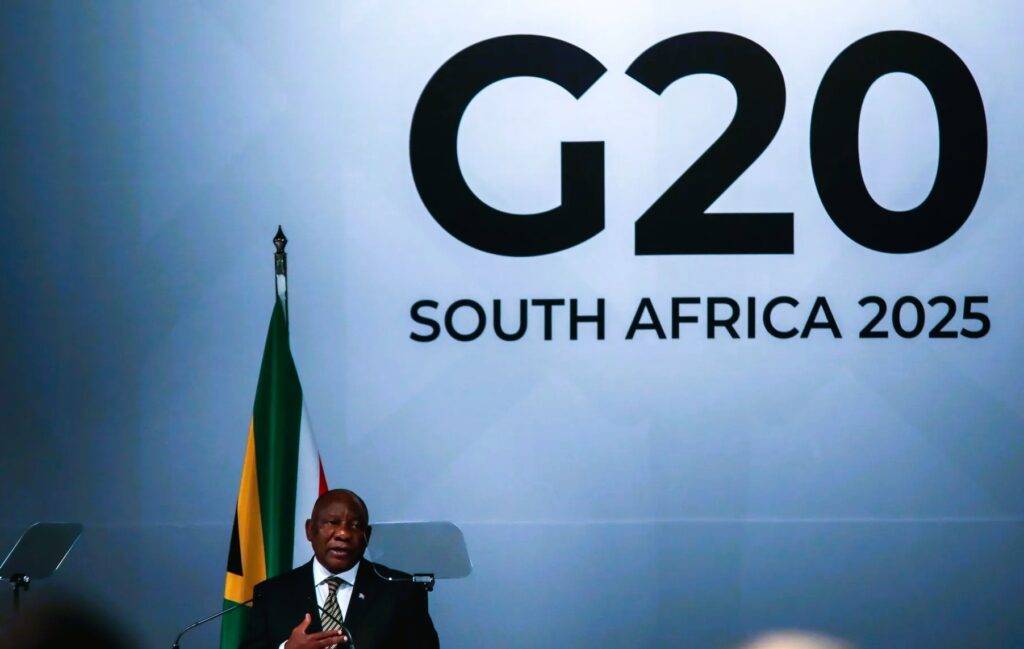
#Trump bold skips G-20 Summit#Global Implications/sbkinews.in
In a surprising geopolitical development, United States President Donald Trump announced he will not attend the upcoming G-20 summit scheduled in Johannesburg, South Africa, on November 22–23, 2025. This marks a significant diplomatic moment, as the G-20 remains one of the world’s leading economic forums, representing a majority of global GDP and trade. President Trump’s decision has raised questions about Washington’s current stance toward multilateral institutions and its broader international policy priorities.
Speaking to reporters at the White House in New York, President Trump said his administration is “reassessing the importance” of certain memberships that may no longer align with “America’s economic and security goals.” The statement came as a surprise to many officials, given the G-20’s role in stabilizing global economies and promoting coordinated responses to pressing issues like debt relief, trade imbalances, and climate transitions.
A Shift in U.S. Multilateral Policy
The Trump administration has often taken a critical approach toward multilateral organizations when it perceives them as unfair to U.S. interests. By skipping the Johannesburg summit, President Trump signaled a possible shift toward more selective engagement. Analysts believe the decision reflects a broader realignment of U.S. foreign policy toward bilateral agreements and regionally focused collaborations rather than larger global platforms.
According to political strategist Michael Adler, the U.S. may be testing how far it can distance itself from traditional global forums without disrupting trade partnerships. “The U.S. has been reassessing where its participation truly yields tangible national benefits,” Adler noted. “Skipping the G-20 might be symbolic, but it also represents a policy statement that aligns with Trump’s ‘America First’ doctrine.”
While Trump’s absence is expected to draw criticism from some allies, White House insiders suggest that senior administration officials, including Treasury Secretary Sarah Gibson and Commerce Secretary David Ross, could attend in his place. This would maintain a limited U.S. presence while reinforcing the President’s focus on domestic economic resurgence and strong bilateral deals.
South Africa’s Role as G-20 Host
South Africa took over the G-20 presidency on December 1, 2024. As host of the 2025 summit, it aims to spotlight issues of African economic inclusion, renewable energy investment, and the reform of international financial institutions. President Cyril Ramaphosa had extended a formal invitation to all G-20 leaders, emphasizing the summit’s theme: “Shared Growth, Shared Future.”
Trump’s decision not to participate has drawn mixed reactions across the continent. Some South African commentators described it as a diplomatic setback, while others interpreted it as an opportunity for emerging economies to assert stronger independence within global governance spaces.
“South Africa was hoping for robust engagement from Washington, especially concerning infrastructure investment and trade expansion between the U.S. and Africa,” said Dr. Naledi Kumalo, a Johannesburg-based economist. “The absence of the U.S. President could affect key announcements or agreements planned for the event.”
Global Reactions and Potential Economic Impact
Several world leaders have expressed disappointment at the U.S. decision, particularly within the European Union and the G7 bloc. French President Emmanuel Macron stated that consistent U.S. participation at global summits remains “vital for collective solutions.” Similarly, Japanese Prime Minister Fumio Kishida emphasized the importance of G-20 unity amid growing global economic uncertainty.
Market reactions have so far remained stable, though analysts warn that Trump’s move might introduce short-term speculation regarding trade policies. Investors are watching closely for any follow-up statements from the U.S. Treasury Department clarifying the administration’s commitment to ongoing global economic coordination.
Experts also highlight that Trump’s absence might shift the summit’s narrative toward strengthening South-South cooperation. Emerging markets such as India, Brazil, and Indonesia are expected to take leading roles in driving climate financing, digital trade frameworks, and inclusive growth agendas.
Domestic Context in the United States
Within the U.S., Trump’s decision has ignited political debate. Supporters of the administration argue that the President is right to prioritize domestic challenges such as manufacturing recovery, energy independence, and fiscal reforms over international summits, which they view as “symbolic gatherings with limited outcomes.” Critics, however, contend that the U.S. risks losing influence in global decision-making bodies by stepping back from the G-20.
Political analyst Karen Edwards remarked, “The G-20 is not just a talking shop—it’s where large-scale consensus can prevent future crises. Skipping it could signal isolationism at a time when collaboration is needed most.” She added that America’s economic interests are deeply connected to global markets, and absence from such venues may weaken future leverage.
Looking Ahead
As the Johannesburg summit approaches, the absence of the U.S. President will likely reshape the event’s dynamics. It could create space for other global powers to assert leadership on technology regulation, infrastructure development, and debt governance. Meanwhile, U.S. policy watchers anticipate that Trump may convene bilateral talks later this year to reaffirm the nation’s trade priorities with selected allies.
Whether this decision marks a temporary diplomatic adjustment or a longer-term strategic realignment remains to be seen. However, one thing is clear: President Trump’s choice not to attend the G-20 summit underscores a redefined vision of global engagement—one rooted in national interest, pragmatic diplomacy, and recalibrated cooperation.
For more comprehensive updates on global affairs and breaking international developments, visit our World News section, where you can stay informed about key geopolitical events and economic trends shaping the world today.