UGC Bill 2026
The University Grants Commission (UGC) notified the Promotion of Equity in Higher Education Institutions Regulations, 2026, on January 13, 2026, aiming to replace the 2012 anti-discrimination guidelines with stricter measures to combat caste-based and other forms of discrimination in colleges and universities. These rules mandate proactive steps for inclusion but have sparked nationwide protests and a Supreme Court stay, raising questions about fairness and implementation. As an SEO content writer with over six years of experience covering Indian education policy, this detailed coverage breaks down the key aspects for students, educators, and institutions.
#UGC Bill 2026
Core Equity Rules in UGC 2026 Bill
The 2026 regulations expand protections against discrimination based on caste, religion, gender, disability, race, place of birth, and more, covering both direct and indirect unfair treatment that affects equality or dignity. Key mandates include establishing an Equal Opportunity Centre (EOC) in every higher education institution (HEI) to handle complaints, provide academic, financial, and social support to marginalized students, and promote diversity.
Institutions must form a 10-member Equity Committee with representation from SC, ST, OBC, women, and persons with disabilities, meeting at least twice yearly to inquire into issues and submit bi-annual reports. Additional requirements feature round-the-clock helplines, Equity Squads or Ambassadors to monitor campuses, and appointment of an Equity Officer and Ombudsperson for oversight. Vice-chancellors, principals, and heads are personally accountable, with fixed timelines for complaint resolution to ensure faster action.
A novel inclusion extends explicit protections to Other Backward Classes (OBCs) alongside Scheduled Castes (SCs) and Scheduled Tribes (STs), responding to Supreme Court directions and past incidents like the deaths of Rohith Vemula and Dr. Payal Tadvi. Non-compliance invites penalties such as bans from UGC schemes, suspension of degree programs, grant withdrawals, or derecognition.
#UGC Bill 2026
Why the New Rules Spark Controversy
Protests erupted across India, from Delhi University to Banaras Hindu University and Allahabad University, with students chanting “UGC Roll Back” and accusing the rules of promoting division under the guise of equality. Critics from general category groups argue the regulations enable “reverse discrimination” by limiting caste-based protections primarily to SC, ST, and OBC, excluding unreserved categories from grievance mechanisms despite potential bias against them.
The vague definition of “caste-based discrimination” in Regulation 3(c) is seen as prone to misuse through malicious or false complaints, lacking safeguards or penalties for fabrications. Absence of general category representation in Equity Committees fuels claims of bias, while broad terms could stifle free speech or academic debate on campuses. Political backlash hit the BJP, with upper-caste supporters protesting what they call a “politically motivated black law,” leading to resignations among some officials.
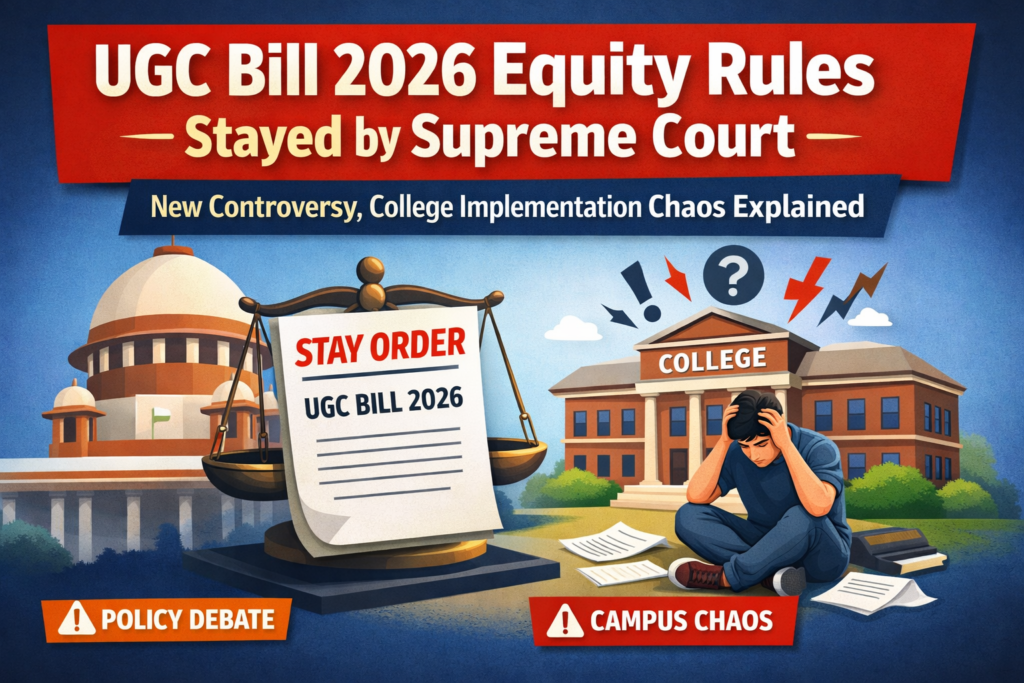
Three writ petitions challenged the rules’ constitutionality in the Supreme Court, alleging non-inclusionary definitions and potential for chaos. On January 28, 2026, a bench led by Chief Justice Surya Kant stayed the regulations till March 19, calling them “vague and misleading,” and reinstated the 2012 framework in the interim.
#UGC Bill 2026
Implementation Roadmap for Colleges
Colleges must submit annual compliance reports via a UGC portal, detailing complaints, actions, and EOC functioning, with a national UGC committee monitoring adherence and investigating serious cases. Heads of institutions bear direct responsibility, facing personal inquiries, financial penalties, or removal for failures.
Setup involves appointing an Equity Officer, forming committees with diverse members (including students), launching helplines, and training squads for proactive monitoring in vulnerable areas like hostels. UGC proposes special funds for EOCs and an independent oversight body for performance tracking, alongside regular audits. Smaller colleges may struggle with resources, prompting calls for graded implementation based on size.
Though stayed, preparations continue: institutions like those in Uttar Pradesh report early EOC formations amid protests. Experts recommend including more student reps from all categories and clear misuse penalties for smooth rollout.
#UGC Bill 2026
Broader Impact on Indian Higher Education
These rules, if revived, could transform campuses into safer spaces for marginalized students, boosting enrollment and retention from SC/ST/OBC groups. However, the stay highlights tensions in balancing equity with meritocracy, potentially delaying reforms amid ongoing litigation.
| Aspect | 2012 Regulations | 2026 Regulations (Stayed) |
|---|---|---|
| Scope | Advisory guidelines on SC/ST promotion | Binding on SC/ST/OBC; EOCs mandatory |
| Mechanisms | Basic cells | Equity Committees, Squads, Helplines |
| Penalties | Limited | Derecognition, grant cuts |
| Accountability | Institutional | Personal for heads |
| Monitoring | Minimal | National committee, portal |
For India’s 1,000+ universities and 40,000+ colleges, this saga underscores policy challenges in diverse societies. Stakeholders await the March 19 hearing, urging dialogue over division.
The University Grants Commission (UGC) notified the Promotion of Equity in Higher Education Institutions Regulations, 2026, on January 13, 2026, aiming to replace the 2012 anti-discrimination guidelines with stricter measures to combat caste-based and other forms of discrimination in colleges and universities. These rules mandate proactive steps for inclusion but have sparked nationwide protests and a Supreme Court stay, raising questions about fairness and implementation. As an SEO content writer with over six years of experience covering Indian education policy, this detailed coverage breaks down the key aspects for students, educators, and institutions.
#UGC Bill 2026
Core Equity Rules in UGC 2026 Bill
The 2026 regulations expand protections against discrimination based on caste, religion, gender, disability, race, place of birth, and more, covering both direct and indirect unfair treatment that affects equality or dignity. Key mandates include establishing an Equal Opportunity Centre (EOC) in every higher education institution (HEI) to handle complaints, provide academic, financial, and social support to marginalized students, and promote diversity.
Institutions must form a 10-member Equity Committee with representation from SC, ST, OBC, women, and persons with disabilities, meeting at least twice yearly to inquire into issues and submit bi-annual reports. Additional requirements feature round-the-clock helplines, Equity Squads or Ambassadors to monitor campuses, and appointment of an Equity Officer and Ombudsperson for oversight. Vice-chancellors, principals, and heads are personally accountable, with fixed timelines for complaint resolution to ensure faster action.
A novel inclusion extends explicit protections to Other Backward Classes (OBCs) alongside Scheduled Castes (SCs) and Scheduled Tribes (STs), responding to Supreme Court directions and past incidents like the deaths of Rohith Vemula and Dr. Payal Tadvi. Non-compliance invites penalties such as bans from UGC schemes, suspension of degree programs, grant withdrawals, or derecognition.
#UGC Bill 2026
Why the New Rules Spark Controversy
Protests erupted across India, from Delhi University to Banaras Hindu University and Allahabad University, with students chanting “UGC Roll Back” and accusing the rules of promoting division under the guise of equality. Critics from general category groups argue the regulations enable “reverse discrimination” by limiting caste-based protections primarily to SC, ST, and OBC, excluding unreserved categories from grievance mechanisms despite potential bias against them.
The vague definition of “caste-based discrimination” in Regulation 3(c) is seen as prone to misuse through malicious or false complaints, lacking safeguards or penalties for fabrications. Absence of general category representation in Equity Committees fuels claims of bias, while broad terms could stifle free speech or academic debate on campuses. Political backlash hit the BJP, with upper-caste supporters protesting what they call a “politically motivated black law,” leading to resignations among some officials.
Three writ petitions challenged the rules’ constitutionality in the Supreme Court, alleging non-inclusionary definitions and potential for chaos. On January 28, 2026, a bench led by Chief Justice Surya Kant stayed the regulations till March 19, calling them “vague and misleading,” and reinstated the 2012 framework in the interim.
#UGC Bill 2026
Implementation Roadmap for Colleges
Colleges must submit annual compliance reports via a UGC portal, detailing complaints, actions, and EOC functioning, with a national UGC committee monitoring adherence and investigating serious cases. Heads of institutions bear direct responsibility, facing personal inquiries, financial penalties, or removal for failures.
Setup involves appointing an Equity Officer, forming committees with diverse members (including students), launching helplines, and training squads for proactive monitoring in vulnerable areas like hostels. UGC proposes special funds for EOCs and an independent oversight body for performance tracking, alongside regular audits. Smaller colleges may struggle with resources, prompting calls for graded implementation based on size.
Though stayed, preparations continue: institutions like those in Uttar Pradesh report early EOC formations amid protests. Experts recommend including more student reps from all categories and clear misuse penalties for smooth rollout.
Broader Impact on Indian Higher Education
These rules, if revived, could transform campuses into safer spaces for marginalized students, boosting enrollment and retention from SC/ST/OBC groups. However, the stay highlights tensions in balancing equity with meritocracy, potentially delaying reforms amid ongoing litigation.
| Aspect | 2012 Regulations | 2026 Regulations (Stayed) |
|---|---|---|
| Scope | Advisory guidelines on SC/ST promotion | Binding on SC/ST/OBC; EOCs mandatory |
| Mechanisms | Basic cells | Equity Committees, Squads, Helplines |
| Penalties | Limited | Derecognition, grant cuts |
| Accountability | Institutional | Personal for heads |
| Monitoring | Minimal | National committee, portal |
For India’s 1,000+ universities and 40,000+ colleges, this saga underscores policy challenges in diverse societies. Stakeholders await the March 19 hearing, urging dialogue over division.Live law
Stay Informed, Stay Ahead – SBKI News: Your Trusted Source for India’s Breaking Stories