A secret investigation by the BBC shows that THQ Taunsa Hospital in Punjab is still doing unsafe things, even though the government has tried to stop them. This has infected hundreds of kids.
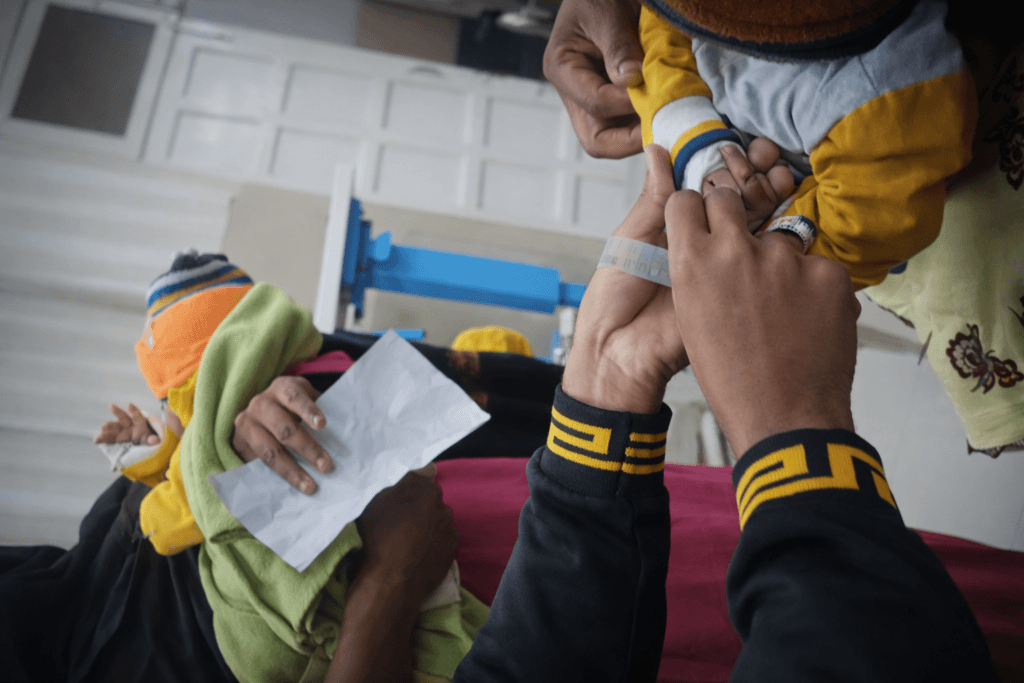
A family member holds a child in a hospital bed as another carer receives treatment, reflecting the fear and distress surrounding the HIV outbreak in Taunsa.
In a heartbreaking tragedy unfolding in Taunsa, Punjab province of Pakistan, at least 331 children tested positive for HIV between November 2024 and October 2025, largely linked to contaminated needles at the government-run THQ Taunsa Hospital. BBC Eye’s explosive undercover investigation, released in April 2026, revealed syringes being reused on medicine vials during 32 hours of secret filming in late 2025—months after authorities promised fixes. This scandal has shattered families, with young lives like 8-year-old Mohammed Amin lost to the virus after routine treatments turned fatal.
Yeh issue kaafi distressing hai, especially jab bachchon ki jaan daav par lag jaaye government hospital mein. The probe highlights how basic safety lapses continue, putting innocent kids at risk even today.
How and Why This Horror Unfolded
The outbreak traces back to unsafe injection practices at THQ Taunsa Hospital, where staff reused syringes on multi-dose vials 10 times, contaminating drugs that were then given to different children in four instances. Even with new needles attached, the syringe body retained the virus, as explained by Dr. Altaf Ahmed, Pakistan’s top infectious disease expert: “Even if they have attached a new needle, the back part, which we call the syringe body, has the virus in it, so it will transfer even with a new needle.”
Undercover footage showed 66 instances of injections without sterile gloves, nurses rummaging through waste bins bare-handed, and open syringes left on non-sterile counters—violating every protocol despite wall posters preaching safety. Systemic issues fuel this: Pakistan’s sky-high rate of unnecessary therapeutic injections (over 4.5 per person annually, among the world’s highest) strains supplies in quota-limited government hospitals, leading to corner-cutting.
Dr. Gul Qaisrani, the private clinic doctor who first spotted the surge in late 2024, noted nearly all 65-70 HIV-positive kids he saw had visited THQ Taunsa: “One mother told me her daughter was injected with the same syringe as a cousin living with HIV, then used on others.” A father challenged nurses on reuse but was ignored. Data from Punjab’s AIDS programme lists “contaminated needle” as the transmission mode for over half the 331 cases, with few mother-to-child links (only 4/97 mothers positive).
Also Read: Therapeutic Plasma Exchange Saves Lives of Poison Ingestion Victims at KGMU
Heart-Wrenching Quotes from the Frontlines
Mohammed Amin’s mother, Sughra, recalls her son’s agony: “His fevers were so bad that he insisted on sleeping in the rain, and he writhed in pain like he’d been thrown in hot oil.” His 10-year-old sister Asma, also infected, kneels at his grave: “He used to fight with me, but he also loved me… He’s with God now.” Asma, losing weight and shunned by neighbors due to stigma, asks her mother, “What is wrong with me?”
Dr. Fatima Mir, a pediatric professor at Aga Khan University, warns after viewing footage: “We must warn our injectors: ‘You have become an active instrument for passing disease.'” Hospital head Dr. Qasim Buzdar dismissed the evidence: “This footage could also be staged… Get your treatment done at THQ Taunsa.” Yeh denial bilkul shocking hai!
Timeline: Taunsa HIV Crisis Unfolds
Pakistan has a grim history of HIV outbreaks from syringe reuse. In 2019, Ratodero in Sindh saw over 1,353 infections (75% in kids under 15) after clinics gave multiple unnecessary injections—new cases persist even now. Recently, Karachi’s Kulsoom Bai Valika Hospital infected 84 children via reused syringes, confirmed by the federal health minister. THQ Taunsa’s crisis mirrors these, driven by cultural injection preferences and shortages.
Timeline:
Late 2024: Dr. Qaisrani notices HIV spike in kids treated at THQ Taunsa.
Nov 2024–Oct 2025: 331 children test positive; contaminated needles are cited in >50% of cases.
March 2025: Punjab suspends superintendent Dr. Tayyab Farooq Chandio; new boss Dr. Buzdar claims “zero tolerance.” He resumes work nearby soon after.
April 2025: The UNICEF/WHO report flags pediatric ER issues at THQ: reused IVs, no sanitizers.
Late 2025: BBC films ongoing violations.
April 2026: BBC exposes footage publicly.
April 2026: BBC releases a probe with real hidden-camera footage exposing ongoing violations (full article and video evidence: BBC Link; Credit: BBC).
Impact on Children and Healthcare
This isn’t just a hospital failure—it’s a public health catastrophe robbing children of futures, forcing lifelong antiretroviral treatment amid stigma and isolation. With Pakistan’s low overall HIV rate (0.1%), these iatrogenic outbreaks explode vulnerabilities in poor communities. Economically, it burdens strained systems; socially, it erodes trust in healthcare. Yeh bacchon ke liye lifetime ka dard hai, aur society ke liye bada sawaal.
The pediatric ward at THQ Taunsa, where undercover cameras caught nurses handling waste without gloves, mirroring issues in the leaked UNICEF report.
India Alert:
For us in India, yeh Pakistan ka crisis ek warning hai—especially border states jaise Uttar Pradesh mein, jahaan government hospitals mein bheed aur resources ki kami common hai. Similar injection overuse exists here too; remember past needle scandals? Indian parents, especially in rural areas, must demand disposable syringes and gloves. Cross-border health threats like HIV don’t respect lines, so bolna zaroori hai safe practices ke baare mein. Our UP health dept. should audit now to avoid a Taunsa repeat.
Expert Analysis
I’ve covered health scandals—this ranks among the worst for sheer negligence. The footage proves “crackdowns” were lip service; systemic fixes like injection quotas, mandatory training, and supply boosts are overdue. Power dynamics let staff ignore complaints, while cultural “injection love” (for even mild fevers) amplifies risks—doctors must push oral meds. Pakistan’s 800 million annual injections scream for WHO-level intervention. Logically, without accountability (like prosecuting reusers), outbreaks recur, as in Ratodero. Yeh tragedy SEO terms mein “preventable disaster” hai, but real mein bacchon ki zindagi barbaad.
What Next
Expect Punjab probes, possible superintendent sackings, and federal guideline enforcement post-BBC pressure. UNICEF/WHO may re-inspect; new screenings in Taunsa could reveal more cases. Long-term: injection bans for non-critical ills, glove mandates, and public campaigns. Asma and survivors need stigma-free ART access. If ignored, expect copycat outbreaks—Karachi-style. Positive note: Early ART keeps kids healthy, but prevention first.
Conclusion
The THQ Taunsa horror—331 kids HIV-positive from reused syringes—exposes deadly healthcare gaps in Pakistan, fueled by negligence persisting post-2025 promises. Families like Asma’s pay the price, but the global spotlight demands change: Train staff, stock supplies, and curb unnecessary jobs. Yeh sirf Pakistan ka nahi, har desh ka lesson hai—bacchon ki sehat pe koi compromise nahi. Stay vigilant, demand better.
Written by A. Aisha.