Unidentified miscreants allegedly hurled stones and heavy objects at the Delhi-Chennai Grand Trunk Express near the Singarayakonda-Ulavapadu stretch in Andhra Pradesh’s Prakasam district on Thursday night, seriously injuring a senior assistant loco pilot. The attack smashed the engine’s windshield, prompted an emergency stop and has led to a police and railway inquiry.
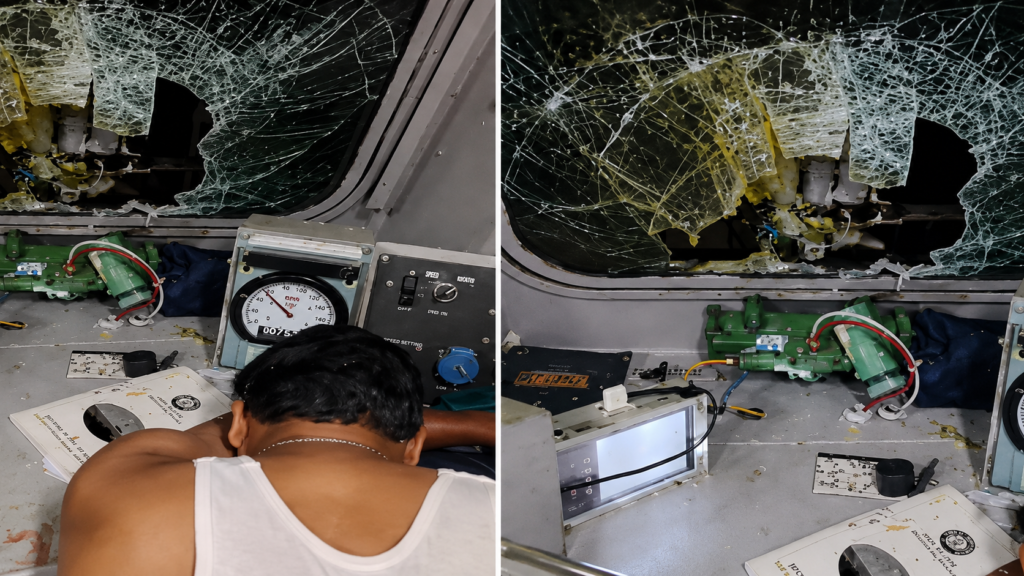
Shattered glass inside the engine cabin of the GT Express after stone pelting near Singarayakonda, with the injured loco pilot receiving emergency attention.
A dangerous stone-pelting incident on the Delhi-Chennai Grand Trunk Express has once again raised concerns about passenger and crew safety on Indian Railways. According to the information available, the train was targeted near the Singarayakonda–Ulavapadu stretch in Andhra Pradesh’s Prakasam district on Thursday night, leaving Senior Assistant Loco Pilot M. Jayaram seriously injured.
The objects allegedly struck the engine cabin, breaking the windshield and causing severe injuries to the on-duty crew member. Despite the attack, the loco pilots continued the journey long enough to stop the train at the nearest station in Ulavapadu, where Jayaram was first given treatment before being shifted to a hospital in Vijayawada. The incident is now under investigation by railway officials and local police. Yeh issue kaafi important hai because it involves not just vandalism but also the safety of train operations and the lives of railway staff and passengers.
What Happened
The incident reportedly took place when the Chennai-bound Grand Trunk Express was passing through the Singarayakonda-Ulavapadu stretch. Unidentified miscreants allegedly threw stones and heavy objects at the moving train, targeting the engine cabin. The force of the impact shattered the windshield and injured the senior assistant co-pilot seated inside. Deccan Chronicle has covered the full story.
What makes the case especially serious is that the attack happened while the train was in motion. That means the driver and crew had to manage the train under stress, injury, and broken visibility conditions. Even after the assault, the loco pilots did not immediately abandon the train. Instead, they continued until they reached Ulavapadu station, where the train was stopped safely.
This kind of quick but difficult response highlights the pressure train crew face in emergency situations. The injured pilot was rushed for treatment, and railway authorities later said he was stable. Still, the incident has left a serious question hanging over the route: how could such a dangerous attack happen on an active rail line?
Why the Attack Matters
Stone pelting on trains is never just a minor act of mischief. When a moving train is attacked, the consequences can be severe. A shattered windshield can injure the locomotive crew, impair the driver’s view, and create a chain reaction that puts hundreds of passengers at risk.
In this case, the loco pilot was seriously injured, but the outcome could have been worse. If the object had struck differently or if the windshield had failed more extensively, the train could have faced operational instability. Trains depend on precision and clear visibility, especially at higher speeds or in stretches where immediate braking is difficult. Even a momentary distraction can cause major risk.
The attack also raises the issue of how vulnerable railway assets remain in some parts of the country. Indian Railways is one of the largest transport systems in the world, and yet it still faces periodic incidents of stone pelting, theft, signal tampering, and vandalism. That is why each such case gets serious attention from officials.
Police and Railway Response
Railway authorities and local police have both launched investigations into the incident. Since no suspects have been identified yet, the inquiry will likely focus on the exact location of the attack, witness statements, available CCTV or route monitoring data, and any local intelligence about anti-social activity in the area.
The circulating video showing the injured loco pilot sitting inside the engine cabin with his head down and shattered glass around him has intensified public concern. Such visuals often trigger a strong response because they show how exposed railway staff are during attacks of this kind. The video also puts pressure on authorities to identify the offenders quickly.
Railway officials have said that Jayaram is stable and undergoing treatment. That is reassuring, but the focus will now shift to accountability. If the attackers are identified, police are likely to treat the matter seriously because this was not random damage to property alone; it was an assault that endangered a railway employee and potentially the train’s passengers as well.
Background and Context
This is not the first time Indian trains have been targeted by stone pelting or other forms of public mischief. Such incidents are often reported on suburban, semi-urban, and intercity routes where tracks pass through open areas or populated stretches. Sometimes the cause is hooliganism, sometimes it is imitative behavior, and sometimes it is an attempt to cause panic without understanding the danger involved.
The Singarayakonda–Ulavapadu stretch in the Prakasam district has now entered that wider pattern of concern. Railway corridors in India often run through mixed landscapes, which means security cannot rely only on station-level enforcement. Track-side vigilance, local monitoring, and community awareness matter just as much.
For railway staff, incidents like this are especially unsettling. Loco pilots are responsible for guiding long-distance trains under demanding conditions. If their cabin is attacked, the first burden is on them to protect the train, respond calmly, and keep the journey going. That is exactly why such attacks are treated as serious safety violations.
Timeline
Thursday night: The Delhi-Chennai Grand Trunk Express passes through the Singarayakonda-Ulavapadu stretch.
During the journey: Unidentified persons allegedly pelt stones and heavy objects at the engine cabin.
Immediately after impact: The windshield shatters, and Senior Assistant Loco Pilot M. Jayaram is seriously injured.
Soon after: The crew continues to Ulavapadu station and halts the train.
At the station: Jayaram is given initial treatment and later shifted to Vijayawada.
Following the incident: Railway officials and local police begin an investigation.
Also Read: Maharashtra Teen’s Speeding Car Hits Pedestrians in Jalgaon, 5 Injured in Hit-and-Run
Why This Matters
This matters because railway safety is public safety. A moving train carries not just passengers, but also the trust that people place in the system. When that trust is shaken by attacks on trains, it affects confidence in the entire network. Yeh issue kaafi important hai because the railway is one of India’s most widely used public transport systems, and even a single attack can create fear far beyond one district.
It also matters for the workforce. Loco pilots, guards, and onboard railway staff already work under pressure. If they have to worry about stone pelting or sudden attacks on the line, that adds another layer of risk to an already demanding job. Protecting them is not optional; it is part of maintaining safe rail operations.
The incident also reflects a broader social problem. In many places, stone pelting is treated as a prank or local nuisance, but when it happens to a train, it becomes a serious criminal and safety issue. Public awareness needs to improve so that people understand how dangerous such actions can be.
India Angle
The India angle here is very clear because this is a railway safety story affecting one of the country’s most important transport corridors. Millions of Indians travel by train every day, and incidents like this make commuters worry about what can happen on open tracks and remote stretches.
In Hinglish, seedhi baat yeh hai: train par pathar phenkna koi bachkana mazaak nahi hai. It can injure crew, damage public property, and put entire journeys at risk. Indian Railways serves towns, cities, and villages across the country, so every such case becomes a national concern, not just a local one.
This story will resonate strongly with Indian readers because train travel is such a central part of daily life. Many families, workers, and students depend on it. When one loco pilot is injured in an attack, it becomes a reminder that railway security must be taken seriously everywhere, not only in high-profile locations.
Analysis
My opinion is that this case should not be dismissed as isolated vandalism. The fact that heavy objects and stones were thrown at the engine cabin suggests a deliberate or at least highly reckless act. The injury to the loco pilot makes the danger undeniable. Authorities will need to investigate not just who did it, but how that stretch of track remained vulnerable enough for an attack to occur.
The key lesson here is that railway security is not just about preventing derailments or major terror threats; it is also about stopping smaller acts of violence that can still cause serious harm. In many cases, such “small” incidents are the warning signs of bigger enforcement gaps. If the offenders are caught and punished swiftly, it will send a needed message. If not, the problem may repeat.
What Next
The immediate next step is the police and railway investigation, which will likely focus on identifying the attackers and mapping the exact point from which the stones were thrown. Officials may also inspect whether there are vulnerable open patches along the route that need fencing, lighting, or patrolling.
Jayaram’s medical recovery will also remain a priority. Since authorities have said he is stable, the hope will be for a full recovery without long-term complications. But the psychological impact on the crew may linger longer than the physical injury.
If the investigation finds repeated stone-pelting risk in the area, Railways may ask for stronger preventive measures, including better track-side monitoring and coordination with local police. A serious response could also involve community-level awareness campaigns in nearby settlements.
Conclusion
The stone-pelting attack on the GT Express near Singarayakonda is a stark reminder of how quickly a train journey can turn dangerous. A loco pilot was seriously injured, the windshield shattered, and the crew had to manage an emergency while still bringing the train to safety. That alone shows how serious the incident was.
As police and railway authorities investigate, the larger message is clear: stone pelting on trains is not a prank, not a nuisance, and not something to ignore. It is a safety threat with real human consequences. Yeh issue kaafi important hai because the protection of railway staff and passengers must remain a top priority across India.
Written By A. Jack