Bhiwadi Labour Strike
Thousands of workers in Rajasthan’s Bhiwadi industrial area have gone on strike outside Relaxo India and Napino, demanding a minimum monthly wage of ₹20,000. Police and district officials have been deployed as talks continue to restore order.
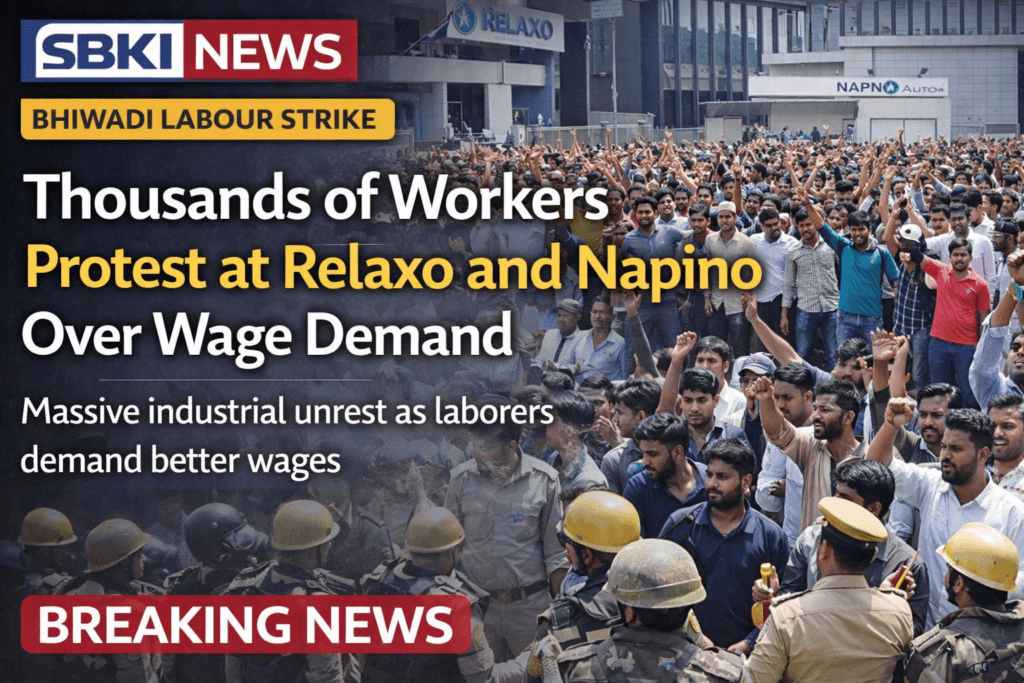
Workers stage a road blockade near Relaxo Chowk in Bhiwadi
In a fresh labour unrest in Rajasthan, thousands of workers in the Bhiwadi industrial hub of Alwar district came out on the roads on Thursday morning to protest against low wages. The employees of Relaxo India and Napino halted work and blocked traffic near Relaxo Chowk, turning the area tense and noisy with slogans and road jams.
The workers are demanding a minimum monthly salary of ₹20,000, saying their current pay is too low compared to the workload they handle every day. The protest comes soon after a similar dispute at the Motherson company, showing that wage anger is spreading across the industrial belt of Bhiwadi.
What Happened
According to reports from the ground, workers at both companies stopped work and gathered in large numbers near Relaxo Chowk, one of the busiest points in Bhiwadi. They blocked the road, raised slogans against company management, and insisted that no return to work will happen until their wage demand is addressed.
The protesting workers say they are being paid far less than what is fair for the amount of labour and overtime they do. Their main demand is simple: raise the minimum wage to ₹20,000 per month. The situation drew immediate attention from the police and district administration, who reached the spot to prevent further disruption and begin talks with worker representatives.
Why The Protest Started
The root of the protest appears to be long-standing dissatisfaction with wages, workload, and pay gaps between what workers expect and what they actually receive. In industrial hubs like Bhiwadi, many workers are employed in manufacturing units where the pace is fast, shifts are long, and the pressure is high. When salaries do not keep up with living costs, frustration often turns into collective protest.
The timing is also important. The unrest began after a similar wage-related protest at Motherson, which seems to have encouraged workers at other companies to step up their own demands. In other words, this is not an isolated event. It looks like a wider labour issue across Bhiwadi’s industrial zone.
Administration Response
As soon as the protest escalated, senior police officers and district officials reached the area. Heavy police deployment was placed near Relaxo Chowk and surrounding roads to stop the situation from worsening. Officials began holding discussions with labour representatives in an attempt to reopen traffic and calm the atmosphere.
This kind of response is standard in industrial labour disputes, especially when a road blockade affects both factory operations and public movement. Authorities usually try to balance two things at once: workers’ right to protest and the need to keep industrial and civic order stable.
Background And Context
Bhiwadi is one of Rajasthan’s biggest industrial hubs and has a large workforce employed in manufacturing and allied sectors. Because the area is heavily dependent on factory production, even a single major strike can affect supply chains, transport, and local business activity.
Labour disputes over wages are not new in this region. The recent unrest at Motherson and now at Relaxo and Napino suggests a growing sense of dissatisfaction among workers in the area. When multiple companies face similar complaints, it usually means the issue is not just about one employer but about broader wage expectations in the industrial belt.
A wage demand of ₹20,000 per month is also not surprising in today’s context, especially with rising household expenses, rent, food prices, and transport costs. Many workers feel their current earnings do not match the cost of living, which is why salary hikes become a major flashpoint.
Timeline
Recent days: Labour unrest was reported at Motherson in Bhiwadi.
Thursday morning: Workers at Relaxo India and Napino stopped work and gathered at Relaxo Chowk.
Soon after: Thousands of workers blocked the road and began chanting slogans.
Same day: Police and district officials arrived and started talks with worker representatives.
This timeline shows how quickly the issue spread from one factory dispute to another. It also shows that Bhiwadi’s labour environment is under pressure right now.
Also Read : Historic: HC Lawyer Leads 100m Dive in Lakshadweep
Reported Worker Concerns
Workers are saying that the wage structure is too low for the amount of work expected from them. They also claim that the workload has increased while earnings have not kept pace. In many factory settings, such complaints often become stronger when employees feel they have little room to negotiate individually.
A labour representative at the site could be expected to say something like, “We are not asking for anything unusual. We just want fair wages for the hard work we do every day.” That statement reflects the mood reported from the protest site, where workers appear determined to continue until there is a clear response.
Why This Matters
This protest matters because Bhiwadi is a major industrial engine for the region. If unrest continues, it can delay production, affect deliveries, and create uncertainty for companies operating in the area. That makes the issue important not only for workers but also for management, local administration, and the wider business ecosystem.
It also matters socially because wage disputes often reflect the real stress faced by industrial workers. When salaries are not enough to cover basic needs, protest becomes a way to demand dignity as well as money. For many families, even a small increase in monthly income can make a major difference. Yeh issue kaafi important hai because it connects directly with livelihood, inflation, and worker rights. news also cover by NDTV
Local Angle
For people in Rajasthan, especially in Alwar and nearby industrial towns, this is a very local and immediate issue. Bhiwadi is not just a factory zone; it is home to thousands of workers who support the region’s economy every day. If strikes continue, the impact can be felt in transport, shops, eateries, and service businesses around the industrial area.
The protests also send a message to other industrial hubs in India. When workers in one region push for wage correction, others often start asking similar questions about fairness and pay. In simple Hinglish, the mood is clear: “kaam zyada hai, to salary bhi sahi honi chahiye.” That kind of sentiment is becoming stronger in many labour-intensive sectors.
Analysis
This story is strong because it combines labour unrest, industrial action, wage demand, and a high-traffic location like Bhiwadi. Readers are likely searching for updates on “Bhiwadi labour strike,” “Relaxo protest,” and “Napino workers strike,” which makes the topic highly relevant for news search visibility.
The deeper story here is not just about one protest. It is about the pressure building inside industrial labour markets where workers want better pay and companies want cost control. If wage disputes begin to appear across multiple factories, managements may need to revisit compensation structures before the unrest becomes more widespread. My view is that this is a warning sign for the industrial belt: once workers see collective action working elsewhere, they are more likely to organise quickly.
What Next
The immediate next step is likely a round of talks between worker representatives, company officials, and district authorities. If those talks make progress, the road blockade may be lifted and work could resume. If not, the protest may continue or spread further within the industrial area.
There is also a possibility that the companies may offer some form of wage review, allowance increase, or future negotiation plan to calm the situation. Even a temporary assurance can sometimes reduce tension, but workers usually want a concrete timeline, not just verbal promises. The coming hours will be important because the next response from management could decide whether this remains a local strike or turns into a bigger labour movement in Bhiwadi.
Conclusion
The labour protest at Relaxo and Napino in Bhiwadi shows that wage dissatisfaction has reached a serious level in one of Rajasthan’s most important industrial hubs. Thousands of workers have demanded a minimum wage of ₹20,000, blocked roads, and forced the administration to step in quickly.
This is an important story because it reflects both economic pressure and worker frustration at the ground level. How the companies and authorities respond next will matter not just for this strike, but for labour relations across the region.
By – M.A. Arif