Cockroach Janta Party plans a Teachers’ Day march from India Gate to Delhi Police Headquarters, led by families of NEET-related suicide victims and people who allege police excesses during the July agitation.
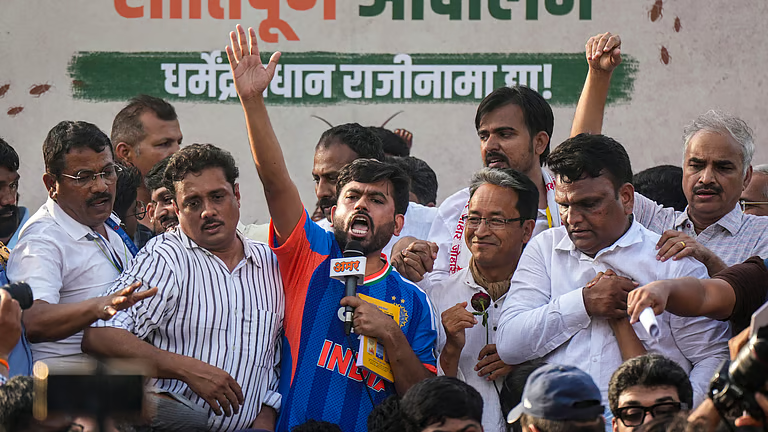
Supporters of the Cockroach Janta Party during an earlier education and examination-reform protest in New Delhi. Image Credit: New IndianExpress
The Cockroach Janta Party (CJP) has announced a fresh protest march in New Delhi on September 5, accusing the Centre of failing to implement commitments made on July 25 that led the organisation to suspend its 36-day agitation over alleged examination irregularities.
The march will begin at India Gate and proceed towards Delhi Police Headquarters on Jai Singh Marg, Connaught Place, the group said in a statement issued after a meeting of its National Working Committee on Monday.
The demonstration will be held on Teachers’ Day and will reportedly be led by families of students who died by suicide following the cancellation and retest of the NEET examination, along with people who allege that they were subjected to police excesses during the July protests.
The announcement comes about a month after the CJP suspended its agitation following talks with the Centre. The organisation now says its patience and willingness to negotiate have been mistaken for weakness.
Why the CJP Is Returning to the Streets
The CJP said it called off its nationwide agitation on July 25 after receiving assurances from the Centre on several demands. These reportedly included:
Compensation for families of NEET aspirants who died by suicide
Withdrawal of FIRs registered against students and protesters
Protection from punitive action linked to the agitation
Further discussions on broader examination reforms
The organisation says the promised action has not been implemented within the agreed timeframe. It alleges that the government has delayed decisions, cited technicalities and failed to provide the written assurance it had promised. This story was also covered by The NewIndianExpress.
The CJP also claims that the Centre has not clearly committed to withdrawing FIRs against protesters. The issue had reached the Supreme Court, where the group reportedly accused the government of resisting efforts to facilitate the quashing of cases against students and demonstrators.
“Our patience cannot be mistaken for weakness. Our good faith cannot become an opportunity for the government to betray the young people of this country,” the CJP said in its statement.
Details of the September 5 March
The protest will start at India Gate and move towards Delhi Police Headquarters in the Connaught Place area.
The CJP has described the event as peaceful and has appealed to students, youth organisations and student bodies from across the country to participate.
Families of NEET aspirants who died by suicide are expected to lead the march. The group also plans to include people who were allegedly injured, detained or otherwise affected by police action during the July agitation.
The planned route and size of the march are likely to require coordination with Delhi Police. Authorities may impose traffic restrictions, regulate movement around India Gate and Connaught Place, and establish barricades near the police headquarters.
Permission for the march, the final route and conditions governing the demonstration will be important factors in determining how the event unfolds.
The CJP’s 36-Day Agitation
The CJP’s agitation began at Jantar Mantar on June 20 over alleged irregularities in the examination system and the NEET paper-leak controversy.
The protest later spread to other parts of the country and became a national youth mobilisation focused on examination transparency, paper leaks, student welfare and accountability in the education system.
The 36-day agitation ended on July 25 after talks with the Centre. CJP representatives Saurav Das and Ashutosh Ranka announced the withdrawal at a joint press conference with Union ministers J.P. Nadda and Jitendra Singh.
The CJP said it was ending the agitation in “good faith”, on the understanding that the agreed commitments would be implemented within the stipulated timeline.
A major political development accompanied the settlement: Dharmendra Pradhan resigned as Union Education Minister.
The CJP now argues that the withdrawal was conditional on follow-up action, especially on FIRs, compensation and institutional reforms. The Centre’s position on the group’s allegations remains central to the next phase of the dispute.
The FIR and Compensation Dispute
The withdrawal of cases against protesters is one of the most contentious issues.
The CJP says many students and demonstrators continue to face legal action linked to the July agitation. It wants the FIRs withdrawn or quashed and has accused the government of delaying the process.
The group also seeks compensation for families of NEET aspirants who died by suicide after the cancellation and retest of the examination.
The government may need to distinguish between cases involving peaceful protesters and cases involving alleged violence, damage to public property or other criminal offences. That could make a blanket withdrawal of all FIRs legally and administratively difficult.
The CJP’s position, however, is that students were subjected to excessive police action and should not face prolonged legal consequences for participating in the agitation.
This dispute could determine whether the September 5 march remains a single-day demonstration or becomes the beginning of another prolonged protest.
Statements From the CJP
The CJP accused the Centre of “delayed action, hidden behind technicalities and avoided giving clear commitments.”
The organisation also said that the written assurance promised during the July settlement had not been delivered.
CJP representatives are expected to raise the following demands during the September 5 march:
Withdrawal of FIRs against students and protesters
Compensation for affected NEET families
Action against officials accused of mishandling examinations
Protection for students from alleged police retaliation
A written and time-bound commitment to education reforms
Accountability for alleged police excesses during the July agitation
The group’s rhetoric has become sharper as the deadline for implementing the July commitments has passed without what it describes as concrete action.
Timeline
June 20, 2026: CJP begins its agitation at Jantar Mantar over alleged examination irregularities and the NEET paper-leak controversy.
June–July: The agitation expands to other areas and becomes a national youth movement focused on examination reform, student welfare and accountability.
July 25: The CJP suspends its 36-day agitation after talks with the Centre. The organisation says it acted in good faith after receiving assurances on compensation, FIRs and further discussions.
After July 25: CJP repeatedly alleges that the Centre has delayed implementation, particularly in withdrawing FIRs and providing written assurances.
August 18: The issue reaches the Supreme Court, where the CJP reportedly accuses the Centre of resisting efforts to facilitate the quashing of cases against protesters.
August 24: CJP’s National Working Committee decides to resume mobilisation and announces a September 5 march.
September 5: Planned Teachers’ Day march from India Gate to Delhi Police Headquarters, led by families of NEET-related suicide victims and people alleging police excesses.
Also Read: Delhi ITO Accident: 2 MLAs Among 6 Injured After CNG Cylinder Burst Sends Car Into SUV
Why This Matters
Yeh issue kaafi important hai because it concerns trust between a youth movement and the central government.
Promise-based protest settlements: If commitments made during negotiations are not implemented, future protest groups may become less willing to suspend demonstrations.
Student legal cases: FIRs can affect students’ education, employment prospects, travel and mental health.
NEET families: Families seeking compensation and recognition may use the march to keep their demands in public view.
Police accountability: Allegations of excessive force during protests require independent review and transparent findings.
Delhi’s law-and-order challenge: A march to Police Headquarters could create traffic restrictions and heightened security around central Delhi.
The central question is whether the government can resolve the dispute through written assurances and dialogue before the march grows into a wider confrontation.
India Angle
The CJP’s campaign reflects a broader concern among Indian students. Competitive exams often determine access to medical colleges, engineering institutes, government jobs and other professional opportunities.
Paper leaks, retests, cancellations and delayed results can affect students for years. Families spend money on coaching, travel, accommodation and applications. A failed or compromised exam can therefore create both financial and emotional distress.
Students across India have repeatedly demanded:
Secure question-paper systems
Transparent examination agencies
Fast investigation into leaks
Fair retest procedures
Compensation for affected candidates
Time-bound results and grievance redressal
Protection from arbitrary police action
For the government, yeh sirf ek protest management issue nahi hai. It is about rebuilding trust in national examinations and creating a system where students believe that hard work will be rewarded fairly.
The September 5 march could attract participants from beyond Delhi if families and student groups from other states join the CJP.
Analysis
The announcement exposes a common weakness in protest settlements: verbal assurances may end an immediate confrontation, but they can create fresh conflict if the timeline, legal process and responsible authorities are not documented clearly.
The CJP says the government promised written assurances. If that document is still pending, both sides may have different understandings of what was agreed on July 25.
The government also faces a legal complication. Not every FIR can necessarily be withdrawn through a single administrative order, particularly if cases involve alleged violence or damage. A case-by-case legal process may be required.
That does not eliminate the need for accountability. The Centre should publicly clarify:
Which commitments were made
Which have been implemented
Which require court approval
What is the timeline for compensation
How peaceful protesters will be protected
Whether FIRs will be reviewed individually or withdrawn collectively
In my view, a transparent progress report before September 5 could prevent escalation. Silence or ambiguous statements may strengthen the CJP’s claim that the government is avoiding responsibility.
What Next
Several developments are expected before the march:
Permission and route talks: Delhi Police and CJP representatives may discuss the proposed route, timing, crowd size and security conditions.
Government response: The Centre may issue a written update on the July 25 commitments.
FIR review: Legal authorities may examine cases involving students and protesters to determine whether they can be withdrawn or challenged in court.
Compensation decision: The government may clarify eligibility, amount and procedure for compensation to affected NEET families.
Student mobilisation: CJP may appeal to youth organisations and student bodies across India to join the march.
Traffic restrictions: Central Delhi may see diversions and security arrangements around India Gate, Connaught Place and Delhi Police Headquarters.
Further protest: If no progress is made, the September 5 demonstration could become the first stage of renewed nationwide agitation.
Conclusion
The Cockroach Janta Party’s decision to hold a September 5 march from India Gate to Delhi Police Headquarters marks a fresh escalation in its dispute with the Centre.
The CJP says it suspended its 36-day agitation on July 25 in good faith after assurances on compensation, FIRs and wider examination reforms. It now accuses the government of delaying implementation and failing to provide the promised written commitment.
Families of NEET aspirants who died by suicide and people who allege police excesses during the July agitation are expected to lead the Teachers’ Day march.
The government still has an opportunity to prevent a larger confrontation through clarity, documentation and dialogue. Lekin agar promises ka clear roadmap nahi diya gaya, toh September 5 ka march youth anger ko phir se national movement mein badal sakta hai.
Written By A. Jack