Pepe’s double secured Ivory Coast’s first ever place in the World Cup knockout stage. The smallest country to reach the finals, Curacao, exited the tournament after a brave but ultimately failed run.
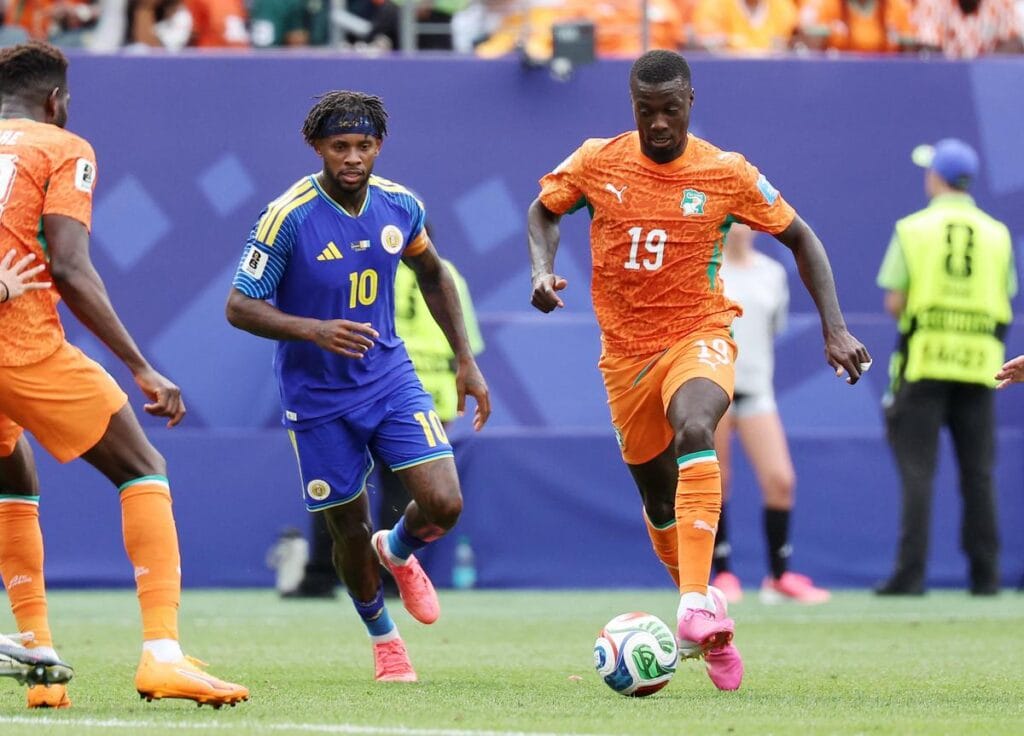
Nicolas Pepe celebrates a double that saw Ivory Coast beat Curacao 2-0. Image Credit: The Hindu
FIFA World Cup 2026: Ivory Coast defeated Curacao 2-0 on Thursday, June 25, 2026, to finish second in Group E and advance to the World Cup elimination rounds for the first time in the country’s history. Nicolas Pepe scored early in the seventh minute and again in the 64th minute, finishing the job with two clinical goals that proved enough to send Curacao home. The result was both historic and emotional, especially for Ivory Coast manager Emerse Fae, whose journey has now come full circle 20 years after he was an unused substitute for the nation’s first World Cup team.
How Ivory Coast Won
Ivory Coast’s win was built on sharp finishing, smart pressing and a willingness to punish Curacao’s mistakes. The opening goal came from a Curacao error while trying to play out from the back. Young winger Yan Diomande, just 19, reacted quickly, pounced on the loose ball and laid it back from the byline for Pepe, who finished it the first time from close range. It was the kind of goal that shows both alertness and composure, and it immediately put Ivory Coast in control. The Hindu has covered the full story.
The second goal was even more polished. Ibrahim Sangare spotted Pepe’s run with a precise through ball, and the forward curled his finish inside the left post from about 10 metres out. That sequence showed the difference in quality between the two sides: Ivory Coast had more pace, more penetration and more precision when the chances arrived.
The conditions also played a part. With temperatures in the mid-80s Fahrenheit and the sun beating down, the game slowed at times, but Ivory Coast remained more dangerous in key moments. Curacao had spells where they competed well and even created opportunities, but they could not match the finishing power of Pepe and the overall attacking threat of the Ivorians.
Nicolas Pepe’s Resurgence
Pepe’s performance was one of the key stories of the match because he has not always been in the picture. After failing to score in five World Cup qualifying appearances and missing out on Emerse Fae’s recent Africa Cup of Nations squad, he was not the obvious hero heading into this fixture. Yet he delivered his first competitive international goals since October 2024 at exactly the right time.
That matters because tournament football often rewards players who can recover form quickly under pressure. Pepe’s goals were not speculative or fortunate. They were decisive, well-timed and technically sound. For a forward looking to rebuild trust and confidence, this was the kind of performance that can redefine a narrative.
Fae also made it clear after the match that he sees Pepe’s earlier issues as resolved. He said the episode is “behind us” and explained that the coach and player had been clear with one another about expectations. That is an important detail because it shows Ivory Coast are not just benefiting from one player’s goals; they are also benefiting from a more settled team environment.
Curacao’s Brave Exit
Curacao may be leaving the tournament, but they did not leave quietly. The Caribbean side became the smallest nation ever to qualify for a World Cup finals, and that alone made their appearance one of the most compelling stories of the competition. Their exit came later than many expected, which is a credit to the work they put into the tournament.
They had moments in the match, and manager Dick Advocaat acknowledged that. The 78-year-old Dutchman, who was taking charge of his third World Cup side, said his team had opportunities but could not match Ivory Coast’s firepower. He noted that the Ivorians’ two forwards were “worth 150 million euros,” a comment that neatly captures the difference in attacking quality on the night.
That quote should not be read as surrender; it was more a realistic assessment of what happened. Curacao competed, they resisted for stretches, and they made Ivory Coast work at times. But when the decisive moments arrived, the difference between a good side and a sharper side became obvious.
Background and Context
This result is important because it marks Ivory Coast’s first trip to the World Cup knockout rounds. In their previous three appearances, from 2006 to 2014, they finished third in their group each time. That history makes this advancement a genuine milestone, not just a routine qualification.
For manager Emerse Fae, the achievement carries personal significance. He was part of Ivory Coast’s first World Cup squad two decades ago, albeit as an unused substitute. To return now as the man leading the team into the knockout stage gives the story a strong sense of closure and progress.
Curacao’s presence also matters in historical terms. As the smallest nation ever to qualify for the World Cup finals, they represented a major underdog story. Their elimination does not erase that achievement; in fact, it makes their participation more remarkable. Simply being there and competing at this level is a huge step for a nation of their size.
Timeline
7th minute: Nicolas Pepe scores Ivory Coast’s opening goal after Curacao fail to clear their lines.
First half: Curaçao stays competitive and creates moments of pressure, but Ivory Coast remains the more dangerous side.
64th minute: Pepe scores again, curling in a composed finish from around 10 meters.
Late match: Curaçao pushes for a response but cannot break through.
Full time: Ivory Coast win 2-0, finish second in Group E, and advance to the knockout rounds.
After the match: Curacao is eliminated, while Ivory Coast prepares to face France or Norway in Arlington, Texas, on June 30, 2026.
Also Read: Mexico Crush Czechia 3-0 to Complete Perfect Group Stage and March into World Cup Knockouts
Reported Quotes and Reaction
Emerse Fae urged supporters to celebrate the historic qualification but also asked them to keep sending positive energy to the team for the next stage. That is a sensible message because the achievement is significant, but the tournament is not over.
Fae’s remarks about Pepe were equally notable. He said the club and player had been clear about why he had previously been left out and what was expected of him. His tone suggested reconciliation, accountability and forward momentum—all useful traits in a dressing room aiming to go deep in a tournament.
Dick Advocaat’s response was more pragmatic. He praised his team’s effort but admitted the quality gap was real, especially in attack. That kind of honesty is common after a defeat, but in this case it also reflected the tactical reality of the match.
Why This Matters
This matters because the Ivory Coast has finally broken through a barrier that had defined their previous World Cup appearances. Advancing to the knockout rounds changes how the team will be perceived, both by fans and by opponents. It also raises expectations, because once a team reaches this stage, people naturally start asking how much further they can go.
It also matters because it shows the value of player redemption arcs in tournament football. Pepe’s resurgence gives Ivory Coast another weapon at exactly the right time, and that can matter hugely in a knockout setting. Yeh issue kaafi important hai because one player finding form can change the direction of an entire national team campaign.
For Curacao, the significance lies in proving that even the smallest nations can reach the World Cup and compete with energy and organization. Their exit is disappointing, but their presence has already expanded the tournament’s story and inspired supporters back home.
India Angle
For Indian football fans, Ivory Coast’s story is especially interesting because it shows how patient team-building can eventually pay off. India’s football conversation often focuses on what is missing — qualification, structure, and consistency — but Ivory Coast’s journey is a reminder that those things can be developed over time. In Hinglish, seedhi baat yeh hai: hard work, clear coaching and belief can take a team from near-misses to history.
Nicolas Pepe’s comeback also gives Indian viewers a familiar kind of sporting drama. Fans in India love a redemption story, where a player who was left out or doubted returns and makes the difference. That emotional angle is one reason global football stories resonate so strongly here.
There is also a practical lesson for India’s younger football ecosystem. Ivory Coast’s attack combined a teenager, a central midfielder and an experienced forward in a way that produced clean results. That blend of youth and structure is something Indian football development can learn from.
Analysis
My view is that Ivory Coast’s biggest strength here was clarity. They knew what they needed, they were aggressive in the right moments, and they finished with purpose. That sounds simple, but at the World Cup level, it is often the hardest thing to do.
Pepe’s return to scoring also adds a very useful storyline for the next round. Teams that have multiple in-form attackers become much harder to prepare for. If Ivory Coast can keep this level of sharpness, they will not be just participants in the knockout stage; they could become a serious threat.
Curacao, meanwhile, exit with dignity and a meaningful chapter in their football history. Their performances may not have taken them through, but they were part of one of the tournament’s most compelling underdog narratives. That’s why this match matters beyond the scoreline.
What Next
Ivory Coast now prepares for a knockout clash against the second-place team in Group I, either France or Norway, in Arlington, Texas, on June 30, 2026. That will be a major test, and it will likely tell us whether their group-stage progress can translate into deeper tournament success.
Curacao’s campaign is over, and their immediate future will be about reflection and growth. They have already made history simply by qualifying, and now the challenge is to turn that achievement into long-term progress for the national team.
For Fae and Ivory Coast, the next step is to keep the same balance of discipline and attacking intent. If Pepe stays sharp and the team keeps defending well, they have every reason to believe they can continue their run.
Conclusion
Côte d’Ivoire’s 2-0 win over Curaçao was more than a routine group-stage victory—it was a historic breakthrough. Nicolas Pepe’s brace sent the Ivorians into the World Cup knockout rounds for the first time, while Curacao’s courageous run came to an end after making history of their own by reaching the finals as the smallest nation ever to qualify. With a tough Round of 32 match ahead, Ivory Coast now has a chance to turn this milestone into something even bigger.
Written By A. Jack