Egypt took the lead through Yasser Ibrahim and Mostafa Zico and looked set for a famous win, but Argentina came roaring back with three late goals in the final 14 minutes. A stoppage-time goal by Enzo Fernandez capped off one of the tournament’s most thrilling comebacks.
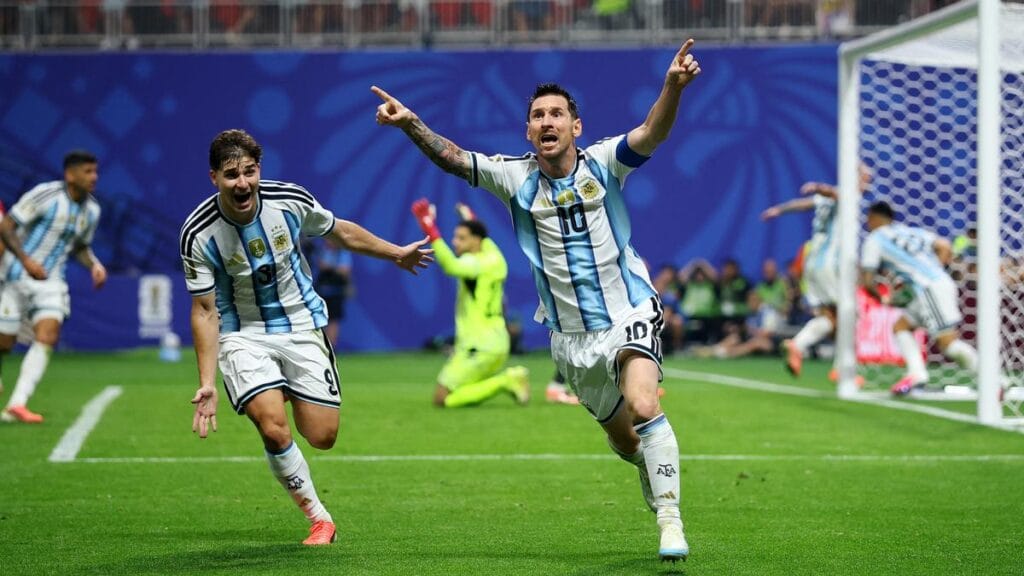
Argentina players celebrate after Enzo Fernandez’s stoppage-time winner completed a 3-2 comeback against Egypt in the World Cup last-16. Image Credit: The Hindu
FIFA World Cup 2026: Argentina survived a major scare and kept their title defence alive with a remarkable 3-2 victory over Egypt in the FIFA World Cup round of 16 at Mercedes-Benz Stadium on Tuesday, July 6, 2026. The defending champions were stunned by a 2-0 deficit after first-half goals from Yasser Ibrahim and Mostafa Zico, but they responded with three goals in the final 14 minutes to complete one of the most dramatic comebacks of the tournament.
Cristian Romero sparked the recovery before Lionel Messi equalised in a frantic late spell, and Enzo Fernandez delivered the final blow in stoppage time to send Argentina into the quarterfinals, where they will face Switzerland on July 12. The result was a perfect example of why World Cup knockout football remains so compelling: one team can dominate early, only for momentum to flip in an instant. Yeh match kaafi special tha because it had everything — pressure, missed chances, belief and a late escape by the champions.
How Argentina Turned It Around
Argentina’s comeback was not just about talent. It was about persistence, composure and refusing to accept defeat even when the game was slipping away. Egypt were disciplined, aggressive and clinically efficient for most of the match. They punished Argentina early and forced the champions into a chase that looked increasingly difficult as the clock ticked down. This story is also covered by The Hindu.
Messi’s missed penalty in the first half added to Argentina’s frustration. When your captain and biggest match-winner fails to score from the spot, the psychological burden can grow quickly. But Argentina did not break. Instead, they kept probing, kept the ball moving and waited for Egypt’s defensive structure to stretch.
The first breakthrough changed everything. Once Cristian Romero scored, Argentina gained belief and Egypt was pushed deeper into survival mode. Messi then found the equaliser, which lifted the pressure from the squad and turned the match into a race against time. Enzo Fernandez’s stoppage-time finish completed the recovery and sealed one of the most memorable late turnarounds of the competition.
This kind of comeback is usually built on the mentality of the team, not just the finishing. Argentina showed that even when they are outplayed for long stretches, they can still stay dangerous. That is what makes champion teams so difficult to eliminate.
Egypt’s Strong Start
Egypt deserve real credit for the way they approached the match. They were brave from the start and took advantage of Argentina’s early vulnerability. Yasser Ibrahim and Mostafa Zico scored the goals that put them 2-0 up and left the defending champions in deep trouble. For most neutral fans, it looked like a genuine World Cup upset was on the cards.
What made Egypt’s performance impressive was not only the goals but also the confidence with which they imposed themselves. They did not sit back and wait for Argentina to recover. They kept their shape, pressed at the right moments and gave themselves a realistic path to victory. When a lesser-ranked side leads a heavyweight by two goals in a knockout match, discipline usually decides the final outcome.
Unfortunately for Egypt, they could not close the match out once Argentina raised the tempo. That is often the hardest part against elite opposition. Holding a lead is one thing; holding it when the world champions start throwing everything forward is something else entirely.
Messi’s Penalty Miss and Response
Lionel Messi’s missed penalty in the first half could have become the defining moment if Argentina had gone on to lose. But instead, it became part of a broader narrative about resilience. Great players are often judged not by whether they fail, but by how they respond after failure. Messi’s equaliser late in the game showed exactly that.
When Messi stepped up again later in the match, the stakes had changed completely. The penalty miss had already passed into the background because Argentina had stayed alive long enough to get another chance at redemption. That is the sort of pressure only World Cup knockout football can create. Every touch becomes heavier, every miss feels bigger and every goal can alter the emotional balance of the entire contest.
Messi’s role also mattered beyond the goal itself. As captain and emotional leader, he kept Argentina anchored while the game was drifting away from them. For younger players, that calm presence can be priceless. It tells the team that panic is not an option, even when the scoreline is against them.
Enzo Fernandez’s Stoppage-Time Winner
Enzo Fernandez scoring in stoppage time was the finishing touch on a comeback that looked impossible for much of the match. His goal was not only decisive, it was symbolic. Argentina had pushed, pressed and forced the game into a state where one final moment could decide everything. Enzo delivered it.
In knockout football, stoppage-time winners carry extra weight because they erase the fear of extra time and reward the side that keeps believing. For Argentina, that late strike meant more than simple progress. It confirmed their status as a team that can survive chaos and still find a way through.
For Egypt, the goal was devastating because they had been seconds away from one of the biggest upsets of the tournament. That emotional swing is what makes football so powerful. In a matter of minutes, celebration turns into heartbreak.
Background and Context
Argentina entered the match as defending champions and heavy favourites, but knockout football rarely respects reputation for long. Their journey through the tournament had already placed pressure on them to deliver with authority, and that pressure intensified once Egypt took control. In World Cup history, title holders are always under special scrutiny because every opponent treats them like the biggest prize.
Egypt, meanwhile, had little to lose and everything to gain. That freedom often makes underdogs dangerous. They can attack with confidence, defend with commitment and play without the burden of expectation. That combination clearly troubled Argentina for most of the game.
This match also fits into a broader trend at the World Cup: late drama and momentum shifts have become a defining theme of the knockout rounds. Teams that appear comfortable can suddenly find themselves on the edge of elimination. That unpredictability is exactly what makes the tournament so followed worldwide.
Timeline
First half: Egypt take control with goals from Yasser Ibrahim and Mostafa Zico.
First half: Lionel Messi misses a penalty after Egypt goalkeeper Mostafa Shobeir saves it.
Final 14 minutes: Argentina begin their comeback with a goal from Cristian Romero.
Late stage: Messi scores to level the match.
Stoppage time: Enzo Fernandez scores the winner.
After the match: Argentina advance to the quarterfinals and are set to face Switzerland on July 12.
Also Read: Belgium Crush U.S.A. 4-1 to Reach FIFA World Cup Quarterfinals as All Three Hosts Exit
Why This Matters
This matters because it shows the difference between strong teams and champion teams. Strong teams can dominate spells, but champions can recover even when they are behind. Yeh issue kaafi important hai because in tournament football, mental strength often matters as much as technical quality.
It also matters because Argentina remains one of the tournament’s biggest storylines. When a defending champion survives a scare like this, it keeps the title race alive and adds momentum to their campaign. For Egypt, the result is painful, but their performance showed they can compete with elite opposition on the biggest stage.
For fans, this is the kind of match that defines a World Cup. It gives drama, emotion and unpredictability all at once. Those are the moments people remember long after the tournament ends.
India Angle
For Indian football fans, this result is especially exciting because Argentina have a huge following in India, and Messi’s name alone guarantees huge interest. In Hinglish, seedhi baat yeh hai: jab Argentina 2-0 se pichhad kar bhi jeet jaati hai, toh fans ko ek proper thriller milta hai. That kind of comeback becomes a talking point across Indian social media, sports pages and fan groups.
It also reflects why football has such a growing audience in India. Big tournaments, superstar players and dramatic finishes make the game easy to follow and emotionally engaging. Matches like this create new fans because they are simple to understand: one team looked finished, then came back and won.
There is also a lesson for Indian football culture. Comebacks in football are never just about skill. They are about structure, belief and staying calm under pressure. That is something young Indian players and fans can learn from when watching top-level international football.
Analysis
My opinion is that Argentina were far from perfect, but their reaction separated them from a team that might have folded. Champions are not defined by flawless performances; they are defined by how they respond when the match goes against them. Argentina’s response here was exactly what makes a title defence credible.
I also think Egypt’s performance should not be reduced to a failure simply because they lost. For 76 minutes or so, they were excellent in terms of game plan and execution. If not for Argentina’s late surge, this would have been remembered as one of the shocks of the tournament. That in itself tells you how close they came.
The biggest tactical lesson is that early control does not guarantee survival in a knockout game. Egypt led 2-0, but once Argentina scored, the momentum changed almost instantly. The defending champions found a way to keep pressure on the Egyptian defence until it cracked.
What Next
Argentina now moves on to the quarter-finals, where they will face Switzerland on July 12. That match will likely test whether this comeback was a one-off dramatic escape or a sign of deeper championship character. If Argentina tighten up defensively, they will remain one of the strongest contenders left in the tournament.
For Egypt, the focus shifts to reflection rather than progression. They will likely look back at the match with a mix of pride and frustration. Pride because they pushed the defending champions to the edge, and frustration because they could not finish the job.
The next few days will also shape the public story around Messi and Argentina. A comeback win like this often builds a team’s identity for the rest of the tournament. If they go on to win again, this match will be remembered as the turning point.
Conclusion
Argentina’s 3-2 win over Egypt was one of those World Cup matches that will be remembered for the emotion as much as the scoreline. Egypt led 2-0 and looked set for a famous upset, but Argentina responded with relentless pressure, a Messi equaliser and Enzo Fernandez’s stoppage-time winner to seal the comeback. It was a display of resilience, talent and belief from the defending champions and a painful missed opportunity for Egypt. In the end, this was more than just a victory — it was a reminder of why World Cup football remains unmatched for drama.
Written By A. Jack