Messi’s opener against Austria took him past Miroslav Klose’s World Cup goal record, but Peter Schmeichel and other critics say the goal should have been ruled out for a foul in the buildup. Argentina booked its spot in the Round of 32, but now the discussion about the referees is taking center stage.
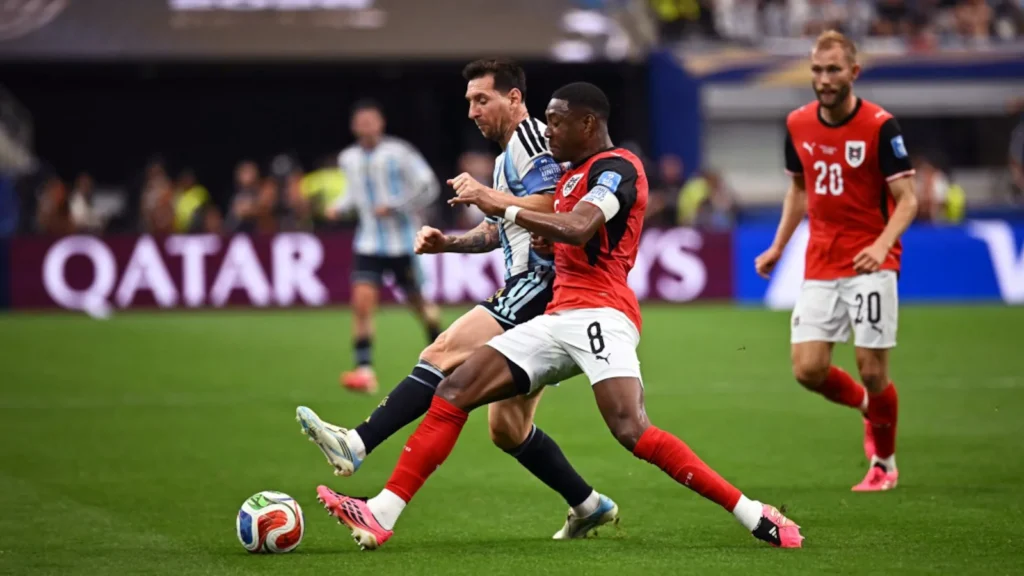
Lionel Messi scoring against Austria in the FIFA World Cup 2026 Group J match at the Dallas Stadium in Arlington. Image Credit: NDTV Sports
FIFA World Cup 2026
Lionel Messi found himself at the center of another refereeing storm after scoring what was described as his record-breaking 17th FIFA World Cup goal in Argentina’s 2-0 win over Austria on Monday at the Dallas Stadium in Arlington, Texas. The goal helped Argentina secure a second straight victory and qualification for the Round of 32, but the celebration has been diluted by claims that the opener should have been disallowed. Former Manchester United goalkeeper Peter Schmeichel said the incident leading to the goal involved a foul and that VAR should have stepped in to reverse the decision.
Why the Goal Is Under Scrutiny
The controversy centers on the build-up to Messi’s opener, which came after what Schmeichel described as a foul in favor of Austria. According to him, Argentina’s attack should have been stopped earlier because the play involving Alexis Mac Allister and Xaver Schlager amounted to a free-kick the other way. His argument is straightforward: if the foul had been correctly called, Messi’s opener would never have happened. NDTV Sports has covered the full story.
That is why the issue has generated so much attention. In football, a goal can be technically correct on the scoreboard and still be disputed if the sequence leading to it was flawed. Here, critics believe the referee missed a “clear and obvious” error, and that is exactly the kind of situation VAR is meant to correct.
Messi, of course, still got credit for the goal, and on paper it moved him beyond Miroslav Klose in the all-time World Cup scoring list. But in practice, the debate is not about the number alone. It is about fairness, refereeing standards, and whether big players receive the benefit of the doubt in major tournaments.
What Peter Schmeichel Said
Speaking on Fox Sports, Peter Schmeichel was blunt about the incident. He said he did not think the goal should have stood and argued that the earlier challenge should have resulted in a free-kick for Austria. Schmeichel also said VAR should have corrected the mistake, calling it a clear and obvious error.
That criticism matters because Schmeichel is not just any commentator. He is a respected former goalkeeper with deep experience at the highest level, so his comments carry weight in a discussion like this. When someone of that stature says the officiating team failed, the controversy gets louder and harder to ignore.
Background on Messi and Argentina
This is not the first time Messi has been at the center of refereeing debate at this World Cup. In Argentina’s opening group match against Algeria, Messi escaped punishment after a studs-up challenge on Aissa Mandi in the 30th minute. The Algerian Football Federation later lodged a formal complaint, claiming Messi’s challenge deserved a red card and that VAR failed to intervene on multiple occasions.
That background explains why the latest incident has quickly become bigger than a single goal. There is now a growing perception among some observers that Argentina, and Messi in particular, have benefited from officiating decisions. Whether that perception is fair or not, it has clearly shaped the public reaction.
At the same time, it is important to note that Argentina’s football on the pitch has still been strong. Two straight wins and six points have already taken them into the Round of 32. So while the officiating debate continues, their qualification is not in doubt.
Match Context and Result
Argentina beat Austria 2-0 at the Dallas Stadium in Arlington, Texas, and that win officially sealed progression to the knockout stage. Messi’s goal opened the scoring, and he later added another to complete a brace. The final group match against Jordan will now have no bearing on qualification, which means Argentina can afford to rotate and manage workloads if needed.
Austria, meanwhile, was left feeling aggrieved. Losing by two goals is one thing; feeling that a key moment was mishandled is another. In tournaments like this, one refereeing call can reshape an entire group dynamic, and that is why the anger has been so visible.
Why This Matters
This matters because World Cup scoring records are the kind of milestones that define football history. If a record-breaking goal is later questioned, it creates uncertainty around one of the sport’s most celebrated achievements.
It also matters because refereeing consistency is a core part of the game’s credibility. Fans can accept mistakes, but they get frustrated when they believe VAR did not do what it was designed to do. Yeh issue kaafi important hai because it goes beyond Messi and touches the trust people place in tournament officiating.
For Austria, the concern is fairness. For Argentina, the concern is reputation. And for FIFA, the concern is simple: if these controversies continue, the World Cup narrative shifts from football to officiating.
India Angle
From an Indian audience perspective, this story will resonate strongly because Messi remains one of the most followed sports figures in the country. Indian fans track his every move, and any controversy around a World Cup record instantly becomes a major talking point on social media and sports shows.
In Hinglish, seedhi baat yeh hai: jab Messi goal karta hai aur log bolte hain “yeh goal stand nahi karna chahiye tha,” toh debate aur bhi badi ho jaati hai. Indian football fans, especially younger viewers, are increasingly tuned into VAR drama, refereeing calls, and record-breaking moments, so this story has very high interest value.
It also shows how global football controversies reach Indian audiences almost instantly. A Messi goal in Texas can become a trending topic in Mumbai, Delhi, Kolkata, or Kochi within minutes. That is the power of football’s global reach.
Also Read: FIFA World Cup 2026: Egypt Comes From Behind to Defeat New Zealand 3-1 in Group H
Timeline
Argentina’s opening match vs Algeria: Messi escaped punishment after a studs-up challenge, prompting an official complaint from the Algerian Football Federation.
Monday, Group J vs Austria: Messi scored twice as Argentina won 2-0 in Arlington, Texas.
After the opener: The first goal came under immediate scrutiny, with critics saying it should have been disallowed.
Post-match: Peter Schmeichel publicly argued the goal should not have stood.
Current status: FIFA has not issued a clarification, and the controversy remains unresolved.
Analysis
My view is that the controversy will probably grow rather than fade, especially because the goal was tied to a milestone. If the same sequence had happened in a league match, it would have been debated for a day or two. But at a World Cup, and with Messi breaking a scoring record, the conversation becomes much bigger.
Logically, this also reinforces how much VAR decisions shape football narratives now. It is no longer just about whether the ball crossed the line. It is about the sequence before the goal, the interpretation of contact, and whether officials are consistent in applying the rules. In Messi’s case, that consistency is now being questioned loudly.
What Next
The immediate next step is whether FIFA addresses the criticism or lets the matter fade naturally. If the organization stays silent, the controversy may continue to circulate, especially among supporters who already feel the refereeing has gone Argentina’s way.
Argentina will move on to Jordan with qualification already secured, which could reduce pressure on the team but not on the debate surrounding their performances. If Messi adds more goals later in the tournament, this particular record may continue to be discussed alongside every scoring milestone.
For Austria, there is no changing the result, but there may still be frustration over what could have been if the early call had gone their way. For fans, the larger issue is whether World Cup officiating can keep up with the expectation that major errors should be corrected immediately.
Conclusion
Lionel Messi’s “record” 17th FIFA World Cup goal has become the center of a refereeing debate after experts, including Peter Schmeichel, argued it should not have stood against Austria. Argentina still won 2-0 and moved into the Round of 32, but the controversy has turned a historic scoring moment into a wider discussion about VAR, fairness, and officiating standards. In a tournament where every decision matters, this is one of those incidents that will stay in the conversation long after the final whistle.
Written By A. Jack