Mikel Oyarzabal netted a double as Spain came from behind to beat Austria 3-0 and reach the last 16 of the World Cup, with Pedro Porro also scoring his first senior international goal for La Roja. The result sent Spain into the last 16 and dashed Austria’s hopes in their first World Cup knockout appearance in 44 years.
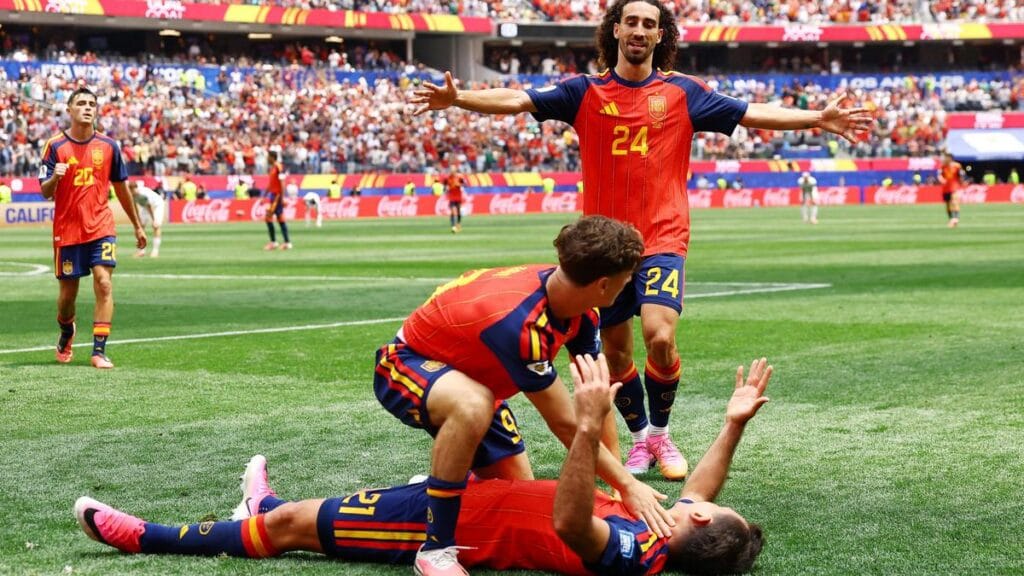
Spain celebrates after a 3-0 win over Austria in the FIFA World Cup Round of 32, with Mikel Oyarzabal and Pedro Porro starring in the victory. Image Credit: The Hindu
Spain booked their place in the FIFA World Cup 2026 Round of 16 with a polished 3-0 victory over Austria in their Round of 32 clash, ending the evening with authority and confidence. Mikel Oyarzabal scored twice, Pedro Porro netted his first senior international goal, and Spain showed the kind of attacking rhythm that can carry a team deep into a tournament. Austria, meanwhile, were left frustrated after their first World Cup knockout appearance in 44 years ended in disappointment.
The result carried added significance because it ended Spain’s long wait for a knockout-round World Cup win since their 2010 title run. That alone makes this a major moment for Spanish football. Austria entered with hope and energy, but Spain’s blend of composure, movement and finishing made the difference. Yeh match kaafi important thi because it showed Spain are not just advancing; they are doing it with growing confidence.
How Spain Controlled the Match
Spain won this game through control, timing and efficiency. They did not simply attack in waves; they attacked with structure. Their possession helped them dictate the tempo, while their forward players kept Austria constantly under pressure. Once Spain found the opening goal, the match began to tilt in their favour. The Hindu has covered the full story.
Mikel Oyarzabal was the standout name. His brace underlined the kind of form every tournament side needs from its forward line. He was in the right place at the right time, but that still requires sharp movement and confidence to finish. Pedro Porro’s goal was also significant, not just because it added to the scoreline, but because it was his first senior international goal for Spain. That kind of contribution from a defender or wide player often signals a team in full rhythm.
Spain’s attacking shape also mattered. With Lamine Yamal starting in attack alongside Alex Baena and Oyarzabal, Spain had pace, movement and directness in the final third. Yamal has now scored in three appearances for Spain in this tournament, which adds another layer to Spain’s momentum. Even with Nico Williams still recovering from a leg injury, the team had enough attacking depth to overwhelm Austria.
Austria tried to stay competitive, but they were outclassed. Once Spain established control, Austria struggled to turn the match into a physical or tactical contest on their terms. In knockout football, that is usually the end of the road.
Oyarzabal’s Red-Hot Form
Mikel Oyarzabal’s brace is one of the clearest signs that Spain are getting consistent attacking output from their key players. Tournament football often turns on one forward finding rhythm early, and Oyarzabal seems to be in that zone. His goals were not just about individual finishing; they were the result of Spain creating repeatable attacking patterns that made his movement dangerous.
That is what makes him so important. A striker in form gives a team both confidence and flexibility. Spain can now rely on a player who is not forcing the issue but responding naturally when chances arrive. For a team aiming for the latter stages of a World Cup, that is a major advantage.
Pedro Porro’s first senior goal also deserves attention. In tournaments, goals from unexpected sources often carry extra value because they make a team harder to predict. Opponents cannot focus on just one or two scorers if the rest of the squad is also contributing. That depth is a good sign for Spain.
Austria’s Brave Effort Falls Short
Austria entered the match with a sense of history and opportunity. This was their first World Cup knockout appearance in 44 years, so the occasion itself was meaningful. But a big stage can expose the difference between a competitive side and an elite one. Spain made that gap visible.
Austria did make changes in the lineup, bringing in Kevin Danso, Paul Wanner and Michael Gregoritsch, with Phillip Mwene, Philipp Lienhart and Marko Arnautovic starting on the bench. Those adjustments suggest they were trying to balance energy and freshness. But against Spain’s technical control, the changes were not enough to shift the momentum.
The key issue for Austria was that they could not sustain enough pressure. In knockout football, even underdogs need a stretch where they can alter the rhythm of the match. Austria did not get that stretch. They were forced to defend too much and, as Spain’s confidence grew, the game got harder for them to influence.
Background and Context
Spain’s first knockout World Cup win since 2010 is a major talking point because it connects the present team to one of the most successful periods in Spanish football history. The 2010 title remains a reference point, and any tournament run now will be judged against that standard. This win will not win the World Cup by itself, but it does matter because it signals that Spain can handle elimination pressure again.
Austria’s knockout return after 44 years also matters. Long gaps between appearances create emotional weight, and the team’s fans will have hoped for a breakthrough. Instead, they ran into a Spain side that was sharper and more complete in every key area.
Spain’s lineup choices also show the kind of squad planning that matters in tournaments. Luis de la Fuente brought in Pedro Porro and Dani Olmo, while Marcos Llorente and Mikel Merino dropped to the bench. Those decisions suggest tactical flexibility and confidence in the squad’s depth. In modern international football, that is often what separates teams that merely participate from teams that advance.
Timeline
Before kickoff: Spain make two changes; Austria make three.
Early phase: Spain settles into control with possession and forward movement.
First breakthrough: Spain score and begin to dominate the tempo.
Mid-match: Mikel Oyarzabal continues his scoring run and Pedro Porro adds his first senior goal.
Final stages: Austria fail to recover and Spain close out a 3-0 win.
After the match: Spain advances to the Round of 16, while Austria’s historic knockout run ends.
Also Read: FIFA World Cup 2026: USA Beat Bosnia and Herzegovina 2-0 to Reach World Cup Round of 16
Why This Matters
This matters because Spain are building a real tournament identity again. A 3-0 knockout win is not just about qualification; it is about tone, authority and belief. When a team wins like this, it sends a message to the rest of the field that they are not only surviving but improving with each stage. Yeh issue kaafi important hai because momentum in World Cup football can become self-reinforcing.
It also matters because Austria’s story reflects the harsh side of knockout football. A strong team can still be eliminated if it runs into an opponent that is simply better on the night. That is why the World Cup remains so compelling — the gap between hope and heartbreak can be very small.
For fans, especially younger viewers, matches like this are educational. They show the value of structure, patience and attacking intelligence. Spain did not rely on chaos; they relied on repeated, disciplined quality.
India Angle
For Indian football fans, Spain’s win will feel familiar in one important way: the importance of composure under pressure. In Hinglish, seedhi baat yeh hai — jab team panicked nahi karti aur apna structure maintain karti hai, tab result aata hai. Spain did exactly that, and it is a useful lesson for anyone who follows tactical football.
Indian readers who admire technical football will also enjoy the way Spain distributed their goals across different players. It proves that a team can be dangerous without depending on one superstar alone. That kind of balance is something many fans in India value when watching international football.
There is also a broader cultural connection. Spain’s style — possession, movement, patience and sharp finishing — is often appreciated by Indian football followers who prefer intelligent buildup over direct play. This match was a clean example of that approach working in a knockout setting.
Analysis
My opinion is that Spain are looking like a team that is growing into the tournament rather than merely scraping through it. That is a valuable sign in World Cup football. If a side is controlling matches, scoring through multiple players and keeping defensive shape, it usually means the tournament plan is working.
Austria should not be dismissed, though. Reaching a first knockout stage in 44 years is itself an achievement. But this match showed that momentum alone is not enough when a technically superior side brings precision and depth. Spain were simply better at every key phase of the game.
Pedro Porro’s first senior goal is another subtle but important detail. It points to a squad where contributions can come from multiple areas. That tends to matter more in the later knockout rounds, when opponents begin to shut down the obvious routes to goal.
What Next
Spain now move into the Round of 16 with confidence and a clearer sense of their tournament identity. Their next challenge will be tougher, but this performance gives them a strong platform. They will want to keep Oyarzabal in form and continue getting attacking output from different parts of the squad.
Austria exits with disappointment but not without a sense of progress. Their first knockout appearance in 44 years should still be seen as a step forward, even if it ended badly. The next task for them will be to build on the experience and turn it into sustained tournament competitiveness.
For the World Cup as a whole, Spain’s result adds another strong contender to the later stages. A team that wins like this becomes one to watch, because the combination of form, depth and confidence can be carried forward.
Conclusion
Spain’s 3-0 win over Austria was a complete and convincing knockout performance, powered by Mikel Oyarzabal’s brace and Pedro Porro’s first senior international goal. It marked Spain’s first World Cup knockout victory since 2010 and sent them into the last 16 with real momentum. Austria’s long-awaited knockout appearance ended in frustration, but Spain’s control and finishing made the result feel deserved from start to finish. If Spain can keep this level of sharpness, they will be one of the most dangerous teams left in the tournament.
Written By A. Jack