The ATS of Gujarat has arrested five additional suspects in connection with the terror group Jaish-e-Mohammed and remanded them to eight days of police custody. This arrest is in view of increasing investigations being carried out regarding radicalization and training in explosives.
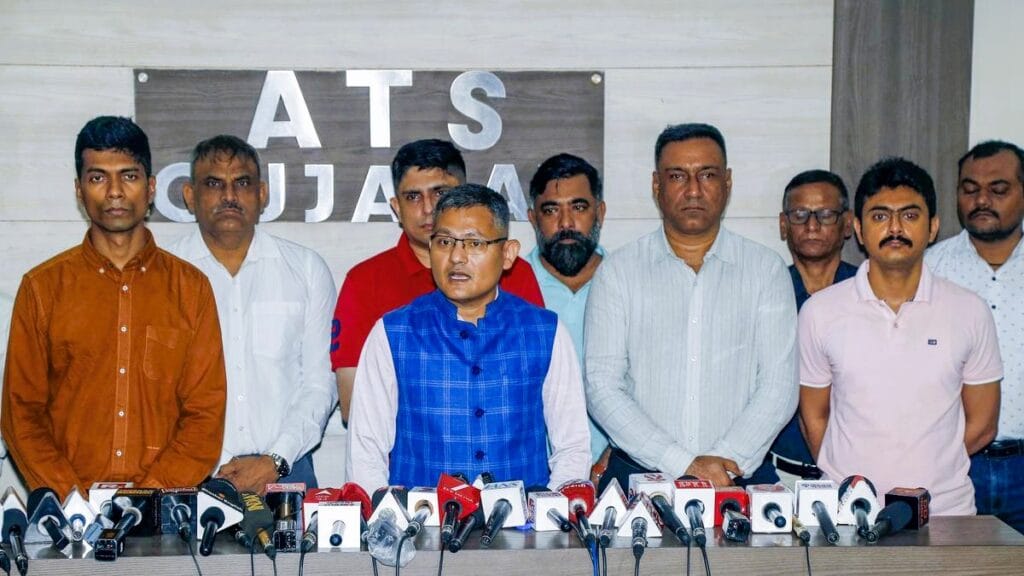
The accused was arrested by Gujarat ATS officials following the arrest of five more men connected to the terror group Jaish-e-Mohammed. Image credit: The Hindu.
A total of five other accused persons from the terrorist organization Jaish-e-Mohammed (JeM) have now been taken into custody by the Gujarat ATS and have been granted a remand period of eight days, taking forward an already serious counter-terrorism inquiry process. These arrests were carried out in Gujarat on Friday and officials claimed that the accused were part of a larger network that was under scrutiny for their terror-related activities.
As per the details provided by the ATS, these individuals had apparently been in touch with each other for several days and were found to be involved in certain activities pertaining to explosives and radical communications. This matter has created serious concerns regarding how these networks are created, operated and expanded across various states. Yeh matter kaafi serious hai.
What The ATS Said
Gujarat ATS SP K. Siddharth K. further stated that the five accused individuals came into the notice of the police authorities following the arrests made previously against eight accused from different parts of the country. Moreover, he revealed that the team has been monitoring the accused for around 10 days since the receipt of certain intelligence inputs regarding the same. For more latest news from all over, check out here.
ATS claimed that the accused individuals have radicalized each other and have been brainwashed due to the speeches of Masood Azhar. Furthermore, they revealed that the accused carried out some experiments related to the making of explosive devices, and they were successful in doing the same.
Who The Accused Are
Bilal Abid, Ayub Khadiwal, Mohammad Shafi, Mohammad Jaiswal, and Mohammad Amir Shinoi, among others, have been named as the five new accused who have been arrested by the authorities. All of them appeared before the court and were remanded in police custody for eight days.
Prior to their arrest, the officials had detained eight other accused from different places such as Gujarat, Madhya Pradesh, Delhi, and many other places. The growing number of suspects signifies that it was not a single cell operating alone, but rather a bigger network of terror support. In fact, usually, when one accused is apprehended, a trial follows, and that’s exactly the case now.
How The Investigation Unfolded
The ATS said that detailed interrogation and intelligence analysis over the last two weeks helped identify the newly arrested men. During that process, investigators reportedly learned that the group had grown increasingly radicalized through discussions over the last three years, particularly after listening to speeches by Masood Azhar.
Officials also said the accused had collected explosive materials such as potassium nitrate, sulfur, coal, wires, and detonators from local markets and online platforms. They then conducted their own experiments, which ATS says proved successful. If that claim is fully established in court, it would point to a serious and active terror preparation effort rather than passive ideological support.
The Legal Framework
It has already been booked against several sections of the Bharatiya Nyaya Sanhita and the Unlawful Activities Prevention Act. It is an important development because cases under UAPA are always taken very seriously since they have security ramifications for the nation.
While the previous eight individuals were booked under Sections 13, 17, 18, 38, and 39 of UAPA and Section 148(6) of BNS, which are concerned with illegal activities, terrorist support, conspiracy, and putting public safety in jeopardy, the current arrests will make it even more complicated for investigators as they try to establish each individual’s role in the crime.
Background And Context
This case occurred when the ATS arrested its first eight suspects, and after the past two weeks of interrogation, the network became larger. From the statements given by the authorities, the arrest of these men was made through intelligence and further investigation. The arrests of the JeM-associated suspects have spread beyond one place, and the operation seems to be taking place in different states.
Jaish-e-Mohammed is one of the terrorist organizations that are very well watched in India, as agencies keep checking for any activity in terms of recruitment and support for radicalization of the organization. This case is one of the many cases in the national security aspect where an online influence combined with procurement and experimentation in one place can develop into a greater threat.
How the Gujarat ATS JeM Probe Unfolded
About 10 days ago: Gujarat ATS begins tracking the suspects after intelligence inputs.
Over the last 14 days: Detailed interrogation of the earlier accused helps identify more names.
Earlier: Eight accused linked to the case are arrested from different states.
Friday: ATS arrests five more accused associated with JeM.
After arrest: The five are produced before the court and sent to eight-day police remand.
This timeline shows that the case is moving quickly and that investigators are using each arrest to uncover more of the network.
Why This Matters
It is important here since anti-terrorism investigations are not just about arresting people but also making sure that networks are stopped from taking steps beyond their plan. In the event the claims of explosives tests turn out to be true, then the investigation would be of high significance to public safety.
This is important since the alleged radicalization process seems to have taken place gradually and not abruptly. This means that families, communities, and digital environments locally could fall prey to radical ideologies. Yeh issue kaafi important hai because it shows how terror networks can develop through everyday communication and procurement channels before the threat becomes visible.
Gujarat ATS and the Wider Terror Threat in India
From the point of view of the Indian readership, this case should serve as an illustration that internal security issues continue to be relevant for various regions of the country, not only for borderlands. States such as Gujarat, Madhya Pradesh, Delhi, and others form a single security landscape in terms of cooperation in the counter-terrorist measures.
In addition, the case demonstrates the importance of taking into consideration the local markets and Internet sources while investigating the issues related to terrorism in India. In cases where ingredients for explosives could be acquired on the ordinary markets or through the Internet, the borderline between regular trade and potential terrorist activity becomes blurred. The hindu has covered this story.
What the Gujarat ATS Arrests Reveal About the Bigger Threat
The most critical element in this case is the presence of a combination of radicalization and preparation. The vast majority of terror cases either have one or the other; in this case, however, it looks like the ATS claims the presence of both elements. This is crucial since it means that there was a process of gradual movement from influencing people to preparing an attack.
The use of speeches made by Masood Azhar as a radicalizing instrument demonstrates the power of extremist propaganda even in the modern age of digital and social networks. Meanwhile, the buying of explosives in local markets shows the danger posed by simple daily transactions, which can become an element of a much bigger chain. And this is precisely why it is so difficult to conduct investigations into terrorism without the help of intelligence and surveillance, as well as rapid remand interrogation.
Finally, the remand period of eight days is also important since it allows the ATS to interrogate suspects, follow their contacts, seize devices, and identify any co-conspirators.
What Happens Next in the Gujarat ATS Terror Probe
The next phase might involve more probing while in custody by the police and forensic examination of devices, as well as tracking any financial or technological connections among the suspects. Further investigation might be done to check whether there are any more collaborators who are present in some other state than the one from which these new five suspects were arrested.
The court proceedings will also be important in view of the fact that the prosecution will prepare its case under the provisions of the UAPA law as well as other laws. Depending upon the further evidence, further arrests are possible in addition to the terrorism-supporting charges.
Conclusion
The arrests of five more people alleged to have been associated with Jaish-e-Mohammed constitute an important development in Gujarat ATS’ counter-terrorism probe. According to officials, the persons were radicalized, had access to explosives, and were members of a larger group that was already under surveillance.
Although the legal perspective remains to be seen in light of what the investigation may turn up, the early results are definitely disturbing. The current case is an example of how a threat to national security can develop stealthily in terms of ideology, communication, and physical preparation.
— Written by A. Aisha–