A 31-year-old MSc Physics student was found dead after an incident at the Lecture Hall Complex; police are examining counseling records and other information to determine the circumstances.
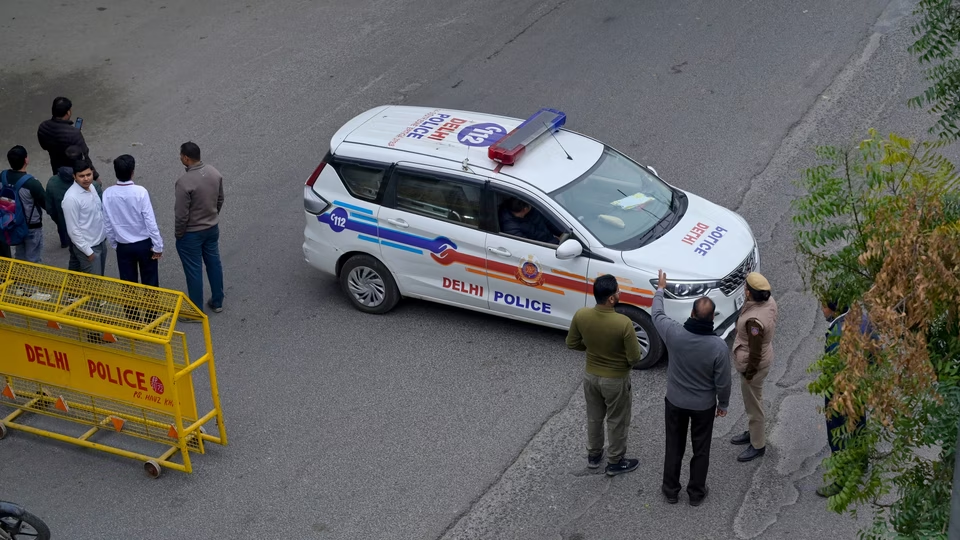
This image is only for illustrations. Image credit: HindustanTimes
A 31-year-old student pursuing an MSc in Physics at the Indian Institute of Technology (IIT) Delhi died by suicide on the institute’s campus on Saturday morning, August 22, 2026, Delhi Police said.
The student was found after an incident at the sixth floor of the Lecture Hall Complex (LHC). Police received a control-room call at around 8.33 am and took the injured student to the IIT Delhi campus hospital, where doctors declared him dead on arrival.
Police said no suicide note was found at the scene or in the student’s possession. Investigators are examining his mobile phone, counseling records, and other relevant information from the institute to establish the circumstances surrounding the death.
This is the second reported suicide at the IIT Delhi campus since March, when a 19-year-old first-year BTech student died in an earlier incident.
What Police Have Said
Deputy Commissioner of Police (Southwest) Amit Goel said the police control room received information at around 8.33 am regarding a student who had fallen from a campus building.
A police team reached the IIT Delhi campus and shifted the student to the institute hospital, where he was declared dead on arrival. The student was later identified as a 31-year-old MSc Physics scholar.
Police said the student entered the IIT Delhi campus through the main gate at around 8 am. He then went to the Lecture Hall Complex and took a lift to the sixth floor.
No suicide note has been recovered, and police have not announced a possible motive. Investigators are examining all relevant evidence rather than attributing the incident to academic pressure or any other single factor without confirmation. This story was also covered by The Hindustan Times.
A crime-scene team and a Forensic Science Laboratory (FSL) unit were called to collect evidence from the location. Police are also examining the student’s mobile phone under due procedure.
IIT Delhi’s Statement
IIT Delhi expressed grief over the student’s death and said the Delhi Police investigation was underway.
“The institute deeply mourns the tragic and untimely demise of an M.Sc. student. The Delhi Police are investigating the incident. Our deepest thoughts and prayers are with the bereaved family. The institute is providing all support to them,” IIT Delhi said in an official statement.
The institute has not publicly disclosed the student’s identity, academic record or counseling history. Police said counseling records and other relevant information were being obtained as part of the investigation.
The privacy of the student and family is particularly important while the investigation remains in progress.
Investigation Underway
The investigation is expected to examine the student’s movements on campus, recent communications, academic and personal circumstances, and any contact with counseling or support services.
Police have not recovered a suicide note. The absence of a note does not establish a motive, nor does it rule out emotional or mental-health distress. It means investigators must rely on a broader set of evidence.
The inquiry may include:
CCTV footage from the campus and Lecture Hall Complex
Entry records and security logs
Mobile-phone data and recent communications
Statements from classmates, faculty members and staff
Academic and hostel-related records
Counselling and welfare information, subject to legal and privacy safeguards
Forensic examination of the scene
Postmortem findings
It is important not to speculate about the reason for the death before the police and family have more information.
Second Reported Case Since March
The latest incident is the second reported suicide at IIT Delhi since March 2026. wionews+1
In the earlier case, a 19-year-old first-year BTech student died in a room on the campus. Police registered a case and began an investigation. IIT Delhi subsequently sent an email to students encouraging them to use counseling services and seek help when experiencing emotional distress.
Two cases in the same campus within a few months are likely to intensify questions about student welfare, counseling access, academic stress, peer support and crisis prevention.
However, the existence of two incidents does not by itself establish a common cause or systemic failure. Each case must be investigated individually, while the institute should still review whether its support systems are easy to access and trusted by students.
Mental Health on Campuses
Students at India’s premier institutions often deal with demanding academic schedules, research pressure, examinations, financial concerns, career uncertainty, family expectations, relationship difficulties and loneliness.
Postgraduate and research students may face additional challenges, including long academic timelines, uncertainty over funding, supervisor relationships, publication pressure and concerns about future employment.
These factors do not mean that every student in distress is at risk of suicide. But they underline why campuses need multiple layers of support:
Accessible counselling without stigma
Emergency mental-health response
Peer-support networks
Faculty training to identify warning signs
Clear referral pathways to psychiatrists and hospitals
Regular outreach rather than only crisis-time announcements
Confidential mechanisms for reporting distress
Academic flexibility during serious mental-health episodes
A counseling service is most effective when students trust that seeking help will not harm their academic standing, privacy or future opportunities.
Timeline
August 22, 2026, around 8 am: Police say the 31-year-old MSc Physics student enters the IIT Delhi campus through the main gate.
Shortly afterward: The student goes to the Lecture Hall Complex and takes a lift to the sixth floor.
Around 8.33 am: The Delhi Police control room receives a call about the incident.
Morning response: Police reach the campus and shift the student to the IIT Delhi hospital, where he is declared dead on arrival.
Investigation begins: Crime-scene and FSL teams collect evidence; police recover a mobile phone and find no suicide note.
Institute response: IIT Delhi expresses condolences and says it is providing assistance to the bereaved family.
Earlier case: A 19-year-old first-year BTech student died in a separate reported incident at IIT Delhi in March 2026.
Ongoing: Police seek counseling records and other relevant information while verifying the circumstances of the latest death.
Also Read: Chhatrapati Sambhajinagar Tragedy: Boy and Parents Die After Cliff Incident Following iPhone Dispute
Why This Matters
Yeh incident kaafi important hai because it raises urgent questions about mental health support and crisis response in higher education institutions.
Student welfare: IIT Delhi and other institutions must ensure that counseling and emergency support are visible, accessible and confidential.
Repeated campus incidents: The second reported case since March makes a review of prevention systems especially important.
No premature conclusions: Police have not identified a reason, so speculation about academic pressure or personal issues should be avoided.
Family privacy: The student’s identity and personal records should be protected while the investigation continues.
Prevention: Suicide is preventable when people in distress receive timely, compassionate and professional support.
The impact extends beyond the student’s family. Classmates, teachers, researchers and staff may experience grief, shock or anxiety following a death on campus. The institute should provide trauma-informed support to those affected.
India Angle
The IIT Delhi case reflects a broader concern across Indian universities, coaching centers, and professional institutions. Students often move away from home and may struggle silently because they fear being judged as weak or unsuccessful.
Families and institutions should look for warning signs such as the following:
Sudden withdrawal from friends or classes
Statements suggesting hopelessness or self-harm
Major changes in sleep, eating or behaviour
Giving away belongings or saying goodbye
Severe anxiety, panic or emotional distress
Sudden decline in academic participation
Increased substance use or risky behaviour
A person who says they are thinking about suicide should be taken seriously. They should not be left alone, challenged, mocked or told to simply “be strong.” Calm listening and immediate professional support can save lives.
Analysis
The most important point is that a crisis response cannot end with a condolence statement or a general email.
Institutions should assess whether students can obtain help quickly, including outside standard office hours. They should also examine wait times, counselor availability, referral systems, emergency protocols and whether students believe their information will remain confidential.
Academic departments and supervisors need training to respond appropriately when students show distress. Peer groups can also help, but they should not be expected to manage a life-threatening crisis without professional support.
At the same time, it would be wrong to assume that a single campus policy can prevent every suicide. Mental-health crises are complex and individual. The goal should be to build several points of support so that a student has more than one opportunity to seek help.
What Next
The next steps are likely to include:
Police investigation: Officers will examine CCTV footage, phone data, witness statements and other evidence.
Forensic and postmortem procedures: These will help establish the formal circumstances of death.
Institute review: IIT Delhi may review counseling services, emergency protocols and campus safety arrangements following the incident.
Student support: Counseling and grief-support services should be offered to classmates, faculty members and staff affected by the death.
Family assistance: The institute has said it is providing support to the bereaved family.
Wider institutional review: Other IITs and universities may revisit suicide-prevention programs, mental-health outreach and after-hours crisis support.
Conclusion
A 31-year-old MSc Physics student at IIT Delhi has died in an incident being investigated as suicide, police said. The death is the second reported suicide at the campus since March.
Police have not recovered a suicide note and have not established a reason. They are examining forensic evidence, the student’s mobile phone, counseling records, and other relevant information.
The tragedy is a reminder that high-performing institutions also need strong, compassionate and easily accessible mental-health systems. Students should be able to ask for help without fear of stigma or academic consequences.
Written By A. Jack