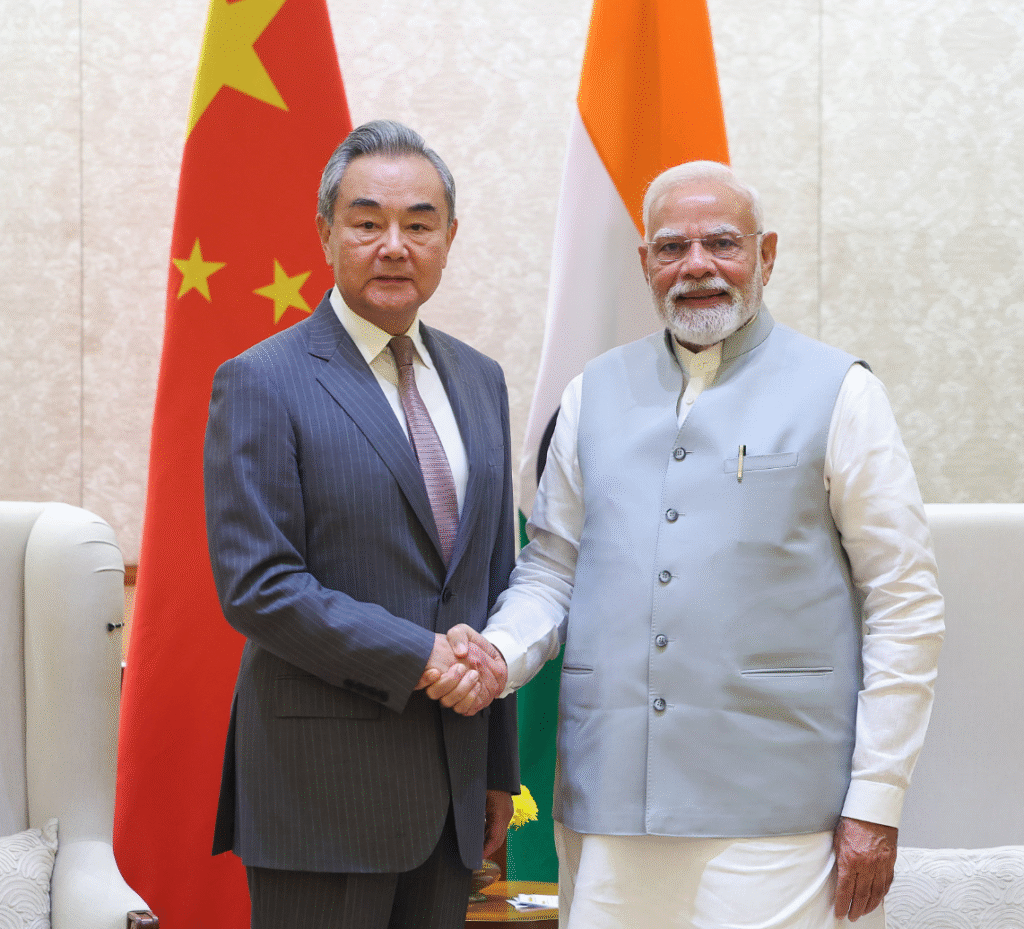
NEW DELHI, [19 August] – In a potentially pivotal moment for Asian geopolitics, the foreign ministers of India and China have announced a renewed and accelerated push towards finding an “early settlement” to their protracted and perilous boundary dispute. The agreement, reached during high-level talks between India’s External Affairs Minister, Dr. S. Jaishankar, and his Chinese counterpart, Wang Yi, signals a shared intent to move beyond the military stalemate that has defined relations since the deadly Galwan Valley clash of 2020. However, seasoned observers caution that while the language is positive, the path to actual boundary delimitation remains fraught with complexity, historical baggage, and deep-seated strategic mistrust.
The announcement moves the dial from managing crises and facilitating disengagement at specific friction points to addressing the root cause: the undefined and contested 3,488-kilometer-long Line of Actual Control (LAC).
From the Ground Up
The talks did not take place in a vacuum. The LAC has witnessed the highest level of military tensions in decades in the last four years. The Galwan episode, which had casualties on both sides, was a watershed moment, shattering bilateral trust to the core.
Since then, diplomacy has primarily focused on crisis management through military and diplomatic talks (the Working Mechanism for Consultation & Coordination (WMCC) and Corps Commander-level meetings). These talks have been successful in achieving disengagement at a few key flashpoints like Pangong Tso, Gogra (PP-17A) and Hot Springs (PP-15).
But big flashpoints like Depsang and Demchok remain unresolved with thousands of troops still forward deployed at high alert. So the context is of a fragile peace held together precariously by layers of temporary agreements. The new pledge to ‘early settlement’ is an attempt to create a more permanent and stable basis.
Decoding the Diplomatic Language
Both ministers’ comments and the joint statement use carefully chosen language to reveal the consensus and the challenges.
“Early Settlement”: This is the biggest lesson. It means a top-level political instruction to bureaucrats and diplomats to fast-track talks. It moves the boundary question from the back burner to the top of the agenda.
Both sides reiterated the importance of respecting the Line of Actual Control (LAC) and maintaining peace in the border areas. This is the basic precondition for any serious talks on the delimitation. That has always meant India going back to the pre-April 2020 position and addressing whatever outstanding issues there were.
“Bilateral Engagement”: The constant refrain in India-China relations is the focus on resolving the issue at the bilateral level, without any external mediation. It points to an understanding, grudging but common, that they alone have to fix this problem.
“Three-Step Plan”: The reference to the existing three-step resolution plan is not new but important. This plan, agreed in principle years ago, includes:
Political Consensus Achieved: A mandate for a solution must be given by the top leadership.
Negotiating a Framework Agreement: Diplomats and specialists would arrive at a broad framework for resolution.
Delimitation and Demarcation: The technical process of drawing the precise boundary line on maps and finally on the ground.
The current talks seem focused on injecting momentum into the first two steps.
The Mountain of Challenges
The optics are good, but the road to delimitation is extremely steep.
The main issue: Different perceptions of the LAC There is no line on the map that we both agree on. The two sides have very different claims, and this results in overlapping patrolling routes and perceived transgressions. Closing this perceptual gap is the single biggest barrier.
The Legacy of 2020 and Trust Deficit: PLA’s large forward deployment in 2020 has shattered the foundational agreements that had kept peace since 1993. Restoring even a small amount of trust in such a delicate negotiation will be a Herculean task. India will watch any arrangement that lends legitimacy to Chinese gains.
Strategic Rivalry and International Context The border issue cannot be divorced from the larger strategic contest. China’s close ties with Pakistan (and its involvement in Pakistan-occupied Kashmir), its growing influence in the Indian Ocean, and India’s deepening strategic partnership with the Quad nations (US, Japan, Australia) all cast a long shadow over bilateral talks. Any concessions on the border could be seen as a weakness in this larger contest.
Domestic Political Considerations: Nationalistic public sentiment matters in democracies and authoritarian regimes alike. Any hint of compromise on territorial integrity is a politically explosive issue for the leadership in both New Delhi and Beijing.
Cautious Optimism and a Long Road
An “early settlement” probably doesn’t imply a resolution in months, or even a couple of years. Instead it means a reinvigorated political process with a defined end.
The immediate steps will probably include:
Enhanced Diplomatic Engagements: More WMCC sessions, Special Representative meetings.
Disengagement Completion: A new round of efforts to address the outstanding friction points in Depsang and Demchok, leading to a more favorable atmosphere for broader talks.
Technical and Expert Meetings: Reuniting joint teams of cartographers and surveyors to compare notes and maps—a painstaking but vital process.
A Necessary First Step on a Long March
The Jaishankar-Wang Yi agreement to find an early settlement is a critical and needed diplomatic move. The decision to de-escalate the rhetoric and pursue a political solution rather than perpetuate a military standoff is a conscious one.
But this is only the first step on a long and hard road. The announcement opens a door that has been firmly closed since 2020. The billion dollar question: do both nations have the political will, compromise and trust to walk through it and finally settle one of the world’s most intractable border disputes? For now, the only prudent stance is cautious optimism, backed by rigorous scrutiny of on-ground actions. The world will be watching, because the resolution of the India-China boundary will not just reshape the geography of the Himalayas but the strategic landscape of the entire Indo-Pacific.
India and China hail warming ties amid Trump-induced geopolitical shake-up—The Guardian
for more news click here