
PUNE: The ancient Kambareshwar Temple in Pune has re-emerged as the water level in the Bhatghar Dam has fallen to a meagre 6 per cent. Locals and historians believe the centuries old Shiva temple dates back to the Mahabharat era and draws attention every year when the waters recede.
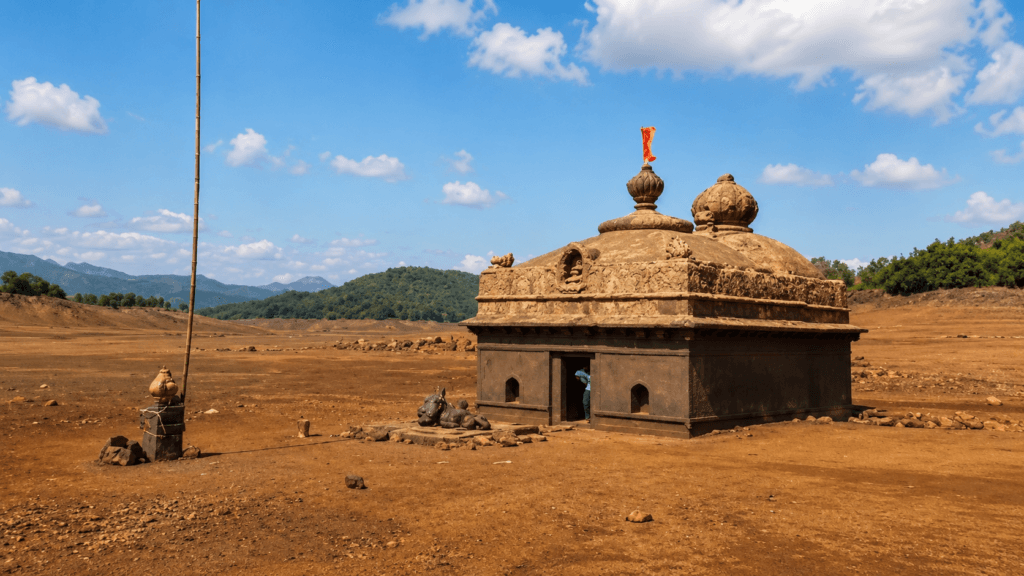
The Kambareshwar Temple in Pune emerges from the receding waters of Bhatghar Dam, revealing its historic stone structure and submerged sanctum.
A rare historical sight has returned to Pune, where the “Pandav-era” Kambareshwar Temple has emerged once again as the waters of Bhatghar Dam recede to just 6 per cent capacity. The temple, believed by many to be from the Mahabharat period, is known for appearing only for a short window every year before being submerged again for most of the year.
This ancient structure, also called Kambareswar Temple, has become a point of fascination for visitors, devotees, and historians because of its unusual setting and remarkable endurance. For nearly 10 months of the year, the temple remains underwater, but every May it reveals its full form as water levels drop. The sight is not only religiously significant but also visually striking. Yeh scene kaafi unique hai because it combines faith, history, and nature in one frame.
Why the Temple Emerges Now
The temple emerges at this time because Bhatghar Dam’s water level naturally declines toward the end of summer. As the reservoir shrinks, the temple’s stone structure becomes visible again. This seasonal exposure is what makes the temple such a special attraction. NDTV has covered the full story.
The retreating water has exposed the temple’s full upper structure, including its stone walls and the area around the sanctum. The sanctum sanctorum remains filled with knee-deep water even when the temple is visible, which adds to its mystique. Devotees reportedly dip their hands into this water and touch the idols inside while seeking blessings from Lord Shiva.
The temple is said to house a self-manifested Shiva lingam, an idol of Goddess Parvati and Nandi Maharaja seated before her. These elements make the temple both spiritually significant and historically important. The visible structure is a reminder that some heritage sites continue to survive despite years of partial submersion.
What Makes Kambareshwar Temple Special
Kambareshwar Temple stands out because of its architecture and its survival under water for decades. The upper part of the temple is made using limestone, sand, and baked bricks, while the walls are carved from heavy stones. That engineering strength is one of the main reasons the temple has remained intact despite being underwater for long periods.
Ancient rocks and Veergals, or heroic saga stones, are also found in front of the temple, adding to its historical value. Such stones are usually associated with old regional traditions and memorial markers. Their presence suggests that the site may have deep cultural roots beyond just its religious function.
The fact that the temple still stands strong after years of being submerged is what surprises even modern engineers and visitors. A structure exposed to repeated water pressure, changing temperatures, and seasonal flooding should normally show greater damage. Yet the foundation and core structure of this temple are said to remain largely intact, which speaks to the skill of its original builders.
Historical and Cultural Background
Historians and locals believe the temple dates back to the Pandava era, though that claim belongs more to tradition and belief than to formal archaeological confirmation in this report. Still, the temple’s age and enduring design make it an important part of Pune’s cultural landscape.
Temples like this often become living links between mythology and local memory. In India, many ancient sites are tied to the Mahabharat or Ramayan eras through tradition, oral history, and religious belief. Whether viewed as mythology or heritage, such places carry emotional and spiritual value for the communities that visit them.
The Kambareshwar Temple is one such site where history is not locked inside a museum. Instead, it appears and disappears with the seasons, turning the changing water level into a natural calendar. That makes the temple not just a monument but a recurring event in the life of the region. In simple words, this temple is not just a building; it’s a seasonal heritage experience.
Timeline
Most of the year: The temple remains submerged under Bhatghar Dam water.
End of May each year: Water levels fall, and the temple re-emerges.
This year: The dam level dropped to around 6 per cent, revealing the temple clearly.
Following monsoon: The reservoir will refill, and the temple is expected to submerge again for about 10 months.
Also Read: Mumbai Teen Attacks Friend With Machete Over Alleged Calls to His Mother
Why This Matters
This matters because the temple represents the intersection of heritage preservation, religious practice, and environmental change. For devotees, it is a sacred site that becomes visible only briefly each year. For historians, it is a living example of old architecture surviving in difficult conditions. For the public, it is a rare and fascinating reminder of India’s layered past.
It also matters because the temple’s appearance depends on water levels. When reservoirs recede to such a low point, it naturally raises questions about seasonal water availability, drought conditions, and dam management. So while the temple is drawing attention, the dropping water level is also a reminder of how climate and resource stress affect communities. Yeh issue kaafi important hai because heritage and water security are both part of the same reality.
India Angle
The India angle here is strong because ancient temples, seasonal rituals, and water bodies are deeply woven into the country’s cultural fabric. Across India, many old temples, shrines, and submerged monuments carry legends that attract pilgrims and tourists alike. Kambareshwar Temple fits perfectly into that tradition.
For Indian readers, especially in Maharashtra, the temple’s reappearance is not just a news item. It is a moment that brings together devotion, curiosity, and local identity. In Hinglish, seedhi baat yeh hai: jab pura temple paani se bahar aata hai, log sirf darshan nahi karte, history ko live dekhte hain. That is why the temple continues to generate interest every year.
Analysis
My opinion is that Kambareshwar Temple is a powerful example of how heritage survives in unexpected ways. Instead of being preserved in a protected enclosure, it lives through a seasonal cycle of submersion and reappearance. That makes it emotionally stronger for local people because the site is not static; it returns every year like a reminder of continuity. At the same time, the temple’s re-emergence also highlights the broader environmental reality: when water levels fall sharply, it is not only history that appears but also the pressure on water resources. That dual meaning gives this story depth beyond its visual appeal.
What Next
The next phase is simple and predictable: as long as water levels remain low, the temple will continue to be visible for visitors and devotees. Once the monsoon arrives and the Bhatghar Dam fills up again, the temple will likely go back underwater for another ten months.
In the short term, there may be increased local footfall from devotees, researchers, and tourists who want to witness the temple before it disappears again. In the longer term, the site may attract more historical or architectural attention if researchers decide to study its construction or preservation in greater detail. Either way, the temple’s annual emergence is likely to remain a recurring attraction in Pune’s seasonal news cycle.
Conclusion
The reappearance of the Kambareshwar Temple from beneath Bhatghar Dam is more than just a visual spectacle. It is a reminder of India’s layered history, living faith traditions, and the strength of ancient craftsmanship. Believed to be from the Pandava era, the temple continues to inspire devotion and curiosity every time it emerges.
As the water recedes and the temple stands visible once again, it draws people toward a rare blend of mythology, architecture, and nature. And when the monsoon returns, the temple will once again disappear beneath the waters—making its brief annual appearance even more special.
Written By A. Jack