Delhi Capitals ended their IPL 2026 league campaign on a high with a comprehensive 40-run victory against Kolkata Knight Riders in Kolkata on Sunday, powered by KL Rahul’s fluent half-century and a three-wicket burst by Kuldeep Yadav. KKR got off to a good start thanks to Ajinkya Rahane but a middle-order collapse gave DC an easy finish.
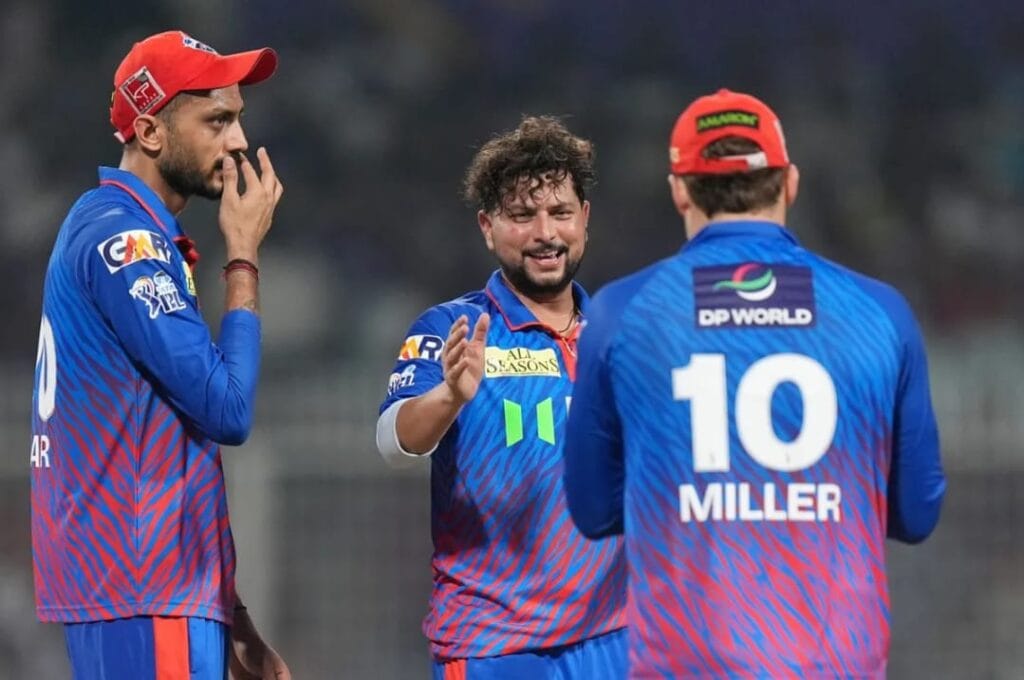
Delhi Capitals players celebrate after Kuldeep Yadav’s key wickets helped them beat Kolkata Knight Riders in Kolkata.
Delhi Capitals signed off from the IPL 2026 league stage in style, defeating Kolkata Knight Riders by 40 runs in Kolkata on Sunday in a match that swung sharply after a promising start from the home side. Put in to bat first, DC posted a strong 203/5, with KL Rahul leading the charge through a classy 60 off 30 balls, before Kuldeep Yadav returned to haunt his former team with a match-defining spell.
KKR looked in control early in their chase, thanks to Ajinkya Rahane’s brisk 63 off 39, but once the partnership chain broke, the innings unraveled fast. The final seven wickets fell for just 35 runs, and KKR were eventually bowled out for 163 in 18.4 overs. Yeh result kaafi important hai because it showed how quickly an IPL chase can collapse when pressure builds and wickets keep falling.
What Happened
Delhi Capitals won the game in two clear phases: first with a strong batting performance, then with disciplined bowling that choked KKR’s chase. DC’s total of 203/5 was built on top-order composure and timely acceleration, with KL Rahul anchoring the innings and making sure the side stayed ahead of par. In T20 cricket, anything above 200 is a strong platform, and DC made sure their total looked even more imposing by finishing well. NDTV Sports has covered the full story.
KL Rahul’s 60 off 30 balls was the batting highlight of the night. His innings was both elegant and efficient, the kind of knock that keeps the scoreboard moving without unnecessary risk. He gave DC the balance they needed, while the rest of the batting unit supported the effort enough to push the total beyond KKR’s comfort zone.
The bigger story, though, was Kuldeep Yadav. The left-arm wrist spinner picked up three wickets and applied pressure at a time when KKR needed stability. Against a side that has seen him up close in the past, Kuldeep’s spell felt especially impactful. His variations, control, and ability to break partnerships made the difference in the middle overs.
KKR’s reply started with intent. Ajinkya Rahane scored 63 off 39 and gave the chase life, but the support around him did not last. Once the middle overs began to bite, DC kept taking wickets, and the innings lost rhythm. The final seven wickets falling for 35 runs tells the real story of the collapse: KKR did not just slow down; they completely lost control. Delhi’s bowling unit, led by Kuldeep and supported by Lungi Ngidi’s three wickets, finished the job efficiently.
Why Kuldeep Was the Difference
Kuldeep Yadav’s role in this match was not just about the wickets column. It was about timing, match awareness, and the pressure he created for his former side. When a spinner gets wickets in the middle overs, it changes the equation immediately because batters are forced to attack or defend under pressure. Kuldeep did exactly that.
What makes the performance more notable is the opposition. KKR know Kuldeep’s style, and that familiarity can sometimes reduce a spinner’s advantage. But in this case, it did not matter. He used pace changes, flight, and line intelligently to disrupt rhythm. In a chase of 204, a bowler who can take wickets in clusters is often the most valuable player on the field.
That is why this game will be remembered less as a batting shootout and more as a bowling-masterclass response from Delhi. Kuldeep’s spell did not just slow KKR down; it turned the match into a one-sided finish. Simple words mein bolein toh, Kuldeep ne game ka mood hi badal diya.
KKR’s Missed Opportunity
Kolkata Knight Riders had the kind of start that should have kept them alive in the chase. Ajinkya Rahane’s 63 off 39 gave them momentum, and early on, the score looked manageable. But after that, the innings drifted. The middle order could not convert Rahane’s work into a sustained chase, and wickets began to fall too regularly.
That is where KKR lost the game. In high-pressure T20 run chases, a strong start is only useful if the innings are then stabilized. Once the wickets started to tumble, the asking rate likely became too steep for the remaining batters. Delhi’s attack kept the pressure on, and the final collapse to 163 all out showed a side that had run out of answers.
The last seven wickets for 35 runs is the kind of stat that tells you everything. It suggests not only bowling excellence from DC but also poor response from KKR under pressure. For fans, that will be frustrating because the chase never quite finished the way the start promised.
Background and Context
This was the final league-stage game of IPL 2026 for Delhi Capitals, so the win carried strong finishing value even if the team had already played out most of its campaign. Ending on a high matters in cricket because it influences morale, team reflection, and public perception. A final league win gives players something positive to carry into the off-season or next phase of planning.
For KKR, the defeat came in their own backyard, which makes it sting even more. Home conditions are usually expected to help a chasing side or at least provide familiarity, but that advantage did not translate into a result here. The performance also exposed how fragile a chase can become when one major wicket falls and the rest of the line-up cannot rebuild quickly enough.
The history between Delhi and Kolkata also adds an interesting layer. Kuldeep’s success against KKR carries emotional weight because of his connection with the side he once represented. Matches like these often get extra attention because they combine cricketing skill with narrative value. That is one reason IPL stories travel so fast in Indian sports media.
Timeline
DC innings begins: Delhi Capitals bat first after being put in.
KL Rahul takes control: Rahul scores 60 off 30 and anchors the innings.
DC finish strong: Delhi posts 203/5 in 20 overs.
KKR chase starts well: Ajinkya Rahane scores 63 off 39.
Middle overs shift momentum: Kuldeep Yadav breaks partnerships with three wickets.
Late collapse: KKR lose seven wickets for 35 runs.
Final result: KKR are bowled out for 163 in 18.4 overs, losing by 40 runs.
Also Read: RR Beat MI by 30 Runs to Seal IPL 2026 Playoffs Spot, PBKS and KKR Exit Race
Why This Matters
This matters because final league games often shape how teams and players are remembered in a season. A strong finish can offset earlier inconsistency, while a collapse can leave a lasting negative impression. For Delhi Capitals, this was a confidence-boosting way to end the league stage. For KKR, it was a reminder that one good start is not enough without depth in the chase.
It also matters because IPL fans in India follow these details closely. Performances like Kuldeep’s and Rahul’s feed the discussion about form, selection, and future roles. The league is not only entertainment; it is also a pressure test for Indian and overseas players alike. Yeh issue kaafi important hai because it reflects how quickly narratives change in Indian cricket.
India Angle
For Indian audiences, this result has several talking points. KL Rahul’s batting adds to the conversation around his consistency, while Kuldeep Yadav’s spell strengthens the case for wrist spin as a valuable weapon in T20 cricket. Both players are important names in Indian cricket, so their performance naturally gets wider attention.
The India angle is also about fan emotion. KKR supporters in Kolkata would have expected a better finish at home, while DC fans can at least take heart from a clean victory in the final league game. In Hinglish, the seedhi baat yeh hai: when Indian stars perform, the story gets even bigger. That is why this match will be discussed not only as an IPL result but also as a showcase of Indian talent.
Analysis
My opinion is that Delhi Capitals won this game with balance rather than just brilliance. Rahul gave them a proper platform, and Kuldeep ensured that KKR never got comfortable in the chase. That combination is exactly what teams need in T20 cricket. KKR, on the other hand, will feel they let the match slip after Rahane’s start. The collapse was the key story, and collapses like that often reflect both pressure and poor shot selection. In a tournament as competitive as the IPL, those mistakes are punished very quickly.
What Next
Delhi Capitals will now look to carry the momentum from this win into whatever comes next in their season planning, whether that is a qualification context or offseason evaluation. A strong finish always helps team morale and can influence retention decisions, role clarity, and confidence heading forward.
For Kolkata Knight Riders, this defeat will likely trigger a review of their middle-order batting and chase management. If a team can begin well but still collapse, it usually points to a structural problem rather than a one-off issue. The next step for KKR will be to assess how they handle pressure when early wickets fall and how they can avoid another similar ending. Fans will expect answers, and rightly so.
Conclusion
Delhi Capitals ended their IPL 2026 league campaign on a high with a complete 40-run victory over Kolkata Knight Riders. KL Rahul’s polished fifty, Kuldeep Yadav’s three wickets, and a disciplined bowling display gave DC a deserved win, while KKR’s chase fell apart after a promising start.
The match mattered because it showed the value of control under pressure. Delhi held their nerve, KKR lost theirs, and the result offered one final reminder that in the IPL, momentum can change in just a few overs. For DC, it was a satisfying finish. For KKR, it was a disappointing end.
Written By A. Jack