Fresh violence has erupted in Manipur’s Kamjong district near the India-Myanmar border, with multiple villages reportedly set ablaze, reigniting tensions between Kuki and Tangkhul Naga communities and raising concerns over renewed instability in the state’s hill regions.
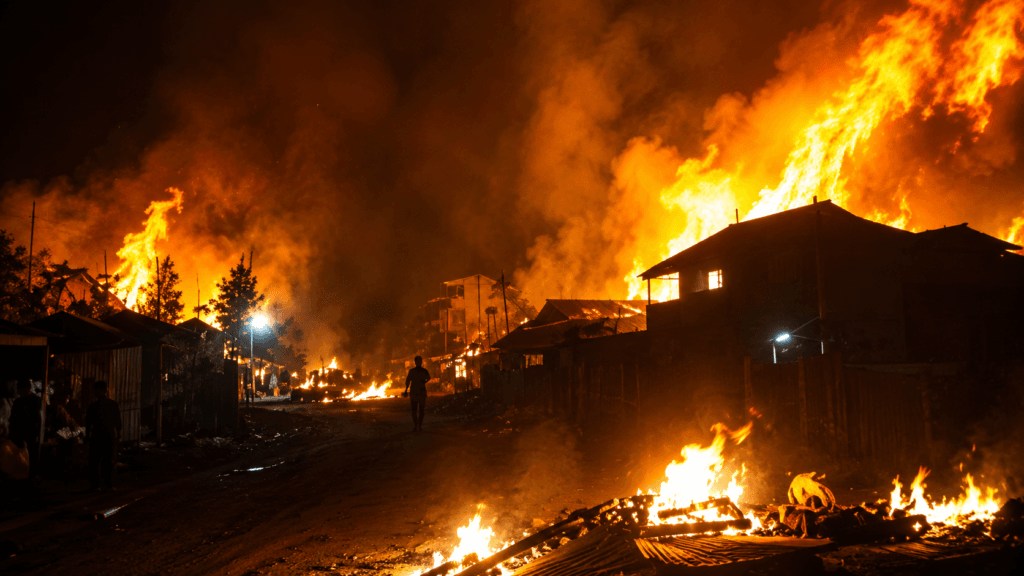
A representative image showing smoke rising from a hill village in Manipur after reports of arson attacks, symbolizing renewed ethnic tensions near the India-Myanmar border.
Manipur has been rattled by fresh violence, including reports of arson attacks on villages in the sensitive Kamjong district, which shares a border with Myanmar. Initial reports said one Kuki-dominated village and two villages of the Tangkhul Nagas were attacked and several houses allegedly torched. The scale of the destruction and possible casualties could not be independently verified at the time of reporting but the incident has revived fears of renewed ethnic tensions in the northeastern state after months of relative calm.
The recent violence has also resulted in a new round of allegations and counter-allegations between the Kuki and Naga organizations. The Tangkhul Naga village authority accused armed cadres of the Kuki National Army-B (KNA-B) and other Kuki militant groups of carrying out coordinated attacks on Kongkan Thana and Shangkalok, two Tangkhul Naga villages bordering the international border. However, Kuki groups have denied the allegations and reportedly accused Naga groups of attacking Kuki settlements, further deepening mistrust between the communities.
As security agencies start their assessment, the incident highlights the fragile peace in Manipur and the ongoing challenges of bringing normalcy to one of India’s most conflict-sensitive regions.
How the Violence Unfolded
Local reports say violence erupted in the early hours of the day in remote villages in Kamjong district. Residents said they saw houses burning and families were forced to run from their homes to safety.
Early reports indicate that arson attacks targeted one village dominated by the Kukis and two villages inhabited by the Tangkhul Nagas. Witnesses said it gutted or damaged a number of houses. Officials, however, have not yet confirmed how many homes were affected and have not officially confirmed reports of injuries or fatalities.
The villages are in remote locations and the difficult terrain and communication problems along the India-Myanmar border have made independent verification of the damage difficult. Security forces reportedly moved in to assess the situation, secure the areas affected and prevent further clashes.
It is expected that authorities will conduct a thorough investigation before determining who is responsible for the attacks.
Fresh Allegations Between Kuki and Naga Organizations
The recent violence has immediately sparked another round of accusations between Kuki and Tangkhul Naga organizations.
The Tangkhul Naga village authorities have accused the armed cadres of Kuki National Army-B (KNA-B) and other Kuki militant outfits for launching coordinated attacks on villages of Kongkan Thana and Shangkalok. These allegations state that the attacks were well-coordinated and carried out in close synchrony to create unrest in the district.
Kuki groups, on the other hand, have refuted these allegations, claiming that Naga groups attacked Kuki settlements. Both sides blamed each other for provoking violence in statements, a sign of the deep mistrust that persists even with repeated appeals for peace from civil society groups and government authorities.
At this time, the allegations have not been substantiated and law enforcement agencies have not officially taken responsibility for the attacks.
Security Forces on Alert
Following reports of the violence, security forces have increased their presence in the Kamjong district and adjoining areas.
The officials are monitoring the situation closely to avoid any reprisal attacks and restore law and order. Further deployments will be considered as the security situation evolves.
Kamjong’s position on the border with Myanmar makes it even more difficult for authorities to monitor cross-border activity and stop armed groups from exploiting the rugged terrain, Upper said.
Senior officials are likely to go through intelligence inputs and coordinate with local administration for the safety of civilians displaced in the violence.
Also read: Bomb Attack Kills Two Children, Firing Claims Two More in Manipur Violence
Background
Manipur has seen protracted ethnic tensions since violence first broke out in May 2023 between the Meitei and Kuki communities, with hundreds dead, thousands displaced and property destroyed.
While the Kamjong district has not been the main epicenter of the Meitei-Kuki conflict, it has remained a sensitive area due to long-standing disputes involving different tribal communities, including the Kuki and Tangkhul Naga populations.
The proximity of Myanmar, armed groups, past land conflicts and competing territorial claims have added complexity to the district’s path to lasting peace.
Over the years, many insurgent groups have operated in the hill districts of Manipur and security management has therefore been a difficult task for the state and central governments.
The recent incident demonstrates that despite strengthened security and ongoing peace processes, local tensions continue to pose a serious risk.
Recent Developments Timeline
Ethnic violence that broke out in May 2023 has dramatically altered the security situation in Manipur. This has resulted in prolonged unrest and a large deployment of central security forces.
The government repeatedly appealed for peace, but in the months that followed isolated incidents of violence, arson and armed encounters continued in different districts.
In recent months, there had been a relative quiet, with fewer large-scale incidents, and a cautious optimism that stability might gradually return.
But the reported arson attacks in the Kamjong district have again raised fears that localized conflicts could trigger greater instability if not contained quickly.
Now, authorities are expected to step up security operations while promoting dialogue among community leaders.
Why This Matters
The latest round of violence is significant as it threatens to unravel the fragile peace efforts in Manipur.
Each new incident increases the mistrust among communities and makes reconciliation more difficult. Families displaced by violence lose not only their homes but also their access to education, healthcare and livelihoods.
This is a very important issue because the violence is affecting ordinary civilians much more than political or armed actors. Whenever clashes erupt, children, the elderly and farmers living in remote villages bear the brunt.
The repeated violence also puts a strain on security forces, humanitarian agencies and local administrations striving to provide relief while maintaining public order.
The incident is a reminder that peace requires not just security operations but sustained political dialogue and confidence-building measures beyond Manipur.
India Angle
From a humanitarian and a strategic point of view, stability in Manipur is important for India.
The state shares an international border with Myanmar and is a critical gateway for trade, border security and India’s Act East Policy. Continued unrest in border districts can disrupt connectivity projects, affect cross-border trade and complicate regional security efforts.
The conflict also points to the larger issues of dealing with ethnic diversity in the north-eastern states of India. Among communities with different histories, identities and territorial aspirations, inclusive governance and continued dialogue are needed to prevent tensions from resurfacing.
The latest incident is another reminder to the citizens across the country that peace and development are inseparable. A stable environment is critical for tourism and infrastructure projects, investors and educational institutions.
Analysis
From a journalistic and conflict-reporting standpoint, the recent violence in Kamjong is a case in point of how easily local-level disputes can spiral out of control in places where trust between communities has already been eroded.
As it stands, the attacks have not yet been officially attributed, and it is critical to distinguish verified facts from competing allegations. In conflict situations, responsible reporting is especially critical, as misinformation can stoke tensions and lead to additional violence.
The event also highlights the limits of relying only on security deployments. To sustain peace, political engagement, community dialogue, transparent investigations and accountability for the perpetrators of acts of violence are needed, while maintaining law and order is essential.
Another important aspect is the role of border management. Kamjong’s proximity to Myanmar poses unique security challenges that demand coordinated intelligence, effective policing and continued vigilance against the movement of armed groups.
Ultimately, the success of the peace efforts in Manipur will depend on rebuilding trust at the grassroots level. But without addressing long-standing grievances and ensuring equal protection for all communities, isolated incidents may continue to threaten broader stability. Also covered by NDTV
What Next?
The immediate priority for the authorities will be the security of the affected villages, to prevent a cycle of retaliatory violence and to provide assistance to displaced families.
Police and security agencies will be expected to conduct a thorough investigation of the attacks, collect evidence and identify those responsible. Authorities may also step up patrols and surveillance in vulnerable border areas to prevent any further incidents.
State and central governments are expected to continue to work with community leaders to de-escalate tensions and promote peaceful dialogue.
Humanitarian agencies could write down property damage and coordinate relief efforts if families have been displaced.
Observers will also be keenly watching whether the incident triggers renewed political discourse on long-term peacebuilding, rehabilitation and conflict resolution in the hill districts of Manipur.
Conclusion
The reported arson attacks in Manipur’s Kamjong district are another disturbing chapter in the state’s long battle to restore lasting peace. The destruction of homes and renewed mistrust between Kuki and Tangkhul Naga communities highlight the tenuous state of security in the region, even as investigations continue and competing allegations remain unverified.
Manipur’s remote hill districts are plunged into uncertainty, displacement and fear with each new flare-up of violence. The highest priority must remain the protection of civilians and an impartial investigation into the latest attacks.
As India continues to work for peace and development in the Northeast, the Kamjong incident serves as a reminder that security measures alone cannot resolve conflicts that have deep roots. Sustainable peace will require dialogue, justice, confidence-building and inclusive governance that addresses the concerns of all communities while ensuring accountability for those who resort to violence.
A holistic approach that combines law enforcement, humanitarian assistance and political dialogue is the only way forward for Manipur to achieve lasting stability and reconciliation.