
The civic body targets alleged illegal extensions and common-area encroachments at Prabhadevi high-rise; notices are issued across Wings A and B, with initial action in four flats.
Rustomjee Crown, a luxury high-rise residential complex in Prabhadevi, Mumbai. Image Credit: NDTV
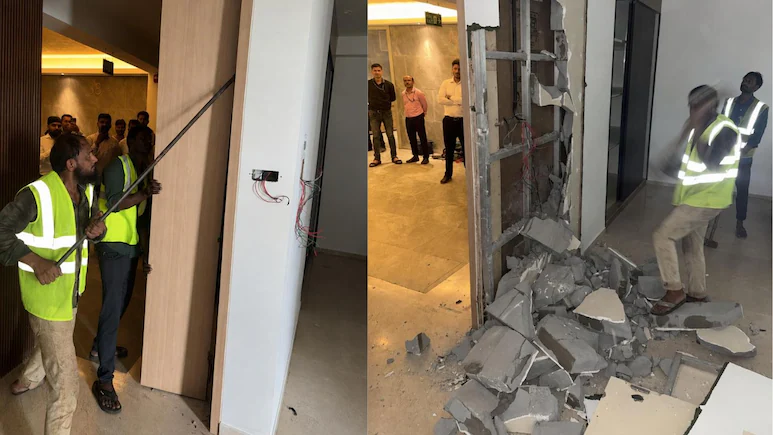
The Brihanmumbai Municipal Corporation (BMC) has begun demolition action against alleged unauthorised construction and alterations at Rustomjee Crown, a luxury housing project in Mumbai’s Prabhadevi area.
The action covers 128 flats across Wings A and B of the project, which was built on the former Crown Mill Compound. The BMC has issued 138 notices over alleged violations of sanctioned building plans, including the incorporation of common and open areas into private apartments.
Initial demolition action has reportedly been carried out in three to four flats, with further action expected over the coming days.
The case has attracted significant attention because several flats are reportedly linked to Maharashtra politicians, bureaucrats and prominent businesspeople. The allegations concern common areas around lifts, lobbies, kitchen ducts, ventilation shafts and other spaces that residents allegedly merged with their apartments.
What the BMC Is Targeting
The complaint alleges that some flat owners incorporated shared spaces into their private homes, increasing the usable area of the apartments beyond what was approved in the sanctioned building plan.
The alleged alterations include:
Common lobby areas near lifts
Lift-side spaces
Kitchen ducts
Ventilation shafts
Free-of-FSI areas
Additional spaces converted into habitable areas
Amalgamation or joining of flat areas
Common areas in a housing project are generally intended for shared use by residents and for essential services such as ventilation, fire safety, access, maintenance and utilities. This story was also covered by NDTV.
If such spaces are enclosed or absorbed into private flats, it can affect building services, emergency movement, fire-safety arrangements and the rights of other residents.
The BMC action is directed at structures and additions it considers unauthorised. It does not mean that all 128 flat owners have been found guilty of the same violation. Each notice and structure will need to be assessed separately.
Complaint by RTI Activist
The complaint was filed by RTI activist Santosh Daundkar in November 2025.
Daundkar alleged that owners of 128 flats had occupied or merged common areas around the lift lobbies and other shared spaces into their apartments. He also raised concerns about unauthorised additions, amalgamation of flats, misuse of free-of-FSI areas and conversion of non-habitable spaces for private use.
Following the complaint, the then BMC additional commissioner Ashwini Joshi directed officials to examine the alleged violations and take appropriate action.
The assistant commissioner of the BMC’s G-South ward subsequently ordered action against structures found to be unauthorised.
The case demonstrates how RTI activists and residents can draw civic attention to alleged construction violations in large housing projects. However, final responsibility must be determined through official records, inspections, notices, hearings and legal proceedings.
Rustomjee Crown Project Details
Rustomjee Crown consists of three towers, each rising to 63 storeys. Two of the three towers have received Occupancy Certificates from the BMC, according to the information available in reports. The project is located in Prabhadevi’s Crown Mill Compound, a high-value area of central Mumbai where residential property commands premium rates.
The affected space is estimated to be worth more than ₹250 crore, according to the complaint and activist’s assessment. Property in the relevant part of the building reportedly sells for more than ₹1 lakh per square foot.
These figures explain why the alleged common-area encroachments have become a major issue. Even a small addition or enclosed lobby area can represent substantial value in a luxury tower.
However, market value alone does not establish the legality or illegality of a structure. The question is whether the additions were approved, whether they comply with building regulations and whether they affect common property or safety requirements.
Flats Linked to Politicians and Prominent Persons
Several flats covered by the BMC action are reportedly linked to public figures.
These include:
A flat linked to Maharashtra Cabinet Minister Sanjay Rathod and his wife, Sheetal Rathod
A flat reportedly associated with former state minister Deepak Kesarkar
A flat belonging to Samadhan Sarvankar, son of MLA Sada Sarvankar
Flats reportedly connected to senior bureaucrats and business
Deepak Kesarkar is reportedly paying ₹4.20 lakh per month in rent for the apartment.
The reported links have added a political dimension to the civic action. But the BMC’s stated position is that it is proceeding against structures it considers unauthorised, regardless of who owns or occupies the flats.
That distinction will be important. The action should be based on building records and approved plans rather than the identity or political status of property occupants.
BMC Notices and Legal Framework
The BMC reportedly issued notices under Section 354A of the Mumbai Municipal Corporation Act and Section 53(1) of the Maharashtra Regional and Town Planning Act.
Such notices are intended to inform owners or occupants about alleged unauthorised construction and give them an opportunity to respond or take corrective action.
If an owner disagrees with the BMC’s findings, they may have legal remedies, including submitting documents, challenging the notice or approaching the courts. The civic body, meanwhile, must follow due process before demolishing structures.
The BMC has said it had issued prior warnings and had been engaging with residents to encourage corrective action wherever necessary.
The ongoing drive therefore appears to be the result of a process that began with a complaint, inspections, notices and follow-up action.
Why Common-Area Encroachments Matter
Common areas are not simply empty spaces waiting to be added to private homes. They may serve several essential purposes:
Access for residents and emergency personnel
Ventilation and air circulation
Fire-safety movement
Maintenance of ducts and pipelines
Lift and service access
Electrical and utility infrastructure
Shared rights of all flat owners
If a common lobby or duct is closed off, maintenance staff may face difficulty reaching vital systems. If ventilation shafts are altered, airflow and fire-safety conditions may be affected.
In high-rise buildings, even small unauthorised changes can create larger safety concerns. Building plans are designed as integrated systems, and changes to one area may affect services elsewhere.
This is why housing societies and residents must obtain proper permissions before carrying out structural modifications.
Mumbai’s Construction and Redevelopment Challenges
Mumbai’s limited land availability and extremely high property prices create strong incentives for additional construction and space optimisation.
In luxury apartments, demand for larger homes and premium amenities can encourage residents to enclose balconies, merge rooms, absorb lobbies or alter ducts. In older buildings, residents may also make changes for practical reasons such as storage, accessibility or interior expansion.
But unauthorised construction can create several risks:
Reduction in common access
Fire and evacuation hazards
Weakening or alteration of structural systems
Pressure on utilities
Disputes between residents
Problems with Occupancy Certificates
Legal complications during resale or redevelopment
For buyers, it is important to verify the approved building plan, Occupancy Certificate, society records and any permissions for alterations before purchasing a flat.
For civic authorities, the challenge is to ensure that rules are enforced equally across luxury towers, middle-class buildings and informal settlements.
Also Read: Maharashtra FDA Suspends Licences of 5 Food Outlets at Mumbai Cricket Association Premises
Timeline
November 2025: RTI activist Santosh Daundkar files a complaint alleging unauthorised construction, common-area encroachment and other violations at Rustomjee Crown.
After complaint: BMC officials examine allegations involving common spaces, lift-side areas, ducts, ventilation shafts and possible flat amalgamation.
Previous year: BMC issues notices to owners of flats in Wings A and B over alleged violations of sanctioned building plans. Reports mention 138 notices covering 128 flats.
Administrative direction: The BMC G-South ward assistant commissioner orders action against structures found to be unauthorised.
August 24, 2026: BMC begins demolition action in several flats at Rustomjee Crown, with initial work reported in three to four apartments.
August 25: Further action is expected against flats covered by notices, subject to civic inspection and legal procedure.
Ongoing: Owners, occupants and civic officials are expected to address notices, documents and possible corrective measures.
Why This Matters
Yeh issue kaafi important hai because it brings together building safety, common property rights, civic enforcement and political accountability.
Public safety: Alterations to lobbies, ducts and ventilation spaces can affect fire safety and emergency access.
Resident rights: Common spaces belong to all eligible occupants and cannot be privately absorbed without lawful approval.
Property values: Alleged encroached space worth more than ₹250 crore highlights the enormous financial stakes.
Equality before law: The BMC’s action will be closely watched because several flats are reportedly linked to influential people.
Urban governance: The case tests whether construction rules are enforced even in premium residential projects.
If illegal alterations are established, the action may encourage other housing societies to review similar changes. If owners have valid approvals, the legal process will determine whether the BMC notices and demolition orders can stand.
India Angle
The Rustomjee Crown case has relevance for luxury housing projects across India. In cities such as Delhi, Mumbai, Bengaluru, Hyderabad, Pune and Gurugram, residents sometimes alter apartments after possession. These changes may involve balconies, shafts, terraces, lobbies, parking spaces or service areas.
Homebuyers should understand that an expensive flat is not exempt from building regulations. Before buying, they should check:
Approved building plans
Occupancy Certificate
Carpet area and sanctioned layout
Society share of common areas
Permissions for structural changes
Fire-safety compliance
Records of disputes or civic notices
Housing societies should also maintain clear rules for renovations and prevent residents from blocking ducts, fire exits, lift lobbies or service areas.
Mumbai mein property rates high hain, lekin high price ka matlab yeh nahi ki common spaces privately use kiye ja sakte hain.
Analysis
The political names are reportedly connected to some apartments. But the deeper issue is the enforcement of sanctioned building plans. A demolition drive can produce immediate visual action, but the larger questions concern approval systems:
How were the alleged alterations carried out?
Were society officials aware?
Did architects, contractors or developers raise objections?
Why did enforcement reportedly follow only after an RTI complaint?
Were Occupancy Certificates issued before or after the alleged changes?
Are other luxury buildings facing similar issues?
The BMC has stated that it is acting against structures it considers unauthorised. That is the correct legal framework. The authority must apply the same standard to every flat and publish clear reasons for each action.
In my view, the case should lead to a broader audit of high-rise residential buildings where common areas may have been converted into private spaces. Demolition alone will not solve the issue unless approvals, inspections and accountability are also improved.
What Next
The following developments are expected:
Further demolition: BMC may continue action in flats where alleged unauthorised structures remain after notices.
Owner responses: Flat owners may submit approvals, sanctioned plans or other documents challenging the civic findings.
Legal challenges: Affected residents may approach courts to seek a stay or clarification on individual structures.
Building safety review: Fire and structural-safety officials may examine whether changes affect ducts, ventilation, lifts or emergency access.
Society accountability: The housing society may be asked to explain how alterations were permitted or carried out.
Political scrutiny: Opposition parties and civic activists may demand details about ownership, notices and enforcement.
Wider inspections: BMC could inspect other luxury high-rises for similar common-area encroachments.
Conclusion
The BMC’s demolition action at Rustomjee Crown has put 128 luxury flats under scrutiny over alleged unauthorised construction and the merging of common areas into private apartments.
Initial demolition has reportedly begun in three to four flats, while further action is expected against structures found to violate sanctioned plans.
The case has drawn attention because some flats are reportedly linked to politicians, bureaucrats and prominent businesspeople. But the legal issue remains the same for every owner: whether the construction was authorised and whether common areas were illegally incorporated into private property.
Written By A. Jack