
New research on an infant from Amud Cave in Israel suggests Neanderthal babies may have grown much faster than modern human infants, reshaping ideas about early human development.
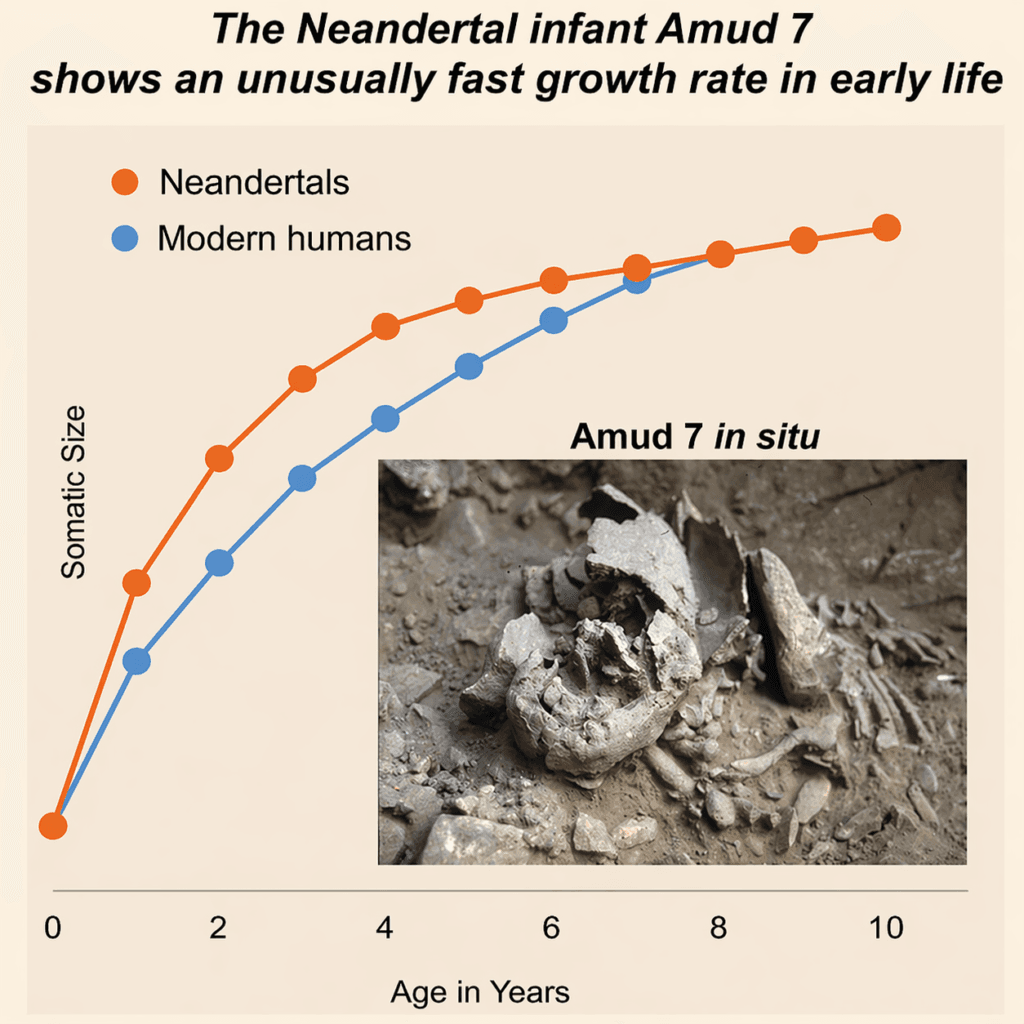
A recent study on the development rate of the Neanderthal infant Amud 7 indicates that he developed at a far quicker pace during his early years compared to present-day infants.
A new study of a Neanderthal infant from Amud Cave in Israel is changing how scientists understand early human evolution. Published in Current Biology, the research suggests the baby, dated to about 51,000 to 56,000 years ago, showed a far more rapid growth pattern than modern human infants.
The discovery matters because it gives researchers a rare look at how Neanderthal children developed physically in their earliest months. In simple terms, yeh finding kaafi important hai because it shows Neanderthals were not just “older humans,” but may have followed a very different biological strategy for survival.
What the Study Found
The infant skeleton, known as Amud 7, is considered one of the most complete Neanderthal infant remains ever found, with around 111 bone fragments recovered. Earlier studies focused mainly on the skull, but the newer analysis looked more closely at the arms, legs, teeth and body proportions.
The teeth suggest the infant died at about 5.5 to 6 months old, yet the arm and leg bones appear much more developed than expected for a modern human baby of that age. Researchers estimate the body length at roughly 70.3 to 78.6 centimetres, which is unusually large for such a young infant. The Cell has covered this story
Why the Growth Pattern Stands Out
Scientists say the Neanderthal infant’s body proportions look closer to those of a modern human child around 13 to 14 months old. That means the bones were developing at a pace that does not match what is normally seen in Homo sapiens babies of the same age.
The study also points to early appearance of adult-like Neanderthal traits, such as a robust clavicle and a relatively straight first rib. These features suggest that certain Neanderthal characteristics emerged very early in life, not only later in adulthood, which gives a different picture of Neanderthal childhood.
Why It Happened
Researchers believe the faster growth may have been linked to the harsh environments in which Neanderthals lived. They inhabited colder Eurasian regions, where a strong body and higher energy demand may have offered survival advantages. Stay updated with all the trending news. Visit SBKI NEWS.
A fast-growing infant may have developed strength and physical resilience earlier, helping the species adapt to cold climates and demanding living conditions. In other words, the Neanderthal body may have been built for speed and survival, while modern humans may have evolved with a different growth balance.
Scientists Say the Fossil Points
The research team said the infant shows “signs of unusually rapid somatic growth,” suggesting Neanderthals had a distinct developmental strategy in early life. That is a significant statement because it supports the idea that Neanderthals were biologically different from modern humans in more ways than previously thought.
Scientists also note that sustaining rapid growth in both the body and skull would have required a huge amount of energy. This makes the finding even more striking, because it suggests Neanderthal infants may have needed a very specific nutritional and biological environment to support that pace.
Amud Cave Discovery and Neanderthal Evolution Context
Amud Cave, located in northern Israel, has been known to researchers for decades, and the infant remains were first discovered in the 1960s and later examined more closely in the 1990s. Only now, with a more complete reanalysis, are scientists able to see the full picture of this infant’s development.
The site dates back roughly 51,000 to 56,000 years, and Amud 7 is one of the youngest Neanderthals ever found there. Previous studies had already identified the skeleton as Neanderthal, but the latest work expands the story from identification to development, which is where the new scientific value lies.
Timeline of the Discovery
1960s: Amud Cave infant remains are first discovered.
1990s: Early analysis focuses mostly on the skull.
2026: A new study in Current Biology examines 111 bone fragments in detail.
April 2026: Findings suggest rapid early growth in the Neanderthal infant.
Why This Neanderthal Baby Discovery Matters
This matters because it changes how scientists think about Neanderthal childhood, development and survival strategy. If Neanderthal babies really grew faster than modern human babies, then the species may have had a very different path to physical maturity.
It also matters for understanding human evolution as a whole. These findings suggest that Neanderthals and modern humans were not just separated by skull shape or tools, but by deep biological differences in how life began and progressed. That is a big deal for anthropology, genetics and evolutionary science.
India’s Curiosity
For Indian readers, this may seem like a distant paleontology story, but it connects directly to the broader question of where humans came from and how our species evolved. India has a strong academic interest in archaeology, evolution and ancient human migration, so such studies often attract attention from students, researchers and general science readers.
It also shows how science keeps rewriting old assumptions. Just like discoveries in Indian prehistoric sites continue to update our understanding of ancient life, this Neanderthal study reminds us that even well-known species can still surprise us. Yeh exactly woh kind of science hai jo curiosity ko alive rakhti hai.
What This Discovery Reveals
My interpretation is that this study will likely become part of a larger debate about Neanderthal life history. If further fossils show similar patterns, the idea of accelerated early growth may become even stronger. But if evidence remains limited to a small sample, scientists will still need caution before making broad claims about all Neanderthal infants.
Still, the central message is already strong: Neanderthals were not simply primitive versions of us. They were a separate human group with their own developmental logic, and that makes the fossil record far more interesting than a basic comparison with modern humans.
What Scientists Study Next About: Neanderthal Growth
The next step will likely be more comparative analysis across other Neanderthal infant fossils, if available. Researchers will want to know whether Amud 7 was unusual or whether rapid growth was a shared pattern across the species.
Scientists may also compare these findings with modern human developmental data, nutrition models and climate adaptation studies. If the pattern holds, it could reshape textbooks and influence how museums and universities explain Neanderthal childhood in the future.
This Discovery Rewrites Early Human Evolution
The Amud Cave infant is more than an ancient fossil; it is a clue to how Neanderthals lived, grew and survived in a harsh world. By showing signs of unexpectedly rapid early growth, the skeleton offers a fresh and more complex view of Neanderthal biology.
For readers and researchers alike, the big takeaway is simple: human evolution was not one straight line. It was a branching, complicated story, and this Neanderthal baby has just added one more surprising chapter.
Written by A. Aisha.