After Rajasthan SOG finds a sample ‘guess’ paper matching more than 140 questions, Centre orders full re-examination, CBI launches probe and NTA promises fee refunds and new dates within 10 days
What happened, to whom, when, and where?
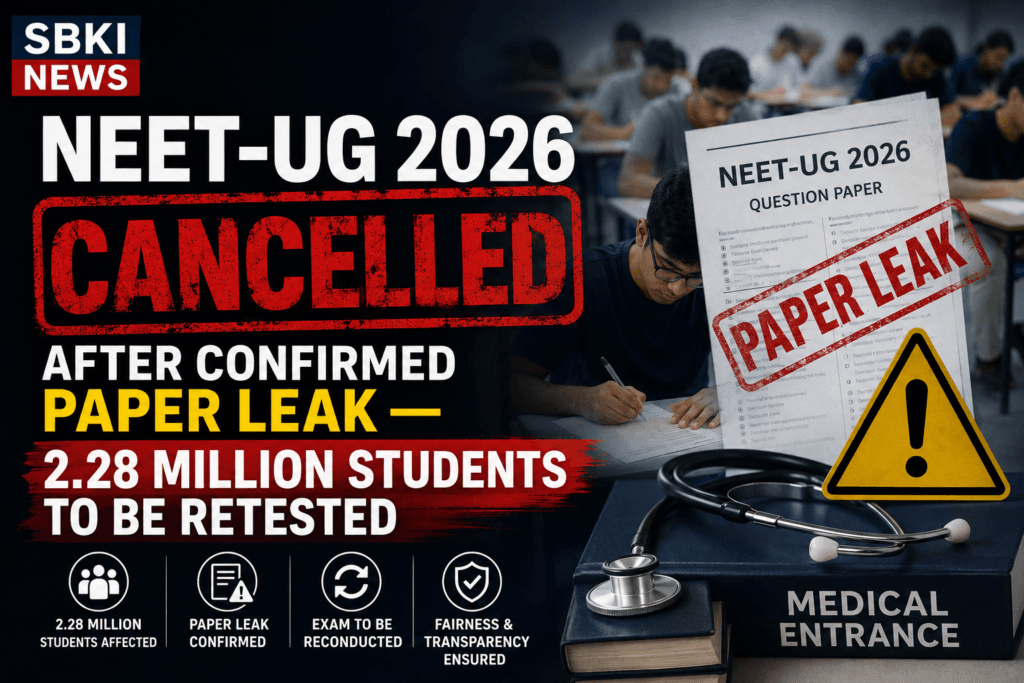
The NEET-UG exam, conducted on May 3, 2026, witnessed approximately 22.79 lakh students sitting for the examination in 565 cities of India and 14 foreign nations. Almost immediately after the conclusion of the examination, allegations of question paper leakage were rampant. The recovered sample or “guess” paper, seized by the Rajasthan SOG, had 410 questions, with more than 140 being identical to those in the actual NEET paper.
After verification from central organizations, the Union government decided to take an unprecedented measure and cancel the whole NEET-UG examination. It has been decided to conduct a fresh examination as soon as possible. The CBI has filed an FIR against unknown individuals and constituted special teams, who have made arrests and detentions. In addition, it has been confirmed by NTA that the candidates will not need to register again and will not incur any extra costs for the examination, as the NTA will pay for the entire cost of the re-examination.
why it happened and how the leak emerged
The allegation about the leakage was based on reports of the striking similarity observed between the “sample” papers that were being distributed and the NEET question paper. According to Rajasthan SOG, they had managed to obtain a document referred to as either a sample or a guess paper with 410 questions. Upon forensic analysis, there were more than 140 matching questions in the question paper for the NEET exam.
What could cause such a thing? There are a number of weak points in large-scale test administration through which a leak can occur: access to draft paper while setting questions, unsecured printing and packaging, distribution and courier channels, local center handling, or coordinated leaks from coaching networks that circulate guess papers. The SOG has got hold of the material, which means it was leaked before the exam. Now the central agencies are looking into the digital footprints, communication records, and printing logs to find out where the leak has happened. “We are looking at printing presses, courier logs, staff who have access to question sets, and coaching hubs, which may traffic in ‘guess’ material,” official sources said.
Verified facts established so far:
The exam was conducted on 3 May in about 5,500 centers.
Approximately 22.79 lakh students appeared for the exam.
The Rajasthan SOG seized a question bank with 410 questions; 140+ questions were similar to the NEET question paper.
The CBI is investigating the case and has formed special teams.
The NTA has cancelled the exam, refunded the fees, and assured that there won’t be any fee for a re-test and fresh registration.
Responses and statements
The NTA Director General explained that the cancellation of the test was done to preserve the sanctity of the examination process and safeguard the interest of the students and further stated that the agency is ready to assist the CBI in any way. The CBI confirmed that a case had been registered by them, and their teams were investigating sources and suspects in various states.
Police from Rajasthan, along with SOG, stated that a high percentage match led to the cancellation of the test. Various student associations and parents are disappointed, anxious, and outraged—many students feel that their efforts spent over months and years may be wasted.
Background and context
NEET-UG is the biggest means through which lakhs of students gain entry to medical education at an undergraduate level each year. Ever since NEET was implemented, it has been considered the standardized way to pursue a career in the field of medicine instead of opting for exams conducted by various states. Considering how crucial and demanding a test NEET is—being responsible for limited seats available and years-long preparations through coaching classes—it is bound to generate a lot of pressure. Previous incidents such as exam malpractice have occasionally led to re-examination; however, an outright nationwide cancellation is unprecedented.
Timeline
May 3: NEET-UG examination held in 565 cities.
First week of May: Rumors on social media and ground level regarding repeated questions and the similarity of the chemistry/biology tests.
After a few days: Rajasthan Special Operations Group seizes a question paper sample; analysis reveals around 140 similarities.
CBI lodges case and forms squads; arrests and searches follow.
Government directs cancellation; NTA declares retest in 10 days and reimbursement of fees.
Why this matters
The cancellation will affect nearly 2.28 million aspirants and their families. For students this means immediate consequences: disrupted timelines, uncertainty about admission, additional stress, and the cost of travel and accommodation to retake the exam. Many candidates, especially from small towns and economically weaker backgrounds, have trained for months, at great expense, and a retest puts them through renewed psychological and financial burdens.
On the institutional front, the NTA and the larger higher-education ecosystem are facing a credibility crisis. The meritocratic premise of admissions – fair competition with secure testing – is damaged if a central exam is seen as tainted. The fallout may also affect admission cycles of medical colleges, leading to delays in counseling and the start of academic sessions. At a governance level, the case raises questions about exam procurement, printing contracts, local center accountability, and whether systemic reforms are overdue.
local and regional consequences
The impact of NEET is felt all over India but especially in small towns where the coaching economy is built around national tests. The hubs of concentrated anxiety will be states with large coaching centers and a heavy flow of aspirants (Rajasthan, Uttar Pradesh, Bihar, Telangana, Andhra Pradesh, Tamil Nadu, and Maharashtra). Uncertainty will impact the economy of coaching hubs and allied sectors (hostels and transport). Opposition and student groups may seek political accountability. The emergence of state policing agencies (such as Rajasthan SOG) as the first flagging authority highlights the intersection between regional enforcement and national-level testing bodies.
Analysis
A few points are worth noting from a journalistic and policy perspective. The scale of the matching questions indicates the leak was not small-scale or opportunistic; it required access to material allowing accurate prediction. Second, the modern countermeasures used around the world – multiple rotating question sets, encrypted digital distribution, last-minute printing with tight chain-of-custody, and independent auditing – must be strengthened. Third, technology can help. Secure printing with tamper-evident packaging, blockchain-style audit trails for question transfers, biometric proctoring, real-time CCTV streaming to central servers, and randomized seat allotments could reduce risk.
Operational reforms that NTA may adopt are independent concurrent audits during printing, central dispatch with GPS and sealed delivery, background checks of staff having access, and criminal sanctions on coaching hubs selling guessed/compiled papers. In the short term, clear public updates from the CBI and NTA – with timelines and named action points – will be key to limiting misinformation and panic. |This Story also covered by The Hindu
What next?
In the immediate future, special teams of the CBI will continue raids, interrogations, and digital forensics. People caught with leaking material or aiding its distribution will likely be arrested. NTA to announce new dates in 10 days; re-exam likely to have new question sets, strict protocols at centers; NTA will refund or adjust candidates’ fees for administrative purposes. New registrations will not be required.
In the longer term, there may be lawsuits and investigations by the legislature or judiciary. In case of institutional responsibility or involvement in fraud, structural changes to the exam process might become necessary. There will certainly be discussions on the issue of coaching practices, regulation of printing and distribution of exams, and demands for more openness.
Conclusion
The cancellation of NEET UG 2026 is an earth-shattering move. Many students will face great distress at once, but it is also an indication of the gravity with which exam malpractice must be taken. Adequate investigation of the matter and swift action to restore faith in the system and to bring about the necessary changes to prevent this from happening again in the future. Meanwhile, students are waiting to see what happens next, comforted by government promises that they will get their money back and be retested.
Written by M.A. Arif