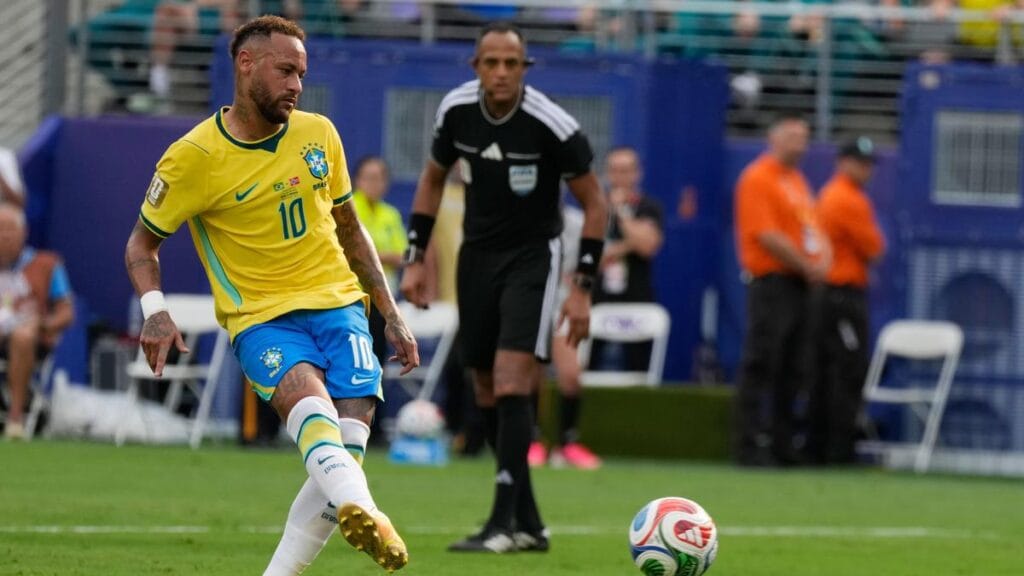
His international journey “started here” at MetLife Stadium and “finished here” after Brazil’s knockout exit, the forward said. Neymar also scored a late penalty after coming off the bench against Norway but it wasn’t enough to save Brazil.
Neymar reacts after Brazil’s 2-1 World Cup loss to Norway at MetLife Stadium, a match that marked the end of his international career. Image Credit: The Hindu
Neymar has announced his retirement from international football after Brazil were eliminated from the World Cup by Norway in the round of 16. The 34-year-old, Brazil’s most influential player for more than a decade, said on Sunday, July 5, 2026, that his journey with the national team is over. Brazil’s exit and Neymar’s decision together mark the end of one of the most closely watched chapters in modern football.
Neymar’s final appearance for Brazil came at MetLife Stadium, the same venue where he made his international debut on August 9, 2010, in a friendly against the United States. Against Norway, he came off the bench and scored a penalty in the closing minutes, but the goal only reduced the margin in a match Brazil ultimately lost 2-1. The moment carried heavy symbolism: the place where it began was also where it ended.
What Neymar Said
Neymar’s words made the announcement feel immediate and final. “I tried,” he said. “It started here at MetLife Stadium, and I finished here. It is now over.” That statement captures both the emotional weight of the night and the sense of closure that followed Brazil’s exit. The Hindu has covered the full story.
He did not frame the decision as a pause or a possible comeback. Instead, the language suggested finality. For a player who has carried Brazil’s hopes in multiple tournaments, that is a major shift. It also signals that the national team is moving into a new cycle without its long-time leading star.
Why He Is Stepping Away
Neymar has been slowed by injuries in recent years, and those fitness problems limited his impact on the national team. While his talent remained unquestioned, repeated physical setbacks made it harder for him to stay consistently available or at his peak. Over time, that changed Brazil’s dependence on him and opened the door for transition.
This retirement announcement also fits the bigger reality of Brazil’s current squad. The country is now entering a period where the next generation is expected to take over the attacking load. That does not erase Neymar’s influence, but it does mark the end of the era in which he was clearly the central figure.
For Brazil, the timing is important. A World Cup exit often forces reflection anyway, and Neymar’s decision intensifies that moment. The team must now rebuild without the player who defined its identity for more than a decade.
Neymar’s Brazilian Legacy
Neymar’s international career began on August 9, 2010, in a friendly against the United States at the same stadium where he ended it. That symmetry gives his story a powerful narrative shape. Few careers have such a clear opening and closing image.
Over the years, Neymar became Brazil’s most important player and one of the most recognisable figures in world football. He was expected to carry the legacy of Brazil’s greatest attacking traditions, and for long stretches he did exactly that. Injuries, however, became a recurring obstacle, and those limitations shaped the second half of his international journey.
Even so, his influence on the national team cannot be measured only by trophies or final results. He carried expectations that few players ever face, and he did so across multiple tournaments. That alone places him among Brazil’s defining football figures.
How the Final Match Unfolded
Against Norway, Neymar was brought on from the bench and still managed to score a penalty in the final minutes. That detail matters because it shows he remained capable of decisive moments even late in his career. But Brazil had already fallen behind, and the goal could not change the outcome.
Norway’s 2-1 victory had already set Brazil on the path out of the tournament. Neymar’s late contribution offered a brief reminder of his quality, but the result was already beyond repair. In that sense, the match became less about one final goal and more about the end of a cycle.
The image of Neymar scoring in his final international game is powerful, but it also underlines the frustration of a career that never quite delivered the World Cup-ending fairy tale many expected. That emotional contradiction is part of what makes his retirement such a major story.
Background and Context
Brazil’s World Cup exit has immediate consequences beyond the scoreboard. The national team is now in transition, and Neymar’s retirement accelerates that process. For a country used to seeing him as the attacking reference point, this is a major change in identity.
His career has also been shaped by the tension between brilliance and availability. At his best, Neymar was capable of changing matches almost alone. But the injuries that followed him in later years made Brazil’s long-term planning more complicated.
That broader context explains why his retirement feels like the closing of a chapter rather than just the end of a player’s international run. Brazil must now move on while also acknowledging how much of its recent football story revolved around him. That is never easy for a team or for supporters who grew up watching him.
Timeline
August 9, 2010: Neymar makes his Brazil debut in a friendly against the United States at MetLife Stadium.
Over the next decade-plus: He becomes Brazil’s leading player and face of the national team.
Recent years: Injuries repeatedly limit his availability and consistency.
July 5, 2026: Brazil lose 2-1 to Norway in the World Cup round of 16.
After the match: Neymar announces that he is done playing for Brazil.
Current phase: Brazil begins a transition toward the next generation.
Also Read: Haaland’s Brace Sends Norway Past Brazil 2-1 in Stunning FIFA World Cup Round of 16 Upset
Why This Matters
This matters because Neymar’s retirement is not only a player announcement; it is a national-team turning point. Brazil have long built their identity around star forwards, and Neymar carried that expectation more than anyone in his generation. His exit means the team must now redefine itself without the player who has been its emotional and tactical centre for so long.
It also matters because his career reflects the pressure that comes with being “the next great Brazilian star.” That label can be a burden as much as an honour. Neymar lived through both sides of it. He delivered memorable moments, but he also carried the weight of constant comparisons and unfinished expectations.
For football fans, this is the end of an era. Whether they loved him or criticised him, few can deny that Neymar shaped Brazilian football for years. When a figure like that steps away, the sport changes a little.
India Angle
For Indian football fans, Neymar’s retirement will feel familiar in one important way: it shows how a team can move from dependence on a single superstar to a broader generational shift. In Hinglish, seedhi baat yeh hai — jab ek bade star ka era khatam hota hai, toh team ko naye leaders dhoondhne padte hain. Brazil are going through that exact transition now.
Indian supporters also understand the emotional side of watching a favourite player’s final chapter. Many fans in India have followed Neymar since his early days because of his flair, dribbling and big-match personality. Seeing him leave the international stage after a World Cup exit is a reminder that even the biggest names eventually pass the torch.
There is also a lesson here for Indian football development. Long-term success depends not only on star power but on building a system that can survive transitions. Brazil is now in that process, and it will be closely watched by fans everywhere, including India.
Analysis
My opinion is that Neymar’s retirement announcement felt inevitable once Brazil were knocked out, but the venue gave it unusual emotional force. The same stadium framed the beginning and the end of his international career. That kind of symmetry is rare and gives the story a strong headline value.
From a football perspective, this also reflects the reality of modern elite careers. Injuries can reshape even the best player’s arc, and national teams eventually have to plan for life after their biggest stars. Brazil are now entering that phase whether they are ready or not.
I also think Neymar’s final penalty is a fitting detail. It shows that even in a reduced role, he could still create one more meaningful moment. But in the larger story, the last image is not the goal — it is the transition.
What Next
Brazil will now begin planning for the future without Neymar in the national setup. That means more responsibility for the younger generation and a new tactical structure around emerging talent. The football federation and coaching staff will need to decide how to redefine the attack.
For Neymar himself, the next chapter is likely to focus on club football and his personal life away from the demands of international competition. His Brazil career, however, is now over, and that is the story dominating the football world.
Supporters will continue to debate where he stands in Brazil’s football history. Some will focus on the injuries and the World Cup disappointments. Others will remember the brilliance, the decisive goals and the sheer joy he brought to the national team. Both views will shape his legacy.
Conclusion
Neymar’s announcement closes one of Brazilian football’s most influential eras. His international career began at MetLife Stadium in 2010 and ended there after Brazil’s 2-1 World Cup loss to Norway, where he scored a late penalty before confirming that his time with the national team is over. Injuries may have slowed him, but they do not erase the scale of his impact. Brazil now turn to a new generation, while Neymar leaves behind a legacy defined by brilliance, expectation and the heavy weight of carrying a football nation.
Written By A. Jack