Prime Minister Narendra Modi addressed India’s 11th Heads of Mission Conference in New Delhi, where he gave guidance on advancing India’s national interests abroad. The three-day conference focused on reforming Indian diplomacy for 2047, with discussions on geopolitics, emerging technologies, and the Bharat story.
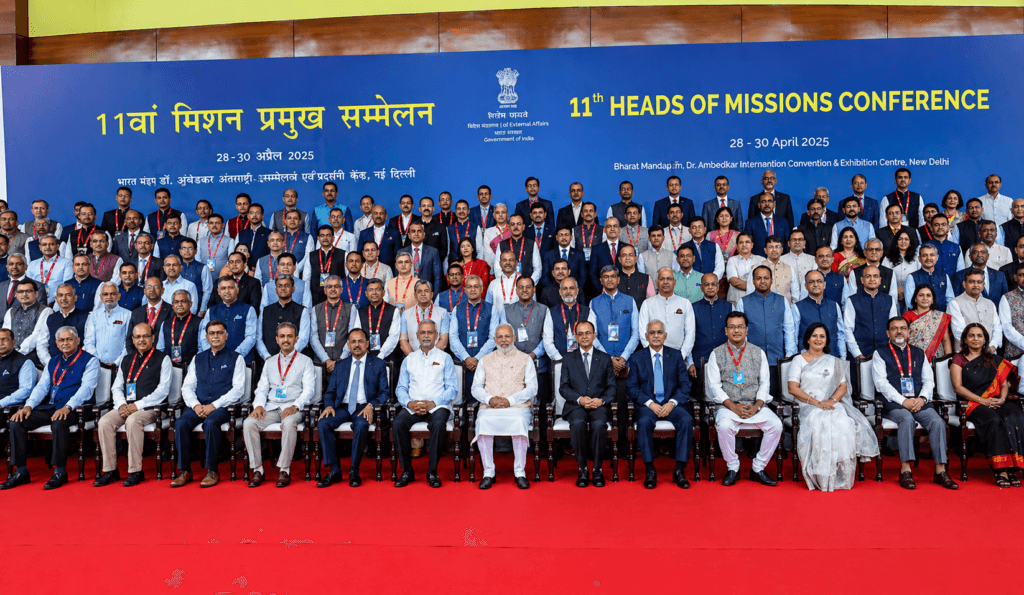
Prime Minister Narendra Modi addresses diplomats at the 11th Heads of Mission Conference in New Delhi, where India’s diplomatic priorities for 2047 were discussed.
PM Modi Gives Strategic Guidance
Prime Minister Narendra Modi on Thursday addressed the 11th Heads of Mission Conference in New Delhi and offered strategic guidance to India’s ambassadors and envoys posted around the world. According to the Ministry of External Affairs, the Prime Minister spoke on promoting India’s national interests overseas and strengthening the country’s diplomatic outreach.
The conference, organised by the External Affairs Ministry from April 28 to 30, brought together Heads of Mission for a high-level review of India’s foreign policy priorities. External Affairs Minister Dr. S. Jaishankar delivered the inaugural address, setting the tone for three days of intense policy discussion, brainstorming, and future planning.
What The Conference Focused On
This year’s conference was centred around the theme “Reforming Indian Diplomacy for 2047,” which directly connects with India’s long-term national vision as the country moves toward its centenary of independence. The discussions were not limited to traditional diplomacy. They also covered emerging technologies, geopolitical developments, India’s global image, and what officials described as the “Bharat story.” The Akashvani News has covered the full story.
That combination is important because diplomacy today is no longer only about bilateral meetings or formal agreements. It now includes tech policy, economic strategy, digital influence, global narratives, and crisis management. In simple words, aaj ki diplomacy sirf embassy-level kaam nahi hai — it is about shaping how the world sees India in every major domain.
Why Modi’s Address Matters
Prime Ministerial guidance at a conference like this is significant because ambassadors and high commissioners represent India’s voice in foreign capitals. Their day-to-day work can influence trade, investment, strategic partnerships, evacuations, consular support, and India’s position in international forums.
When the Prime Minister directly addresses them, it signals a clear top-level policy push. The message is usually not just about protocol; it is about priorities. That means India’s diplomats are expected to align their work more closely with the government’s larger goals, especially as India prepares for a more ambitious global role by 2047.
Why This Conference Was Different
The Heads of Mission Conference has always been an important internal meeting, but the 2047 theme makes this edition especially forward-looking. The focus on reform suggests that India is not only trying to maintain its diplomatic network, but also reimagine it for a more complex and technology-driven world.
The inclusion of yoga, tabletop exercises, and thematic discussions shows that the conference was not just a formal speaking event. It appears to have been designed as a practical working session where envoys could discuss real-world scenarios, policy challenges, and ways to improve coordination. That hands-on format makes the conference more useful than a ceremonial gathering.
Background And Context
India’s foreign policy landscape has changed significantly over the last decade. The country is now dealing with a wider set of partnerships and pressures — from strategic competition in the Indo-Pacific to global technology governance, energy security, supply chain resilience, and the India narrative abroad.
The Ministry of External Affairs has therefore been trying to push a more dynamic diplomatic model. Conferences like this help ensure that ambassadors and mission heads are not working in silos. They are expected to carry a common national message while also adapting it to local realities in their host countries.
Timeline
April 28, 2026: The 11th Heads of Mission Conference begins in New Delhi.
April 29, 2026: External Affairs Minister Dr. S. Jaishankar delivers the inaugural address.
April 28-30, 2026: Mission heads participate in yoga sessions, brainstorming, tabletop exercises, and thematic discussions.
April 30, 2026: Prime Minister Narendra Modi addresses the conference and provides guidance.
Also Read: Tragic Hit-and-Run in Delhi Kills Two Cousins Returning from IPL Match
India Angle
For Indian readers, this conference matters because diplomacy is directly linked to jobs, trade, travel, education, and global standing. A stronger foreign service can help Indian businesses expand overseas, protect Indian students and workers abroad, and secure better strategic outcomes for the country.
Yeh issue kaafi important hai because India’s global influence is growing, and with that growth comes responsibility. The country needs diplomats who can explain India’s priorities clearly, build trust, and deal with a fast-changing international environment. This is not just Delhi-level policy talk — it has a real impact on people and businesses across India.
What The “Bharat Story” Means
The reference to the “Bharat story” is especially telling. It suggests that India’s foreign missions are being asked to present a stronger narrative about the country’s development, culture, innovation, and ambitions. That narrative can be as important as policy itself because perception shapes partnerships.
If India wants to attract investment, tourism, education links, and strategic confidence, its missions abroad must project a compelling and consistent story. This includes explaining India’s reforms, digital growth, manufacturing capacity, democratic strength, and social diversity in a way that resonates internationally.
Analysis
My analysis is that this conference reflects a shift from reactive diplomacy to planned, future-oriented diplomacy. The emphasis on emerging technologies is especially notable because global power today is increasingly shaped by AI, digital infrastructure, cyber policy, and data governance. India’s missions will likely be expected to speak more strongly on those subjects in the years ahead.
Why This Matters
This matters because diplomacy affects national outcomes in ways that are often invisible to the public. A well-run mission can help secure trade deals, support Indian citizens abroad, and protect India’s strategic interests during crises.
It also matters because India is entering a phase where its international role is expanding. The world is watching India’s economic rise, its digital transformation, and its position on major geopolitical questions. That means Indian diplomacy has to be sharper, more coordinated, and more future-ready.
What Next
The next step will likely involve follow-up action from the Ministry of External Affairs based on the conference’s discussions. Missions may receive updated guidance on global messaging, technology diplomacy, economic outreach, and country-specific priorities.
There may also be greater emphasis on training and institutional reform as India prepares for the 2047 target. If the theme is taken seriously, the conference could shape how Indian missions operate for years, not just months.
Conclusion
Prime Minister Narendra Modi’s address to the 11th Heads of Mission Conference highlights how central diplomacy has become to India’s future strategy. With the conference focused on “Reforming Indian Diplomacy for 2047,” the message is clear: India wants its global outreach to be more ambitious, more modern, and more aligned with national goals.
For the country, this is not just about embassies and envoys. It is about building a stronger global position, protecting Indian interests, and telling India’s story with confidence in a rapidly changing world.
Written By A. Jack