
The viral video showed PSI Sandeep Kadam of Deccan Police Station knocking items off the counter and allegedly threatening staff and customers. The Pune Police have taken disciplinary action saying his conduct has damaged the image of the force.
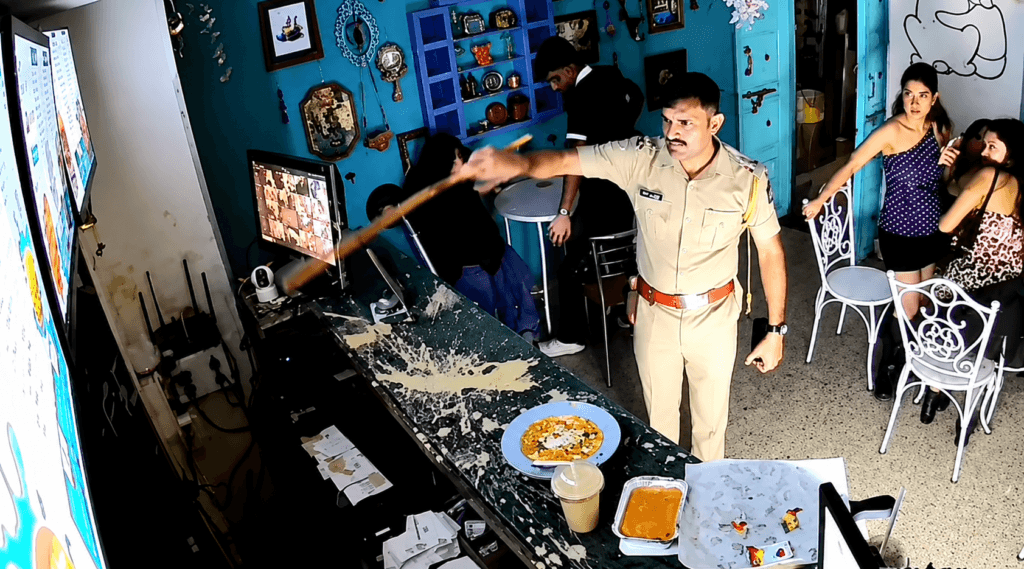
CCTV footage from Flying Gipsy Cafe in Pune allegedly shows PSI Sandeep Kadam creating a ruckus. Image Credit: India Today
A Pune police sub-inspector has been suspended after a CCTV video allegedly showed him misbehaving inside a cafe and forcing customers to leave late at night. The incident reportedly took place around 1.45 am on June 7 at Flying Gypsy Cafe on Shirole Road, where PSI Sandeep Kadam, posted at Deccan Police Station, was on duty when he entered the establishment. The footage, which has now gone viral, has sparked strong criticism online and prompted swift action from the police department.
The video appears to show the officer carrying a baton, sweeping cups and food items off the counter, and confronting people inside the cafe. According to the allegations, he also used abusive and threatening language toward staff. While the matter is still expected to go through departmental scrutiny, the immediate suspension shows that the police force is treating the incident seriously. Yeh incident kaafi sensitive hai because it directly affects public trust in law enforcement.
What the CCTV Footage Shows
Based on the widely circulated footage, PSI Kadam is seen entering the cafe and causing a disturbance. He allegedly knocks items off the counter, orders customers to leave and confronts staff in a manner that appears aggressive. The baton in his hand makes the visuals even more alarming because it signals authority being used in a way that looks intimidating rather than protective. India Today has covered the full story.
For members of the public, such footage can be deeply unsettling. A police officer is expected to calm a situation, not escalate it. When a uniformed officer appears to behave aggressively in a public place, the impact goes beyond the incident itself. It raises questions about judgement, discipline and the standards expected from those entrusted with enforcing the law.
The viral nature of the video also matters. Once such footage spreads online, it quickly becomes part of a wider public conversation about policing. People do not just react to the incident; they react to what it symbolises. In this case, it symbolises misuse of authority, even if the departmental inquiry may later examine more details.
Official Action Taken
Following the circulation of the video, Additional Commissioner of Police Rajesh Bansode issued orders suspending Kadam pending further action. The police department said his behaviour was irresponsible, indisciplined and harmful to the image of the force. That statement is important because it shows the institution itself recognised the seriousness of the episode.
Suspension is the first disciplinary step, not necessarily the final one. It removes the officer from active duty while the department examines the matter further. In cases like this, the internal process may include reviewing CCTV footage, recording statements from staff and customers, and checking whether the officer was on official duty and whether his actions violated service rules.
The quick response from the department also suggests that public pressure and the clarity of the footage may have left little room for delay. In the digital age, misconduct can be recorded, shared and scrutinised within hours. That reality is changing how institutions respond to allegations. Pehle such incidents local level par reh jaate the, but ab viral footage ke baad action jaldi lena padta hai.
Why the Incident Stands Out
What makes this case stand out is not just that a police officer allegedly misbehaved, but that he did so while on duty and in uniform. That combination makes the matter much more serious. People expect a certain code of conduct from police personnel, especially in public-facing situations.
The alleged use of a baton inside a cafe also deepens concern. A baton is a symbol of state power, and seeing it used to sweep items off a counter creates a strong visual impression of intimidation. Even if there are broader circumstances not yet public, the footage alone is enough to trigger questions about proportionality and restraint.
Another reason this case stands out is the setting. A cafe is a public place where customers, staff and bystanders should be able to feel safe. When a police officer appears to turn that place into a site of confrontation, the trust gap widens. That is why this story has resonated so widely.
Background and Context
Police accountability has been a recurring topic in Indian cities, especially when footage or eyewitness accounts bring official behaviour into public view. In many cases, disciplinary action follows only after public pressure builds. That pattern makes the Pune suspension notable because it appears to have happened relatively quickly once the footage spread.
Public trust in policing depends on consistency. Citizens expect officers to act firmly when needed, but also professionally and within the law. When that balance is broken, even once, it can colour perceptions of the force more broadly. This is why departments often move quickly in high-visibility cases: they are not only managing one complaint, they are managing institutional credibility.
Pune, like many major Indian cities, has a large youth population, a vibrant nightlife and many late-night commercial spaces. That creates a regular interface between law enforcement, business owners and customers. Such interactions need to be handled carefully, because a single confrontation can become a citywide issue overnight.
Timeline
June 7, around 1.45 am: The alleged incident takes place at Flying Gipsy Cafe on Shirole Road.
During the incident: PSI Sandeep Kadam is reportedly seen entering the cafe, carrying a baton and creating a ruckus.
Soon after: CCTV footage surfaces and begins circulating on social media.
Public reaction: Users criticise the officer’s conduct and question police accountability.
Departmental response: Additional Commissioner of Police Rajesh Bansode orders Kadam’s suspension.
Next phase: The matter is expected to be reviewed further under departmental procedures.
Also Read: Siya Goyal Lover Chetan Chaudhary Sent to 14-Day Judicial Custody in Pune Murder Case
Why This Matters
This matters because the police are the public face of law and order. When an officer appears to misuse authority, it can damage confidence not just in one station or one city, but in the system itself. People need to believe that the people enforcing rules are also bound by them. Yeh issue kaafi important hai because accountability is the foundation of trust.
It also matters for business owners and customers who operate in late-night public spaces. Cafes, restaurants and other establishments need clarity about how officials should interact with them. A clear line between lawful enforcement and harassment is essential for a healthy urban environment.
For ordinary citizens, the case is a reminder that cameras now change everything. Behaviour that may once have gone unrecorded can now be reviewed by thousands of people. That can be uncomfortable, but it also increases accountability. In that sense, the footage may serve as a deterrent to future misconduct.
India Angle
For Indian readers, this case feels especially relevant because it reflects a larger national conversation about police conduct, power and public behaviour. In Hinglish, seedhi baat yeh hai: uniform ka matlab authority hai, lekin authority ka matlab freedom to misbehave nahi hota. People across India are becoming more vocal about that distinction.
The incident also matters in the context of urban nightlife and late-night policing in Indian cities. Pune, like Mumbai, Bengaluru and Delhi, has a young population that uses cafes and restaurants late into the night. Police presence is necessary for safety, but it has to be professional and predictable. Otherwise, trust erodes quickly.
Social media also plays a big role here. Indian users often react strongly when videos show people in power behaving badly. That pressure can be useful because it pushes institutions to respond faster. But it also means every such incident becomes a test of whether the system can self-correct.
Analysis
My opinion is that the most important part of the story is not just the misconduct itself but the speed of the institutional response. Quick suspension helps signal that the department does not ignore such complaints. That matters for public confidence. But suspension alone is not enough; the department must also complete a fair and transparent inquiry.
I also think this story shows how much modern policing is shaped by visibility. Officers are not only judged by what they do, but by how it looks on camera. That is not always perfect or complete, but it is the reality now. In that environment, discipline and restraint are not optional extras; they are core professional requirements.
At the same time, a full inquiry matters because context matters too. If there were earlier complaints, a disturbance, or any reason for the officer to enter the cafe, those details will be relevant. But unless and until the department clarifies them, the footage remains the dominant public record.
What Next
The next step will likely be a departmental inquiry into PSI Kadam’s conduct, including a review of the CCTV footage and statements from cafe staff and customers. The police may also examine whether any service-rule violations occurred and whether the officer’s actions warrant further punishment beyond suspension.
If the inquiry confirms misconduct, possible outcomes could include a formal charge-sheet, prolonged suspension or other departmental penalties. The case may also be used as a reminder for training and supervision within the force.
For the public, the expectation will be simple: a transparent conclusion and visible accountability. Without that, the suspension could be seen as only a temporary response rather than a meaningful reform step.
Conclusion
The Pune cafe incident involving PSI Sandeep Kadam is a troubling example of how quickly a routine night can turn into a public accountability case. The viral CCTV footage appears to show the officer misbehaving with staff and customers, prompting the police department to suspend him and begin further action. As the inquiry moves forward, the broader issue remains clear: those who enforce the law must also be seen to respect it. That principle is what public trust depends on.
Written By A. Jack