Vijay, the head of TVK, has reportedly given the Governor support from 112 MLAs, but that is still not enough to form a government, which needs 118 MLAs. The political contest in Tamil Nadu is now in a tense waiting period.
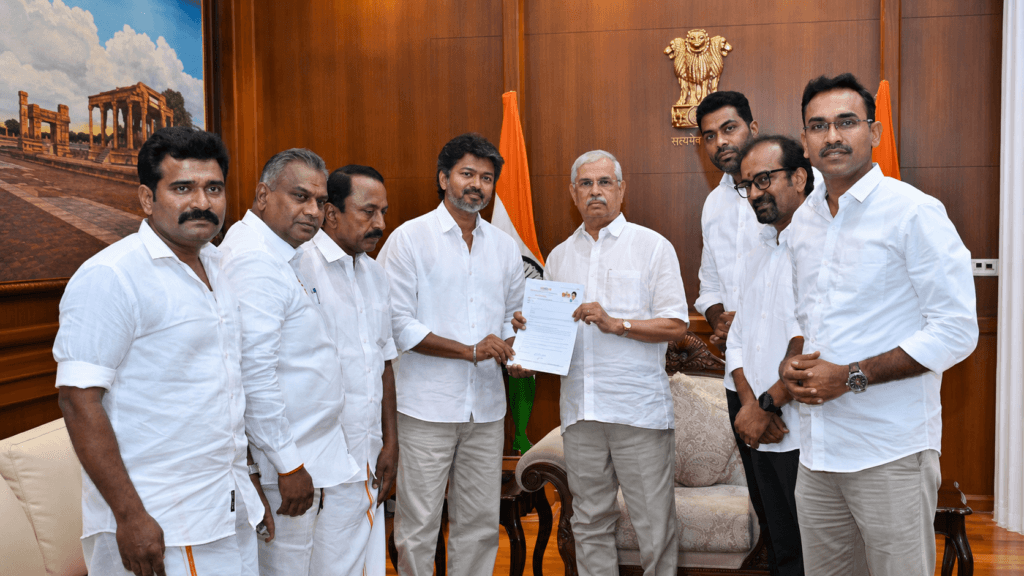
Vijay, the head of the TVK party, meets with Rajendra Arlekar, the governor of Tamil Nadu, during a tense fight to form a government. Sources say that 112 MLAs supported him.
Reports say that Vijay, the head of the Tamilaga Vettri Kazhagam (TVK), has reached an important point in Tamil Nadu politics after giving Governor Rajendra Arlekar letters of support from 112 MLAs. It is said that the Governor told him to come back with proof of 118 MLAs, which is the number needed for a clear majority in the 234-member assembly.
This development has turned into one of the biggest political stories in the state, because it shows how close Vijay is to power while still being short of the final numbers. In simple words, the game abhi khatam nahi hua hai—the race is still on.
Related: Vijay’s TVK Sweeps Tamil Nadu as Driver’s Son Wins Virugambakkam
How the Numbers Game Started
The current deadlock is because Vijay’s side is said to have the support of 112 MLAs, which is not enough to reach the 118-mark needed for a majority in Tamil Nadu. TVK is said to have 107 MLAs, and Congress adds five more, bringing the total to 112. India Today has covered this story.
Reports say that Vijay gave these signatures to the Governor at a meeting at Raj Bhavan/Lok Bhavan, but the Governor wasn’t completely convinced and told him to come back with 118 MLAs. That means the political math isn’t done yet, and more allies may need to join in before the swearing-in can happen.
The situation has made people anxious because the numbers show that the next 24 hours could change everything. Reports also say that the VCK and Left parties might join the alliance, which could help close the gap.
Why It Happened
This situation happened because Vijay’s camp won enough seats to become a serious contender, but not enough to claim power on its own. In coalition politics, even a small numerical shortfall can delay the formation of government, and that is exactly what is happening here.
The Congress has already agreed to help, but only if no communal forces are part of the alliance. This makes things both stronger and more complicated politically. There are also rumors that VCK and Left parties will give more support, which means that the alliance is still being put together in real time.
This is a perfect example of how post-election bargaining works in India from a political strategy point of view. The numbers on paper are important, but so are timing, trust, and whether leaders are willing to publicly support one side.
Reported Statements
Sources quoted in coverage say the Governor told Vijay to “come back with 118,” which has become the central line driving the story. That phrase has now taken on symbolic meaning because it clearly signals that the claim to power is not yet complete.
A report from India Today it was said the TVK had submitted “107 plus five” signatures, but the Governor asked for 118 before moving ahead. Another report said Vijay’s oath-taking looked unlikely immediately because the Governor was not convinced by the numbers.
These statements matter because they show that the issue is not political drama alone — it is a constitutional arithmetic test. Until the majority mark is reached, the road to government remains uncertain.
Background and Context
One of the most closely watched events in Tamil Nadu has been Vijay’s rise to power. TVK, his party, has become a major new force, and this fight to form a government shows that it can now talk directly to the state’s biggest players.
Tamil Nadu has a long history of coalition politics, changing alliances, and strong regional identities. That means that every seat and every letter of support is important. The state often rewards parties that can build wider partnerships instead of relying on the popularity of one leader, which is different from landslide-style politics.
Timeline
Election results: TVK emerges as a major force in Tamil Nadu politics.
May 5, 2026: Vijay meets the Governor and submits support letters from 112 MLAs.
Same meeting: The Governor reportedly asks him to return with 118 MLAs.
Following day: Reports suggest VCK and Left parties may join the alliance.
Next phase: The numbers game continues as parties race to the majority mark.
Why This Matters
This matters because government formation is not only about one party’s ambition; it affects who will govern a major Indian state and how future alliances will be shaped. Tamil Nadu is politically influential, so whichever bloc forms the government will have a big impact on policy, administration, and national party strategy.
It also matters for voters because the outcome could determine how campaign promises are translated into real governance. If Vijay succeeds, it will mark a dramatic political rise. If he falls short, the alliance-building process will show how fragile post-election coalitions can be. Yeh issue kaafi important hai because it could set the tone for future regional politics across India.
For people who watch Indian politics, the story also shows that new parties can take on old power structures, but only if they can turn momentum into real numbers. That’s the difference between a headline and real power.
India Angle
This is a state-level story with national importance for Indian readers. Tamil Nadu often has an effect on politics in other parts of the country, and any new power structure there can change how other regional parties view alliances.
The story also strikes a chord because it shows a common Indian political truth: support is rarely just about ideas. It also has to do with math, timing, and who is willing to stand together at the right time. In that way, Tamil Nadu is once again showing that state politics in India can be just as exciting as national politics.
Analysis
I think Vijay’s camp is close, but not quite safe yet. The Governor’s reported request for 118 MLA support suggests that the final decision will depend on whether likely partners like VCK and Left groups officially join in. If that happens, the alliance could quickly go too far.
But there is also a more important political message here. In India, parties can quickly gain support, but forming a government still depends on trust and showing the public that they are strong. Even a well-liked leader may have to wait without that.
What Next
The next move is likely to come from alliance negotiations. If VCK and Left parties formally join, Vijay’s camp may have enough numbers to push forward with the next stage of government formation.
If the numbers still don’t add up, the process could take even longer and make people wonder about other possible alliances. The Governor’s “come back with 118” comment has set a clear standard, and now it’s up to TVK to see if they can meet it.
As party leaders try to show that they are confident, they may also make more public statements in the next few hours. That would keep the story in the news and keep the pressure on all sides.
Conclusion
Vijay’s government-formation push in Tamil Nadu has become a tense and closely watched political showdown. With 112 MLAs reportedly behind him, he is close to power but still short of the majority number required to take the next step.
The coming phase will decide whether TVK can turn support into government or whether the alliance still needs more time. For now, the story remains simple: Vijay has made his claim, but the final numbers are still waiting to be locked in.
Written by A. Aisha.