Veteran theatre legend Vijaya Mehta, fondly addressed as Bai, is no more. She was 91. It is the end of an era for Marathi and Indian theatre. She combined intellectual depth, discipline and emotional truth, and her life and work changed the face of stagecraft in India.
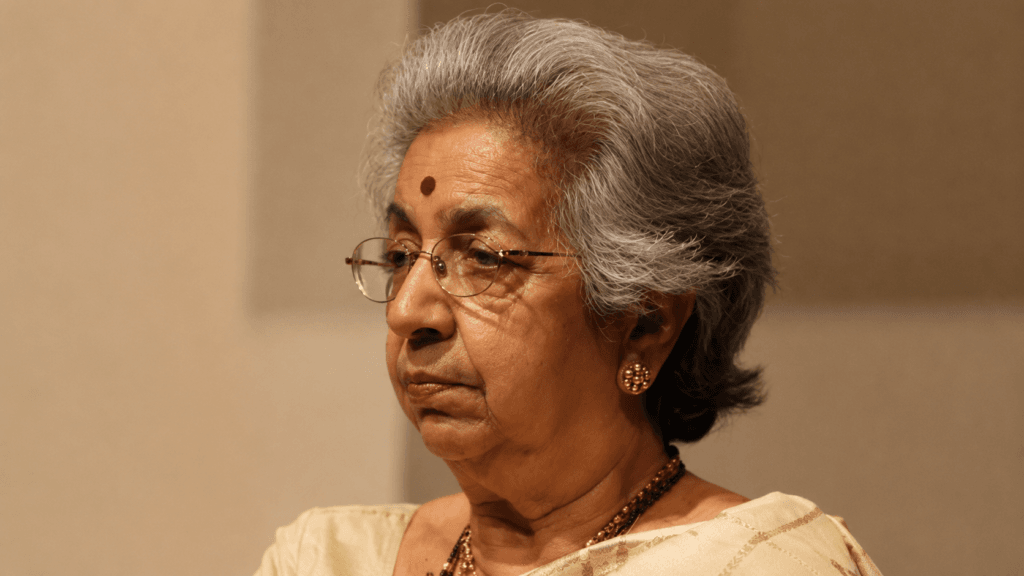
Theatre stalwart Vijaya Mehta, who changed the face of Marathi theatre and inspired generations of actors and directors with her pathbreaking work.
Veteran theatre practitioner, director and administrator Vijaya Mehta dies at 91, leaving a towering legacy in Indian performing arts. To generations of students and artists, she was simply known as “Bai”. She was not just a teacher or a mentor, but a guiding force who shaped the careers and artistic thinking of many in Marathi theatre and beyond.
Her death has prompted a wave of tributes from the theatre world, with actors and directors remembering her as a singular creative force who combined rigour with warmth. For many, this is not the loss of an artist but the loss of an institution. This news is very emotional because Vijaya Mehta was more than a director – she was a force that changed the way theatre was made and understood in India.
Why She Stood Apart
Vijaya Mehta was born on 4 November 1934 in Vadodara into a culturally rich family. Thanks to family connections, she could have gone the mainstream cinema route but chose theatre and trained under Ebrahim Alkazi, stepping into a demanding artistic world that would ultimately define her legacy.
It was an important decision. While the mainstream might have offered comfort and visibility, Mehta chose to dedicate herself to theatre, where experimentation, discipline, and artistic honesty often count for more than glamour. She has lived a career that shows real cultural influence is often achieved by depth rather than visibility.
Her Theatrical Legacy
Mehta was at the crossroad between tradition and modernity for over six decades, taking Marathi theatre to new artistic territory. She was the founder of the Rangayan theatre group, which created a space where theatre was not just performance but thought, inquiry and social reflection.
She was known for moving away from conventional musical theatre without stripping it of its Marathi roots. One of her landmark achievements was the 1973 collaboration with Fritz Bennewitz on Ajab Nyay Vartulacha, CT Khanolkar’s adaptation of Bertolt Brecht’s The Caucasian Chalk Circle. She also staged Eugene Ionesco’s absurdist Chairs, bringing global dramatic language into Indian theatre with confidence and clarity. For latest news check out here.
Her Style And Method
Vijaya Mehta was not only extraordinary for what she staged but also for the way she did it. She demanded truth of her actors and felt that theatre should come from honesty, discipline and deep understanding and not from superficial tricks of performance.
‘Her productions bore the mark of a restless mind and a compassionate heart,’ said actor-director Vijay Kenkre. That combination is rare in any field, especially in theatre, where strong personalities often rule the rehearsal rooms. Mehta seems to have done something tougher: to have exercised power without destroying creativity.
One of the things that struck me about her philosophy was her focus on language and authenticity. Reema Lagoo once said that Mehta asked, “Why should Maharashtrian characters talk like native Hindi speakers? Europeans can speak English with their own accent. That attitude fits in with her general philosophy that theatre should sound real, not artificial.
Voices From The Theatre World
The reaction to her death has been deeply personal, which speaks volumes about the sort of mentor she was. Losing Bai, said Nana Patekar, was like losing his mother, a comment that reveals how close and life-shaping her presence was for her students.
Lillete Dubey dubbed her the “OG Theatre Queen” and praised her warmth, wit and passion. Her remark is not merely a tribute. It sums up how Mehta became the benchmark for a generation in Indian theatre. When people of different traditions speak with this kind of admiration, they usually mean that the person so admired had an influence that extended far beyond a single stage or city.
Vijaya Mehta’s Journey and Lasting Theatre Legacy
Mehta herself was from a world of artistic possibility. She could have easily gone mainstream, with family ties to Nalini Jaywant, Shobhna Samarth, Nutan, Tanuja and Durga Khote. But she chose a path that required more patience and more labour and, in doing so, helped to uplift theatre as a serious cultural discipline in India.
Her work with the National Centre for the Performing Arts, Mumbai, took her impact even further. During her tenure as chairperson, she facilitated collaborations with global theatre figures such as Peter Brook, Eugenio Barba, Ariane Mnouchkine, Jerzy Grotowski, and Richard Schechner. That helped place Indian theatre into a larger international conversation rather than keeping it isolated.
Vijaya Mehta’s Life and Theatre Journey
1934: Born in Vadodara. Vijaya Mehta.
Early career: She studies under Ebrahim Alkazi and dedicates herself to theatre.
1973: Directs Ajab Nyay Vartulacha with Fritz Bennewitz.
1980s: Directs films like Rao Saheb and Pestonjee.
Later years: She chairs NCPA Mumbai and helps build international theatre links.
Vijaya Mehta is no more, dies at 91
This chronology is a long and consistent artistic journey which touched each major phase of modern Indian theatre.
Vijaya Mehta’s Enduring Legacy in Indian Theatre
This is because cultural memory is made by people like Vijaya Mehta. Her work not only entertained audiences but also trained actors, expanded the vocabulary of theatre and pushed Marathi theatre into a more global and intellectually rich space.
It matters, too, because the type of mentorship she provided is increasingly rare. Her emphasis on truth, integrity and discipline feels especially meaningful in an entertainment world that moves so quickly. This is a very important matter, as without such figures, theatre runs the risk of being just performance and losing its deeper purpose.
Marathi Theatre and India’s Cultural Legacy
For readers in India, especially in Maharashtra, it is a loss that is deeply local but national in its significance. Marathi theatre has been one of the strongest cultural traditions in India for a long time and Mehta was one of the people who helped it to evolve while keeping its soul intact. The Hindu has covered this news.
Her influence is still felt in rehearsal rooms, acting workshops and theatre festivals across Mumbai and beyond. For many young actors today, her name is a legend, but they are also inheriting a system of thought that she helped to create. Her death will be felt not just in the elite theatre world but across the wider cultural landscape.
Vijaya Mehta’s Lasting Impact on Indian Theatre
Vijaya Mehta’s legacy is that theatre can be both rooted and experimental. She respected Indian soil and sensibility but was never afraid to engage with Brecht, Ionesco or other global voices. That balance is one reason her work still manages to feel relevant.
And she represents a type of cultural leadership that is less about celebrity and more about institution-building. The theatre world often remembers great performers, but Mehta mattered, too, because she built systems, shaped people, and created standards that lived beyond any one production. That’s a whole other level of impact.
The grief her students and colleagues expressed also speaks to how theatre communities function. They are often families made through common work, discipline and vulnerability. In Mehta’s case, the family appears to have been unusually close.
Vijaya Mehta’s Legacy and Future Tributes
The theatre and film community will likely pay more tribute and offer more reflections in the days to come. Retrospectives of her most important work could also bring productions and films new audiences may not be familiar with back into the fold.
And there is a larger next step for Indian theatre. To maintain the seriousness and curiosity that Mehta represented. Her death is a reminder that the institutions need memory, documentation and transmission so that the coming generations don’t just admire the past but learn from it. To honour her in the best way, keep that standard.
Conclusion
The death of Vijaya Mehta is a huge loss to Indian theatre, as she was one of its most important figures. As director, teacher, administrator and mentor, she helped transform Marathi theatre into a place of intellectual richness and artistic courage.
Her legacy lives on not only in her productions but also in the people she inspired and the standards she set. From Ajab Nyay Vartulacha to her global collaborations and mentorship of generations, Mehta’s legacy is both vast and deeply personal. Indian theatre has lost a colossus and the void will be felt for years to come.
–By A. Aisha–