Eight workers lost their lives and nine others were critically injured in a massive industrial accident at Rashtriya Ispat Nigal Limited’s Visakhapatnam Steel Plant on Monday afternoon. A ladle of superheated molten steel collapsed and spilled 150 tonnes of metal, at 1,500-1,600°C, on the shop floor.
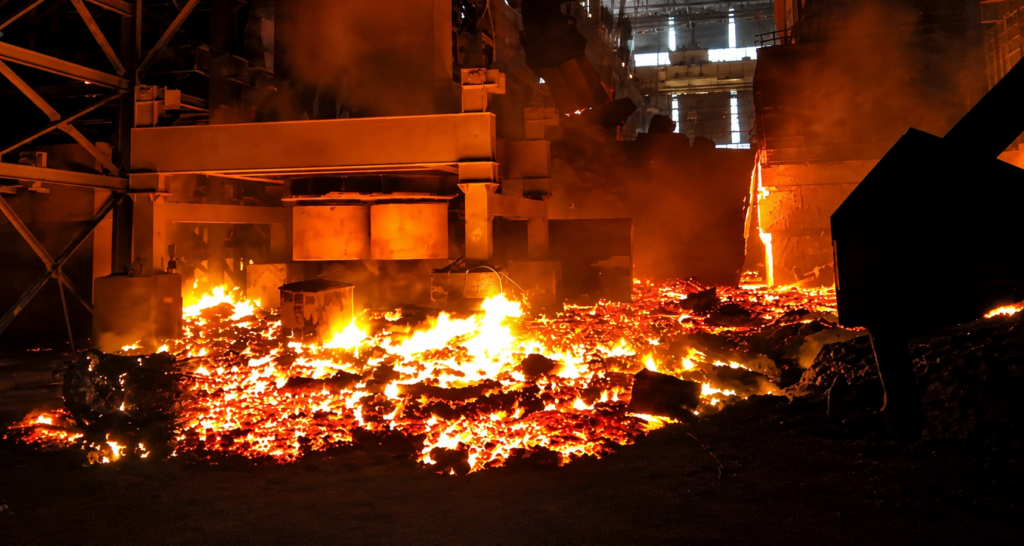
spilling superheated metal and killing eight workers on Monday, June 8, 2026. /image credit: PTI/
At least eight workers died and six others were injured in a catastrophic industrial accident that hit the Visakhapatnam Steel Plant in Andhra Pradesh on Monday afternoon when a ladle filled with molten steel exploded in the plant’s continuous casting department. Around 4.15 pm, an explosion at the Steel Melting Shop facility caused a massive fire and the spewing of about 150 tonnes of superheated liquid metal across the shop floor at temperatures close to 1,600°C.
Five permanent employees and three contract workers are among the dead, including Ramana, Trinadh, and N. Appala Raju, plant officials said. Rescue efforts are underway, and authorities have launched a full investigation into the exact cause of the tragedy. This is an important issue, as it throws up the deadly hazards that industrial workers are exposed to in India’s heavy manufacturing industry and raises urgent questions about safety norms in public sector plants.
Why and How This Happened
The Science of the Molten Steel Explosion
Steel melting needs to heat the metal to very high temperatures, often above 1,500°C, to melt it so that it can be cast. Then the molten steel is taken in huge ladles, crane-held containers meant to carry tons of liquid metal at these international temperatures.
If a ladle breaks or is knocked from its support during transit, the superheated molten metal is immediately poured over the work area, creating a catastrophic fire hazard. Initial reports indicate that in this case, the ladle carrying molten steel suddenly exploded in the continuous casting section of the steel melting shop, resulting in the toppling and dislodging that led to the spillage.
The Sequence of the Accident
The accident occurred during routine production activities in the SMS-2 and STC-3 heat facility of the plant, official sources said. The shift break was over, work was starting again, and a crane was moving the ladle, loaded with tons of molten metal, when it came loose. The container crashed a few moments later, molten steel spilled across the work area, and a massive blaze started in the steel melting shop.
The blast threw approximately 150 tonnes of molten steel across the shop floor, killing eight workers instantly and sparking a fire that engulfed parts of the facility. Emergency teams were at the scene, but the extreme heat and force of the fire made rescue work very difficult.
Worker Demographics and Vulnerability
Out of the eight dead, five were permanent employees of Rashtriya Ispat Nigam Limited (RINL) and three were contract workers. The contract workers—Ramana, Trinadh, and N. Appala Raju—were identified as the most vulnerable and were often paid less and given less safety training than permanent staff. This difference raises questions about the adequacy of protection for contract workers in high-risk industrial environments. There is contract labor in hazardous sections of steel plants all over India, but such cases highlight the acute need for uniform safety standards for all workers.
Quotes
“This is a devastating tragedy for our plant and the entire community,” said a senior plant official at Visakhapatnam Steel Plant. Eight people have died. Six others are battling for their lives in hospitals. We are committed to carrying out a full investigation and ensuring such an incident does not happen again.”
Dr. Suresh Kumar, an industrial safety expert at the National Institute of Occupational Health, Hyderabad, said, “Ladles carrying molten steel at 1,600 degrees Celsius are some of the most dangerous equipment in any steel plant. If the crane mechanism fails or the ladle breaks free, the result is catastrophic. “Regular maintenance and safety audits are key.”
“Contract workers are often given the most dangerous work without training,” said a local leader of the RINL workers’ association, a union. The accident highlights the need for safety policies to be applied equally to permanent and contract workers. “We want an investigation and compensation for the families.”
“The temperature of molten steel in this range can lead to instant vaporization of moisture on skin, causing severe burns,” said Rajesh Mehta, a professor of metallurgy at IIT Madras. Eight workers died on the spot, a spill that was immediate and overwhelming. “Emergency response systems need to be strengthened.”
Background and Context
Visakhapatnam Steel Plant’s History
The Visakhapatnam Steel Plant, operated by Rashtriya Ispat Nigam Limited (RINL), is one of the largest public sector steel manufacturing units in India. The plant is located on the eastern coast of Andhra Pradesh, about 392 km northeast of Amaravati, the state capital, and makes steel for construction, defense, railway, and infrastructure projects across India. The plant has several Steel Melting Shops (SMS) like SMS-1, SMS-2 and Continuous Casting Departments (CCD) to convert molten steel into finished products.
Past Industrial Accidents in India’s Steel Sector
There has been a spate of major accidents in India’s steel industry in the last decade, raising concern about worker safety:
2012: Eleven workers were killed in an explosion at Tata Steel’s plant in Jamshedpur.
2016: 20 workers injured in molten metal spill at JSW Steel’s Vijayanagar plant in Karnataka
2019: Three people died when a crane collapsed at Hindalco’s plant in Odisha.
2022: Four workers died in a fire at SAIL’s Bhilai plant in Madhya Pradesh.
2026: Eight were killed in the Visakhapatnam Steel Plant accident, one of the major industrial tragedies in recent years.
Industry Safety Regulatory Framework
Safety standards for industrial plants are prescribed in the Factories Act, 1948 and the Occupational Safety, Health and Working Conditions Code, 2020. The Central Pollution Control Board (CPCB) and the National Disaster Management Authority (NDMA) also monitor the hazard prevention. But many public sector plants have weak enforcement where budgetary constraints and aging infrastructure raise risks.
Timeline of Monday’s Tragedy
Early Afternoon: SMS-2 and STC-3 heat facilities resume production activities.
4:15 p.m. Explosion of a ladle with molten steel in the continuous casting department.
4:20 pm: Molten steel flows across the shop floor, igniting a large fire.
4:30 p.m.: Emergency teams respond to the scene; rescue operations are underway.
5:00 pm: Five bodies retrieved from the spot; three bodies retrieved later.
6:00 pm: Death toll rises to eight; 6 workers are injured.
7:00 p.m. — Plant officials start a probe; union leaders demand an investigation.
Night: Families of dead workers gather at plant gates for compensation.
Why This Matters
Human Impact and Family Tragedy
The deaths of 8 workers are a loss to their families. Many industrial workers in India depend on daily wages to feed their families. Families can be driven into poverty by the loss of a breadwinner, especially where compensation is delayed or inadequate. It is likely that the three contract workers—Ramana, Trinadh, and N. Appala Raju—were from rural backgrounds and earned lower wages with less job security. The deaths highlight the precarious nature of contract work in dangerous industries.
Public Sector Plants and Industrial Safety Concerns
The accident has posed urgent questions about safety protocols in public sector steel plants. Aging infrastructure, lack of maintenance, and insufficient training for contracted workers can increase the risk of accidents. Ladle explosion of 150 tonnes of molten steel would be a mechanical failure or operational mistake. This is a big issue because similar risks are there in thousands of industrial plants across India, from steel to chemicals to power.
Impact on Steel Production and Supply Chains
The Visakhapatnam Steel Plant is a major source of steel for infrastructure, defense, and railway projects. The accident has stopped production for now in the SMS-2 and STC-3 units, which could impact supply chains. The plant may be able to restart after repairs, but the tragedy could result in more stringent safety inspections, delaying production in the short term. It may affect construction projects and defense procurements that rely on RINL steel.
Labor Rights and Contract Worker Protections
“The deaths of three contract workers highlight the need for equal safety standards for all employees.” Contract labor is used frequently to cut costs, but at the expense of worker protection. Labor unions want contract workers to receive the same training, safety gear, and pay as permanent employees. This incident may provide a push for labor reforms in India’s industrial sector.
India Angle
Visakhapatnam Steel Plant ka yeh accident pure India ke industrial workers ke liye ek sadak hai. The families of the 8 workers killed in this plant in Andhra Pradesh are now demanding compensation and safety. Contract workers like Ramana, Trinadh, and N. Appala Raju are paid less and provided with less safety than permanent employees. This shows that labor reforms are needed.
Lakho industrial workers in India roz high-risk environments mein kaam kar rahe hain—steel plants, chemical factories, and power plants. This accident is a reminder that we need to beef up safety protocols. National Disaster Management Authority aur Ministry of Steel ko ab industrial safety audits ko tight kar dena chahiye. This case proves that industrial accidents are not only local but also of importance for the whole country.
My Take as an News Writer
Industrial Safety Awareness: Incident causes controversy over worker safety in India’s heavy manufacturing sector. The content should link the accident to wider safety reforms and workers’ rights.
Public Sector Accountability RINL, a government-run plant, is facing mounting pressure to improve safety standards. Reports should be on accountability and policy change.
Publishers, the most impactful words in the headlines should be “8 killed,” “molten steel explosion,” “Visakhapatnam Steel Plant,” and “1,600°C.” Don’t speculate. Listen to the confirmed facts from plant officials and emergency teams.
What’s Next
Investigation & Inquiry: Officials will launch a formal investigation into the cause of the explosion, looking into crane mechanisms, ladle maintenance, and operational procedures.
Compensation for Families The plant and the state government will likely have to announce compensation for families of the deceased workers, though contract workers could get less than permanent employees.
Safety Audits: The Ministry of Steel may order compulsory safety audits of all public sector steel plants to prevent such accidents.
Labor Union Demonstrations: Workers’ unions might hold demonstrations for improved safety education and equal pay for contract workers.
Production Disruption: The SMS-2 and STC-3 units will be closed for repairs, possibly impacting steel supply for infrastructure projects.
Policy Reforms: This tragedy may strengthen the demand for labor reforms, including the imposition of stricter safety standards for contract workers in high-risk industries.
Media and Documentary Coverage: The mishap could be featured in news documentaries and investigative pieces on industrial safety in India. This story also covered The Hindu
Conclusion
The Visakhapatnam Steel Plant tragedy is a stark reminder of the deadly perils faced by industrial workers in India’s heavy manufacturing sector. Eight workers died on Monday, June 8, 2026, when a ladle of molten steel at 1,600°C exploded, spilling 150 tonnes of superheated liquid metal. Among the dead, five were permanent employees and three were contract workers, reflecting the precariousness of contract labor in high-risk settings. Rescue efforts are continuing, and authorities have opened a full investigation into the cause of the accident.
Yeh issue kaafi important hai kyunki it lays bare the shortcomings in industrial safety procedures, particularly in the public sector plants, and the need for equal protection for all workers. The tragedy will affect steel production, supply chains, and labor rights debates across India. In the wake of family grief and union calls for reform, the focus has to turn to beefing up safety audits, improving maintenance, and fair pay for contract workers. This accident is not just a local tragedy but a national wake-up call that the issue of industrial safety in India has to be taken seriously to avert any future disasters.