New research has sparked a debate about whether 100% fruit juice should be considered equivalent to whole fruit in healthy eating guidelines. Overall, the review indicates that whole fruits are typically better and that the next U.S. dietary guidelines should include clearer limits and improved labeling for fruit juice.
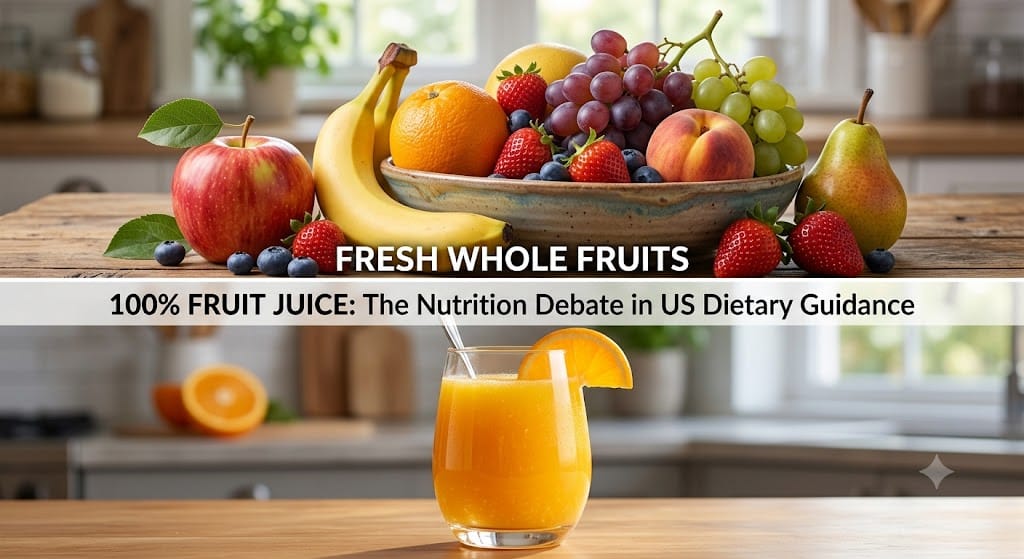
Split image of fresh whole fruits and a glass of 100% fruit juice: The nutrition debate in US dietary guidance. This image was generated with AI.
# Whole fruit VS Fruit juice… In a comprehensive review of scientific evidence, a long-running nutrition question was revisited in the United States: should 100% fruit juice be recommended as a healthy part of the diet, or should whole fruit be emphasized clearly more? The analysis examines whole fruits versus 100% fruit juice for nutrients, satiety and links to chronic disease and says current U.S. dietary guidelines may need stronger clarity in the 2025-2030 update.
The review is published as obesity and associated chronic diseases continue to be a major public health problem in the US. The bottom line: Juice may have some practical value, but whole fruit seems to be better overall in providing health benefits.
Why The Debate Exists
The main problem is that 100% fruit juice is in a grey area. It does have vitamins and some beneficial plant compounds, but it also loses fiber in processing and can deliver sugars in a form that is absorbed more quickly than whole fruit. On the surface it looks healthy, but nutritionally it is quite different from eating an apple or orange in its natural form.
The review also notes that existing dietary advice can be confusing. The 2020-2025 Dietary Guidelines for Americans encourages consumption of fruit but does not explicitly classify sugars in fruit juice as “free sugars,” as the World Health Organization does. This is a very important point because the clarity of wording can influence how families, schools and even clinicians interpret healthy choices. Check out my Health page for more health-related latest news.
What The Evidence Shows
The single most consistent finding across the review is that whole fruit generally beats juice on a number of health markers. Whole fruits have more fiber, more satiety and a slower digestion, which can help people feel full for longer. That fullness is important because it may help you to avoid overeating later in the day.
By comparison, 100% fruit juice is easier to consume quickly and in larger amounts. Studies reviewed in the paper suggest that liquid fruit is less filling than solid fruit, which means people may take in more calories without noticing it. The review also notes that while juice may still contain useful nutrients, processing and storage can reduce some vitamins and antioxidant compounds.
Health Effects Compared
The review says the evidence on 100% fruit juice and chronic disease is mixed, but not reassuring enough to treat juice the same as whole fruit. Some observational studies link higher juice intake with increased risks of type 2 diabetes, weight gain, and certain cancers, while other studies show neutral or modestly beneficial effects at lower intake levels. That mixed picture is one reason the authors argue for more explicit guidance.
Whole fruit, on the other hand, shows more consistent benefits. Higher intake is associated with lower risks of type 2 diabetes, cardiovascular disease, metabolic syndrome, and some cancers. In simpler terms, the evidence base is much more stable for whole fruit than for juice.
Expert Views And Key Takeaways
In sum, the review’s overall message is that fruit juice is not the same as fruit, and policy should reflect that. The authors believe the next round of dietary guidelines should clearly separate whole fruit, 100% fruit juice and fruit drinks with added sugar.
The review’s practical public-health message is that nutritional convenience should not replace nutritional quality. Juice may be easier to consume, but whole fruit is usually the better choice for long-term health.
Background And Timeline
This debate is not new. For years, nutrition bodies in different countries have taken different positions on fruit juice, which has created confusion for the public. The US guidelines have allowed some juice within daily fruit intake, while other countries and organizations have imposed tighter limits. PMC has covered this review.
The review suggests the problem is more urgent, given new evidence has emerged since the last update of the guideline. It says the 2025-2030 Dietary Guidelines for Americans should reflect newer research and more closely align with international thinking on free sugars and juice limits.
Why This Matters
This is important because dietary guidance influences school meals, family nutrition, public health messages and food marketing. Over-sweetening fruit juice can make people think they are making a healthier choice than they are. This can be particularly important for children, who can easily drink a glass of juice and exceed healthy limits without realizing it.
It matters also for low-income families and communities with limited access to fresh produce. The review points out that juice can be cheaper, more easily stored and more widely available than whole fruit in some places. But that practical advantage should not mask the nutritional difference between juice and fresh fruit.
Public Health Angle on India
This matters to Indian readers because in homes, schools and cafés, juice is often considered a “healthy” choice. Packaged juice, fresh juice and fruit drinks are frequently promoted together and this can blur the lines. So, the message here is simple: you get the real benefit of fruit in the whole form.
In the context of the Indian urban lifestyle, the logic of review is also relevant, where people often go for quick breakfast fixes and beverages instead of whole foods. If the US is rethinking how it labels fruit juice, Indian consumers should also look at the serving size, sugar content and whether a drink is really 100% juice or just a fruit-flavored beverage.
Why The Evidence Favors Whole Fruit
“The review is really looking for precision from a policy perspective. Public health advice is best when it’s clear and easy to understand, particularly for parents, schools and busy adults. When guidelines are unclear, it leaves room for people to assume juice and fruit are comparable and this is not supported by the evidence.
From a nutrition science standpoint, it’s all about structure. Eating the whole fruit slows you down, helps you chew more, helps you feel full and keeps the fiber intact. Juice removes much of that structure, so the eating experience and metabolic response are different, even if the vitamin content is still helpful.
# Whole fruit VS Fruit juice
What Next
The next big thing is the 2025-2030 update to the Dietary Guidelines for Americans. The likely pressure point, based on this review, will be whether the guidelines more clearly define “free sugars” and set more specific limits for 100% fruit juice.
One likely outcome is sharper messaging that whole fruit should be the norm, with juice as the exception or occasional. Another likely change is clearer language distinguishing 100 percent juice from fruit drinks with added sugar. It would allow consumers to make better choices without having to decipher nutrition jargon.
Conclusion
This review supports an old nutritional theory: whole fruit is generally better than juice. While there still can be a limited role for 100% fruit juice in the diet, the evidence points to it not being considered equivalent to whole fruit in health advice.
The lesson for policymakers is simple. The next US dietary guidelines may need to be more specific, more practical and more truthful about juice. The message for the everyday reader is just as clear: if you have a choice between fruit and juice, the whole fruit is generally the smarter choice.
–Written by A. Aisha–