“This is just the beginning,” Abhijeet Dipke said on the victory of the Cockroach Janta Party’s protest even as Dharmendra Pradhan’s resignation and the Centre’s assurances seemed to mark the end of the immediate agitation. The 37-day protest was ‘exhausting but historic,’ Dipke said in a morning video message, adding the movement has a ‘long way to go.’
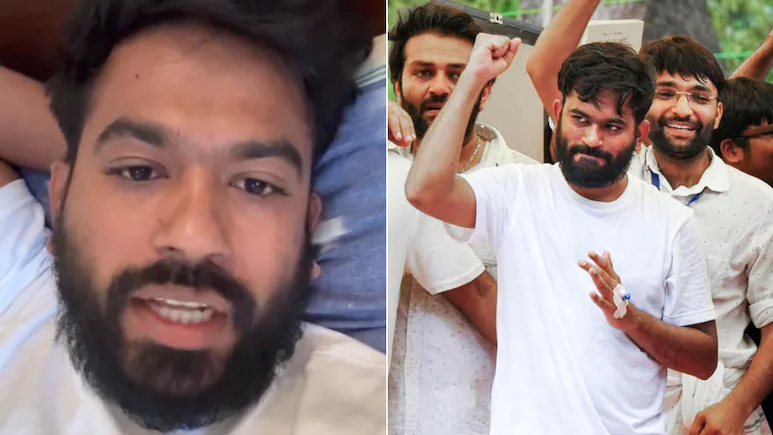
Abhijeet Dipke speaking in a morning video message after the CJP’s protest campaign forced major concessions from the government. Image Credit: NDTV
Abhijeet Dipke, the 30-year-old founder-face of the Cockroach Janta Party, has struck a reflective tone after the movement’s biggest breakthrough yet. In a morning video posted on his X account, Dipke said that after 37 days of protest, resignation, pressure and negotiations, he could finally rest without constantly worrying about what would happen next. But he was quick to add that this was “just the beginning,” not the end of the road.
His remarks came after Dharmendra Pradhan resigned as Education Minister and the government agreed to key demands linked to the NEET paper leak protests. With the immediate agitation withdrawn, Dipke’s message shifted the focus from victory celebration to long-term movement-building.
What Dipke Said
Dipke described the end of the protest period as a moment of relief. “I could go to sleep and wake up in my bedroom without thinking about what to do next or what will happen till evening,” he said in the video, suggesting that the past few weeks had kept him in a near-constant state of pressure.
He also said, “There is no panic,” and described the 37 days as “really, really difficult”. That line matters because it shows how the public face of the movement was not just managing politics and logistics but also surviving fatigue, uncertainty and criticism. This story was also covered by NDTV.
At the same time, Dipke made it clear that the CJP was not packing up for good. “This is just the beginning. The Cockroach Janata Party has a long way to go,” he said, signalling that the protest’s success may now become a platform for a broader campaign.
Why the Protest Mattered
The CJP’s campaign became one of the most talked-about youth movements in recent weeks because it combined satire, anger and mass mobilisation. What began as a satirical response to a remark by the Chief Justice of India evolved into a nationwide protest against exam paper leaks, student distress and the feeling that the education system had failed its own youth.
Dipke and his supporters helped turn Jantar Mantar into a symbolic stage for that frustration. Students, young professionals and other supporters gathered there, chanting slogans and demanding accountability from the government. The protests gained momentum because they tapped into a deep public concern: that merit is only meaningful if exams are fair.
The movement also became politically significant because it pushed the government to respond directly. Dharmendra Pradhan’s resignation and the Centre’s assurances showed that sustained street pressure can still influence power in India. That is a big message, especially for young people who often feel ignored until protests become unavoidable.
Background and Context
Dipke founded the CJP in May as a satirical political response, but the organisation quickly became much larger than a joke or a meme. Over the next 70-odd days, it attracted Gen Z support and turned into a protest identity that many young people could rally behind.
The group’s supporters began calling themselves “cockroaches,” turning a mocking label into a symbol of defiance. That rebranding is important because it shows how modern protest culture works: humour, irony and online identity can become tools of political resistance.
The immediate issue was the NEET paper leak and the related distress among aspirants. Protesters held the education minister responsible for the crisis and demanded his resignation. As the protests dragged on, more supporters joined, and the movement grew from a campus concern into a nationwide youth cause.
Eventually, the government accepted key demands, Pradhan resigned, and the CJP withdrew its protest. Dipke’s latest video is therefore less about the end of a campaign and more about the beginning of a new phase in its public life.
Timeline
-
May 2026: Abhijeet Dipke founds the CJP as a satirical response to a comment by the Chief Justice of India.
-
Following weeks: The group grows into a youth-led movement over exam leaks and education accountability.
-
June and July 2026: Protesters gather at Jantar Mantar, demanding Dharmendra Pradhan’s resignation.
-
Day 37 of the protest: The movement secures major concessions from the Centre.
-
After the resignation: Dipke posts a morning video saying the struggle was difficult but “just the beginning”.
Why This Matters
This matters because it shows how a new generation is organising itself politically. Dipke’s message is not just about one protest victory; it is about the confidence that comes from forcing the government to respond. For students especially, that is a powerful lesson: collective pressure can produce real-world outcomes.
It also matters because the protest gave voice to a larger anxiety around exams, fairness and accountability. In India, where competitive exams can shape entire life trajectories, even the perception of a leak can damage trust across the system. Yeh issue kaafi important hai because it affects not just one batch of students, but the credibility of the whole education structure.
The movement’s success could also influence how future student protests are framed. If satire, discipline and persistence can win concessions, other groups may try similar models. That could reshape protest politics in India in a very visible way.
India Angle
For Indian readers, the CJP story connects directly to student life, exam stress and the feeling that merit must be protected at all costs. In simple Hinglish, baat seedhi hai: jab system fair ho, tabhi mehnat ka result milta hai. That is why this movement struck such a chord.
The national angle is also about youth voice. Young Indians often feel that politics happens above their heads, but this protest showed that they can create pressure from below. The fact that Dipke is now talking about the movement’s next phase means the conversation is not ending with one minister’s resignation.
There is also a cultural angle here. The CJP’s satire-heavy identity made it highly visible online, where political humour travels fast. That gave the movement a very 2026-style identity: part protest, part performance, part pressure campaign.
Analysis
My opinion is that Dipke is trying to protect the movement from being seen as a one-issue outburst. By thanking supporters, critics and even doubters, he is broadening the story into something more mature and sustainable. That is a very deliberate move, and a smart one.
It is also notable that he thanked critics. That kind of language suggests confidence and openness, not just celebration. In political movements, criticism is often seen as betrayal, but Dipke framed it as useful pressure that helped improve the effort. That gives the CJP a more serious public image.
What Next
The next phase for Dipke and the CJP will likely be about organisation, messaging and keeping the momentum alive without the adrenaline of daily protest. If the movement wants to remain relevant, it will need a clearer long-term agenda beyond the immediate paper leak crisis.
There is also the question of whether the CJP becomes a permanent student-political platform or remains a protest brand tied to this specific moment. Dipke’s “long way to go” line suggests he is thinking beyond the current win and toward future campaigns.
For the government, the challenge will be to ensure that the concessions it made are seen as genuine reform rather than crisis management. If not, the movement may regain strength whenever a new exam controversy emerges.
Conclusion
Abhijeet Dipke’s morning video message shows that the CJP sees its victory as a beginning, not a finish line. After 37 days of intense protest, government concessions and a ministerial resignation, Dipke is now trying to turn momentum into a longer political and social journey.
His words reflect both relief and ambition. The protest may be over for now, but the movement’s identity, energy and message are clearly meant to live on. In that sense, the story is no longer only about how the protest ended; it is about what comes next.
Written By A. Jack