Bihar Funeral
In a bizarre and record-breaking display, a grandson in Bihar’s Bhojpur district transformed his 95-year-old grandmother’s funeral into a massive, grand procession featuring 700 vehicles, DJ music, and drone surveillance.
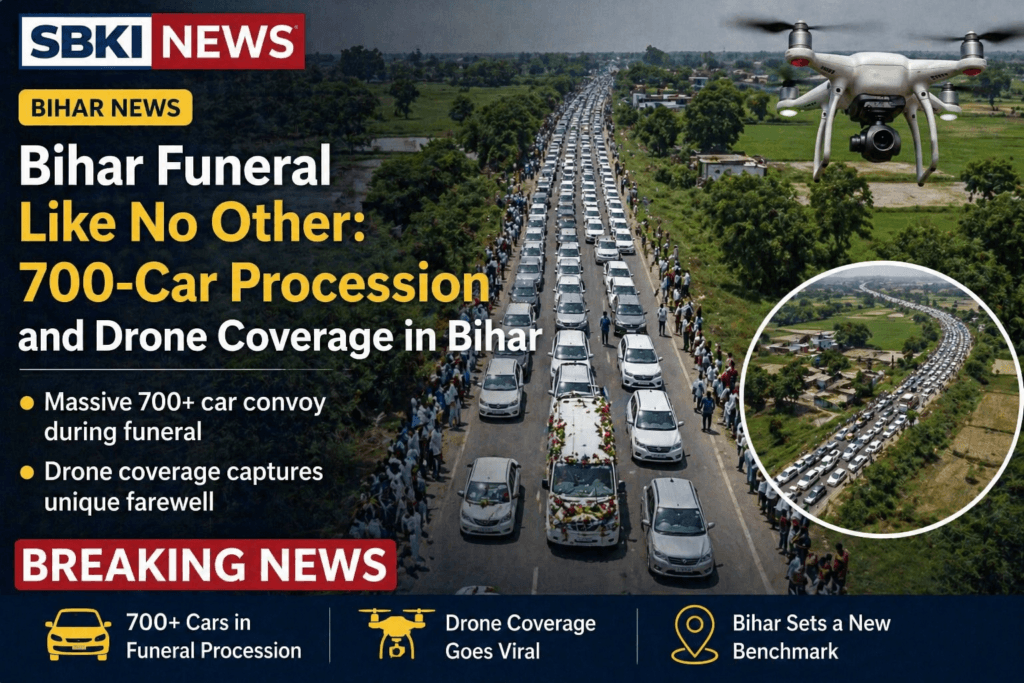
A glimpse of the grand funeral procession in Bhojpur, showing a massive convoy of vehicles stretching across the road.
The Extraordinary Send-Off
This past Friday, April 24, 2026, something very strange happened in the village of Dilmanpur in the Bhojpur district of Bihar. Kaushalya Devi, who was 95 years old, died, and her family, especially her grandsons, decided to hold a funeral that went against the usual, sad rules. The funeral procession turned into a show, with more than 3,500 mourners and a line of more than 700 cars that went on for several kilometers.
Why and How It Happened
The family said that Kaushalya Devi had a long, happy life and that they wanted her last journey to be a “celebration of life” instead of a time of mourning. Ramesh Pandey, her oldest grandson, said, “Our grandmother was the rock of our family.” We lost a guardian, but we wanted to make her goodbye special to honor her memory.
The family worked hard and quickly to get ready, gathering more than 700 cars in just 24 hours. People thought the funeral was a wedding procession because it had traditional “Launda Nach” (a local folk dance), live bands, and DJ music. The family used professional drone cameras to film the huge convoy from above so they could capture every moment.
Social Media Buzz & Community Reaction
The local community was shocked by the sight of thousands of people, music blaring, and hundreds of cars. People on the rooftops looked on in amazement and wondered if it was right to have such an expensive funeral. Some residents praised the family’s love and special tribute, while others expressed alarm at the disturbance to public order and the break with traditional funeral practices.
Why This Matters
This event makes us think about how society sees death and mourning. In modern India, where personal expressions of love are starting to outweigh traditional austerity, the shift toward a “celebration of life” is becoming more and more clear. This case also shows how powerful social media is, since “viral” events like this one can help families become well-known in their area.
What Modernization Does
This event is a big change in culture for rural Bihar, where long-standing customs usually dictate how funerals are held. “Yeh issue kaafi important hai” (this issue is very important) because it shows how modern conveniences like DJ music, drones, and large-scale social media amplification are now affecting even the most serious parts of life. It shows how society is changing and how the line between private grief and public performance is getting less clear.
Expert
As a news writer, I see this as a prime example of “viral human-interest content.” The keywords “unique funeral,” “700 vehicles,” and “viral Bihar” have created a high search volume. Stories that shock or fascinate the audience achieve high click-through rates and broad reach. While the moral debate remains open, the content’s success in digital journalism terms is unquestionable.
Also Read :Surgery Miracle : Young Mother Gets a New Life with Bilateral Hand Transplant
What Happens Next?
Even though the funeral is over, the viral videos are still going around a lot online. Local officials are probably going to look at how to keep traffic and public order in check during these huge events. Going forward, district governments may set rules to make sure that these kinds of private “celebrations” don’t get in the way of public infrastructure.
|This Story Also covered by NBT |
Conclusion
Kaushalya Devi’s funeral in Bhojpur is now known as one of the most unusual funerals in recent history. Whether you see it as an act of deep love or a social extravagance, it clearly shows how Indian culture is changing and how digital media can turn even a last goodbye into a national conversation.