Govt Approves Higher Ethanol Blended Petrol Standards, Provides Tax Relief; Signals End of E20 Fuel Programme in India
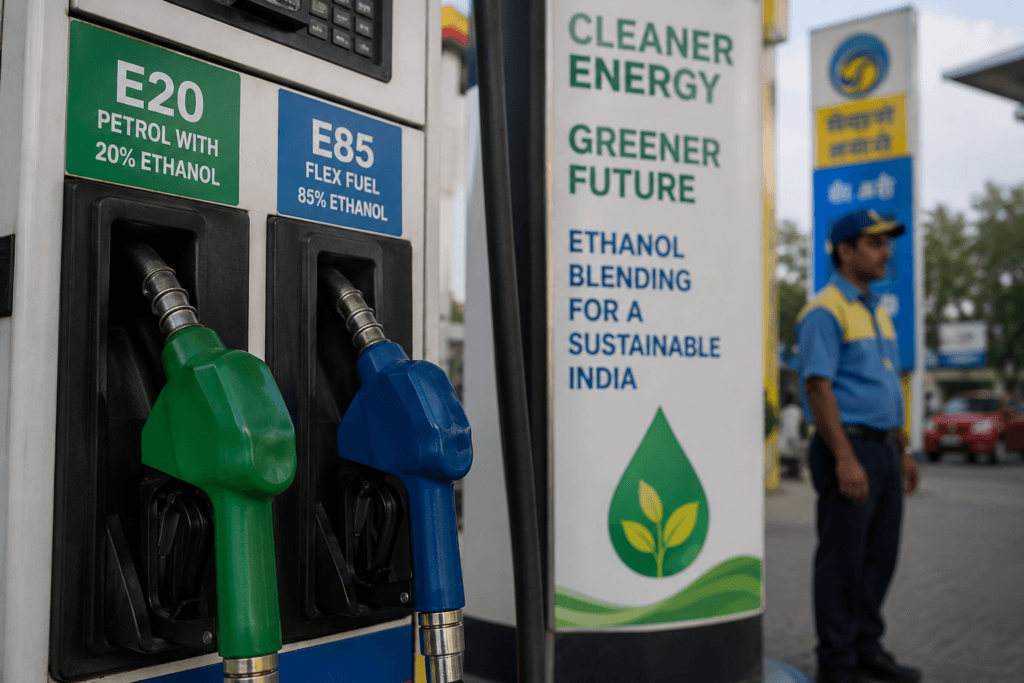
In a historic policy decision that could change the fuel landscape of India, the Central Government has announced excise duty exemptions for higher ethanol-blended petrol grades such as E22, E25, E27 and E30 fuels. The move comes after the government approved standards for petrol containing up to 30 percent ethanol, a major step beyond the country’s existing E20 ethanol-blending program.
The Department of Revenue has issued a series of notifications granting excise duty exemptions and related benefits to petrol blended with 22%, 25%, 27%, and 30% ethanol by volume. These benefits are available for fuels conforming to Bureau of Indian Standards (BIS) specification IS 19850.
The development is another step forward in India’s long-term strategy to reduce reliance on imported crude oil, promote cleaner fuels, help farmers, and strengthen domestic energy security. Industry experts say the move could speed up the commercial use of higher blends of ethanol and create new opportunities in the automotive, agricultural, and energy industries.
Government Pushes Beyond E20 Programme
India has been trying to increase ethanol blending in petrol for several years as a part of its wider energy transition strategy. The government has launched some flagship schemes to bring down the consumption of fossil fuels. One of the flagship schemes is the E20 program, which is blending 20% ethanol with petrol.
The latest step shows policymakers are now preparing for the next stage of ethanol adoption. The government is developing an economic framework to support higher ethanol blends by extending tax exemptions to E22, E25, E27 and E30 fuels, in order to boost fuel producers, distributors and automobile manufacturers.
The tax burden on these fuel categories is expected to be reduced by officials to improve commercial viability and help create a stable market for higher-blend ethanol fuels. The move comes in the background of recent announcements by Union Minister Nitin Gadkari on approval of regulations for 100 percent ethanol-compatible vehicles.
All these policy developments suggest that India is slowly setting the stage for a future in which ethanol will have a much larger role to play in transportation.
Understanding E22, E25, E27 and E30 Fuels
Blended fuels of ethanol are named according to the percentage of ethanol that is mixed with petrol.
E22 is 22% ethanol and 78% petrol. E25 contains 25 percent ethanol. Same goes for E27 and E30, which are 27% and 30% ethanol.
These fuels are at a higher blend than the E20 standard that is being used now and are designed to reduce the amount of fossil fuel used in transportation.
Ethanol is a renewable biofuel mainly produced from sugarcane, maize, damaged food grains, and agricultural residues. It can be produced at home and is a practical substitute for imported petroleum products.
The higher ethanol content may also reduce some carbon emissions, making these fuel blends attractive from both an economic and environmental point of view.
But for these fuels to be adopted successfully, they will need compatible vehicles, supporting fuel infrastructure, and consumer awareness.
Why the Government Approved Higher Ethanol Standards
Approval of BIS standards for higher ethanol blends is critical because standards for fuel quality and safety must be in place before commercial distribution.
In the absence of approved standards, fuel companies cannot legally produce and market higher blend ethanol fuels on a large scale.
The decision of the government to recognize standards up to E30 brings clarity to oil marketing companies, automobile manufacturers, and fuel retailers. It also demonstrates confidence that India’s ethanol manufacturing capacity is growing enough to support higher blending levels.
The step is part of a larger strategy to create a diversified energy ecosystem consisting of ethanol, compressed biogas, electric mobility, hydrogen, and other alternative fuels, experts said.
At the same time, policymakers are trying to create regulatory certainty and economic attractiveness by setting standards and offering tax incentives.
Background
The ethanol blending program in India has seen a remarkable transformation over the last decade.
In the beginning, blending levels were maintained fairly low because of tight production capacity and supply chain issues. However, government incentives and policy reforms, along with more investment in ethanol production, gradually improved availability.
India’s dependence on imported crude oil has been rising, and the Ethanol Blended Petrol Programme picked up pace as the country tried to reduce it. International energy prices also lent legitimacy to domestic alternatives.
Over the years the blending percentages gradually increased, culminating in the nationwide rollout of E20 fuel in several regions.
Union Minister Nitin Gadkari and other policymakers have repeatedly called for increasing the use of ethanol, saying biofuels can help farmers, consumers, and the environment at the same time.
The approval of the E22, E25, E27 and E30 standards can therefore be seen as the next chapter in India’s ethanol story.
Timeline of Key Developments
India’s ethanol blending program started with more modest blending targets, with an emphasis on reducing petroleum consumption.
But as domestic ethanol production grew, the government announced measures to facilitate oil marketing companies’ procurement of more ethanol.
The E20 program was a significant step forward, as fuel suppliers and vehicle manufacturers prepared for higher blending levels.
In recent months we have seen conversations about standards for fuels beyond E20 and announcements around flex-fuel and ethanol-compatible vehicles.
The recent notifications from the Department of Revenue providing exemptions on excise duty for E22, E25, E27 and E30 fuels are a major policy breakthrough towards commercial deployment.
Industry and Expert Reactions
The move has been broadly welcomed by energy experts, who see it as a logical extension of India’s ethanol strategy.
Tax incentives can play an important role in speeding up market adoption, industry observers believe. Lower tax burdens tend to encourage investment, as new products become more commercially attractive.
Automobile manufacturers, also watching closely, need compatible engine technologies for higher ethanol blends. Several companies have been developing flex-fuel vehicle platforms capable of handling higher ethanol levels.
Agricultural experts say rising demand for ethanol could create new markets for crops like sugar cane and maize, which could boost rural incomes.
Meanwhile, some economists warn that the expansion of ethanol needs to be managed carefully in order to balance agricultural resources between food and fuel production.
Why This Matters
Why does it matter? This development is at the intersection of energy security, environmental sustainability, and economic growth.
India has to import most of its crude oil. Every increase in ethanol blending decreases the amount of imported petroleum needed to supply domestic fuel demand.
Ethanol is a renewable fuel that can contribute to decreasing the reliance on fossil fuels, at least from an environmental perspective. It’s not a silver bullet for climate problems, but it’s a key part of a larger clean-energy puzzle.
The decision is also important as it creates a supportive policy environment for future investments in ethanol production, fuel infrastructure, and compatible vehicle technologies.
This is an important issue because fuel prices, energy security, and environmental sustainability have a direct impact on millions of Indians.
What It Means for Farmers and Consumers
For Indian farmers, the growth of ethanol blending is a potential big economic opportunity.
States like Uttar Pradesh, Maharashtra, Karnataka, and Tamil Nadu, which produce sugarcane, would benefit from the increased demand for ethanol feedstock. Additional demand could lead to more stable income streams for farmers and support rural economic growth.
For consumers, greater ethanol blending could also translate into improved fuel security and reduced exposure to the swings in global crude oil prices.
It may not mean lower prices immediately, but it could, in the long run, mean benefits in terms of more fuel being produced domestically and less dependence on imports.
The move is also in line with India’s vision of being more self-reliant in key sectors, including energy.
Analysis
From a policy perspective, the decision to grant excise duty exemptions to E22, E25, E27 and E30 fuels appear to be a well-calculated move to deepen the integration of ethanol.
“The government is not doing a flip, but gradually constructing a framework to incentivize adoption and provide regulatory support.
This approach reduces uncertainty for business while allowing infrastructure and vehicle technologies to evolve in parallel with policy development.
As a news writer, I think this is a sign that the government is getting more confident about the role of ethanol in India’s future energy mix.
But success will depend on a number of factors, including ethanol production capacity, supply chain efficiency, vehicle compatibility, and public acceptance.
The government’s plan sounds ambitious yet realistic. Policymakers are backing an intermediate blended phased approach to transition before moving to even higher concentrations of ethanol. This is also covered by mint
What Next?
The next phase will likely involve more collaboration between oil marketing companies, ethanol producers, automobile manufacturers, and fuel retailers.
Vehicle manufacturers could accelerate the deployment of flex-fuel and ethanol-compatible vehicles capable of operating efficiently on higher ethanol blends.
Fuel stations will also have to change infrastructure and logistics systems to accommodate the additional fuel categories.
Supportive measures may continue to be introduced by policymakers to encourage investment in ethanol production and distribution networks.
“If the implementation is good, India could be one of the biggest markets for ethanol-based transportation fuels in the world.
Conclusion
The center’s move to extend exemptions on excise duty to E22, E25, E27 and E30 fuels is a key milestone in India’s evolving energy strategy. This follows shortly on the heels of approval of higher ethanol-blend standards and sends a strong signal that ethanol’s role in transportation is going to continue to expand.
The government has established conditions that could accelerate the use of higher ethanol blends across the country by reducing tax burdens and providing regulatory clarity.
The policy has the potential to lower oil imports, bolster energy security, assist farmers, and contribute to environmental objectives. There are still hurdles to cross, but the path is clear. India is moving away from the E20 era, gradually transitioning to a more diversified, domestically driven fuel future.