The Ebola outbreak in eastern Democratic Republic of the Congo has passed 1,000 confirmed cases as health officials warn that violence, displacement and poor contact tracing are allowing the virus to spread faster than the response can keep pace. The outbreak, which is centred in Ituri province, has already killed hundreds and may still be in an early phase despite being declared weeks ago.
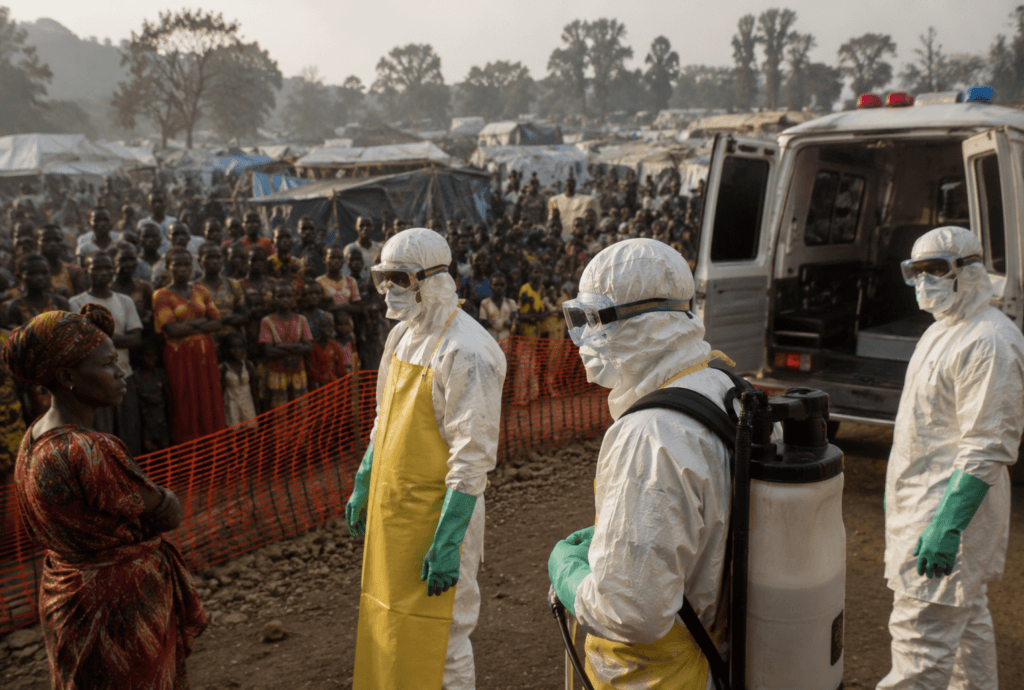
Health workers in protective gear stand at an overcrowded displacement camp in eastern DR Congo, where the Ebola outbreak is being worsened by violence and mass displacement.
The Ebola outbreak in the eastern Democratic Republic of the Congo is one of the country’s most serious public health emergencies in recent years. Health officials said 1,003 people have been infected and 254 have died since the outbreak was declared May 15, with the crisis concentrated in the northeastern Ituri province.
Violence, mass displacement and major gaps in contact tracing are exacerbating the situation. Officials say many infections may still be going undetected, meaning the true scale of the outbreak could be even larger than current figures suggest. This is a very important issue because this is not just a health crisis anymore; it is also a security and a humanitarian emergency.
What Is Happening
The outbreak is caused by the rare Bundibugyo strain of Ebola, for which there is no approved vaccine or specific treatment. That makes containment much more difficult than in outbreaks where preventive tools exist.
The Ministry of Health said on Sunday 100 people have recovered, with at least 365 people in the hospital or isolation. But the same officials also acknowledged that the outbreak might still be accelerating and that the peak might be ahead.
One of the biggest issues is tracking exposure. The ministry said contact tracing has reached only about 55 percent of those who may have been exposed. In a disease such as Ebola, where speed counts, such a gap can give rise to new chains of transmission before health teams can step in.
Why Containment Is So Difficult
The outbreak is happening in a context of already high insecurity. The ISIL-affiliated Allied Democratic Forces have attacked Ituri, driving thousands of people to flee to overcrowded displacement camps.
This displacement has created conditions that are very dangerous for disease control. Sanitation is harder, access to health services is weaker and contact tracing is much more difficult when large numbers of people are crammed into camps.
“If you want to control an outbreak, especially an Ebola outbreak, you have to know the index case,” said Dr. Jean Kaseya, director general of the Africa Centres for Disease Control and Prevention. “We don’t have confidence in the timing of this outbreak. “That statement is important because it implies that the virus could have been circulating for some time before authorities had fully identified the outbreak.
Overcrowded Camps Raise Alarms
One of the most worrying spots in the region is the Kigonze displacement camp near Bunia. Over 20,000 people have sought shelter there, officials said last week that 10 people had died in unexplained circumstances.
No cases of Ebola have been confirmed at that site yet, but public health workers clearly worry about what might happen if the virus reaches a crowded camp setting. Charite Banza, a civil society leader in Ituri, said that if disease spread among the thousands living there, it would be “a real catastrophe” because of precarious living conditions.
That’s not an exaggeration. Ebola thrives where health systems are strained and where people can’t be quickly isolated or treated. Overcrowding and displacement exacerbate that challenge.
Background On The Outbreak
Officials say the outbreak was declared on May 15, but experts now say it could have been circulating for months before that. That delay is important because Ebola outbreaks can spread silently before they’re detected, especially in places with weak surveillance.
This current outbreak is already being referred to as the worst on record in the first month. Congo’s Ebola outbreak has the most confirmed cases in the first month of any Ebola outbreak in Africa, a senior WHO official said.
The scope is particularly disturbing because it adds a new chapter to a disease that has long bedeviled the region. The two biggest Ebola outbreaks before this one were the 2014-2016 epidemic in West Africa, which killed about 11,000 people, and a less deadly outbreak in Congo in 2018. Al Jazeera has covered this story.
Why This Matters
Why does this matter? Ebola is not only a deadly disease; it’s a disease that can quickly overwhelm communities when response systems are weak. “The combination of conflict, displacement and poor contact tracing is creating a perfect storm.
Also Read: Ebola-like Viruses: What India Needs to Know After Global Alerts on Orthoebolaviruses
And it matters because the outbreak could be underestimated. Case numbers officially reported may not reflect the true burden if many infections continue to go undiagnosed. This implies that resources, staffing and international support may need to expand rapidly.
For families living in displacement camps, the danger is immediate. They are already subjected to violence and precarious living conditions, and now they have the fear of a potential epidemic. Simply put, these folks are being hit from all sides at once.
Public Health Response
WHO and regional health authorities are working to ramp up the response as quickly as possible. The response needs to scale up to match the outbreak,” WHO’s Abdirahman Mahamud said, adding that this is now starting to happen.
That is encouraging, but the situation is still fragile. Timing is important in an outbreak of this size. If tools of containment are brought to bear too late, the virus may outrun health teams trying to isolate cases and protect contacts.
The International Organisation for Migration said it had also confirmed at least 25 cases in displacement camps in eastern Congo, including 14 deaths. If true, that would further illustrate how dangerous the camp setting has become.
India’s Public Health Lessons from the Congo Ebola Outbreak
For Indian readers, this outbreak is a reminder that Ebola remains a global health threat even when it seems far away from home. India’s health system has to be vigilant to guard against imported infections, especially in a world where international travel can quickly spread diseases across borders.
The situation also offers a larger lesson for India: Outbreak control is not only about hospitals and vaccines but also trust, surveillance and access at the community level. “Areas affected by displacement or conflict are more prone to disease spread because health systems are not able to function smoothly.
Indian public health planners frequently look to African outbreak responses for ways to improve preparedness back home. Yeh bohot important point hai because the lessons from Congo can help shape better emergency response models for future outbreaks in India and the wider region.
Why the Outbreak Is Spreading So Fast
This outbreak is a case in point for the way Ebola behaves in the context of overlapping public health and security crises. The virus is dangerous, but it’s the circumstances surrounding it—violence, displacement, late detection—that make it a bigger catastrophe.
What is especially worrying is that contact tracing has been able to reach only about 55 percent of exposed people. “Contact tracing is one of the best tools we have to stop Ebola, but it only works if teams are able to reach communities and move freely.
Another big concern is the uncertainty over when the outbreak began. If the virus had been circulating for months, it means that the official response came after the outbreak had already spread more widely than initially thought. That raises the stakes for all that follows.
Ebola Outbreak Timeline in Eastern DR Congo
Months before May 15, 2026: The virus could have been spreading already, experts say.
15 May 2026: An Ebola outbreak was officially declared in the Ituri province.
June 21, 2026 (Sunday): Health officials report 1,003 infections and 254 deaths.
June 2026: WHO says response is growing but still struggling to keep up.
Current phase: Cases are being reported in overcrowded displacement camps with rising concern for wider spread.
This timeline shows how quickly the outbreak snowballed after it was noticed and how much damage may have been done before it was officially declared.
What Happens Next in the Congo Ebola Crisis
The next stage will probably involve scaling up contact tracing, isolation and support to displaced communities. Health teams also need better access to insecure areas to find cases before they spread further.
Should the outbreak continue to spread in displacement camps, international agencies may have to increase emergency assistance, including surveillance and community protection. The big question now is whether the response can move quickly enough to catch up with the virus.
Officials will also attempt to better identify the earliest cases, as that may help them understand how the outbreak began and where the virus spread first. That investigation is likely to determine the rest of the response.
Conclusion
“The Ebola outbreak in eastern DR Congo is a major crisis because it is spreading in a context that is already weakened by conflict and displacement. With over 1,000 confirmed cases and hundreds of deaths, and only partial contact tracing, the threat is far from being under control.
The lesson is a stark one: when disease meets insecurity, the consequences can escalate very quickly. The outbreak could continue to grow in the weeks ahead unless the response expands sharply and reaches displaced communities.